


site search
online catalog
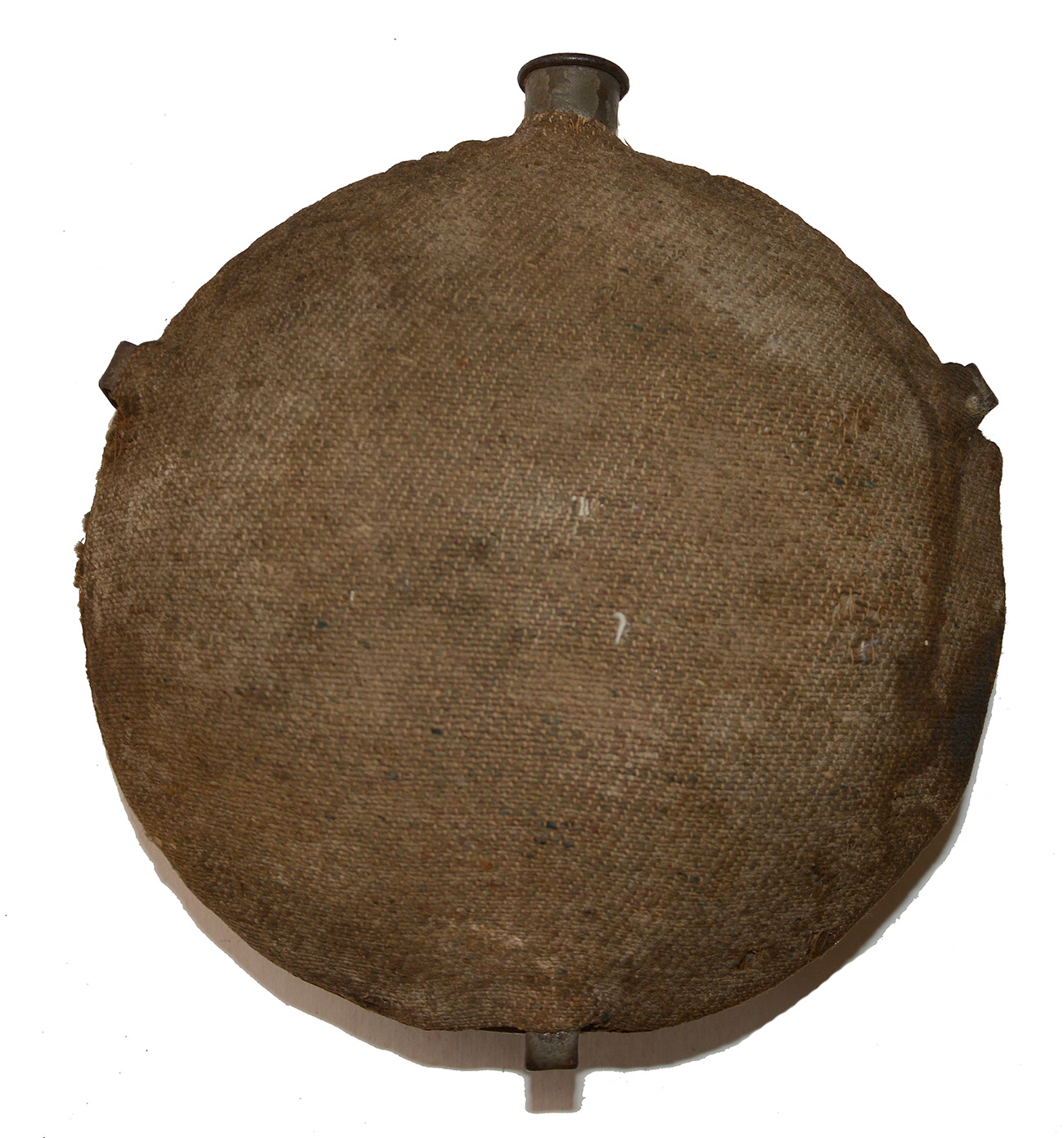
FEDERAL MODEL 1858 SMOOTHSIDE CANTEEN, SHOT THROUGH — PHILADELPHIA DEPOT, FROM THE FAMILY OF LIEUTENANT COLONEL THOMAS CHAMBERLIN, 150TH PENNSYLVANIA VOLUNTEERS, "SECOND BUCKTAILS"
Hover to zoom
$3,750.00
Quantity Available: 1
Item Code: 1323-68
Shipping: Determined by Method & Location of buyer
To Order:
Call 717-334-0347,
Fax 717-334-5016, or E-mail
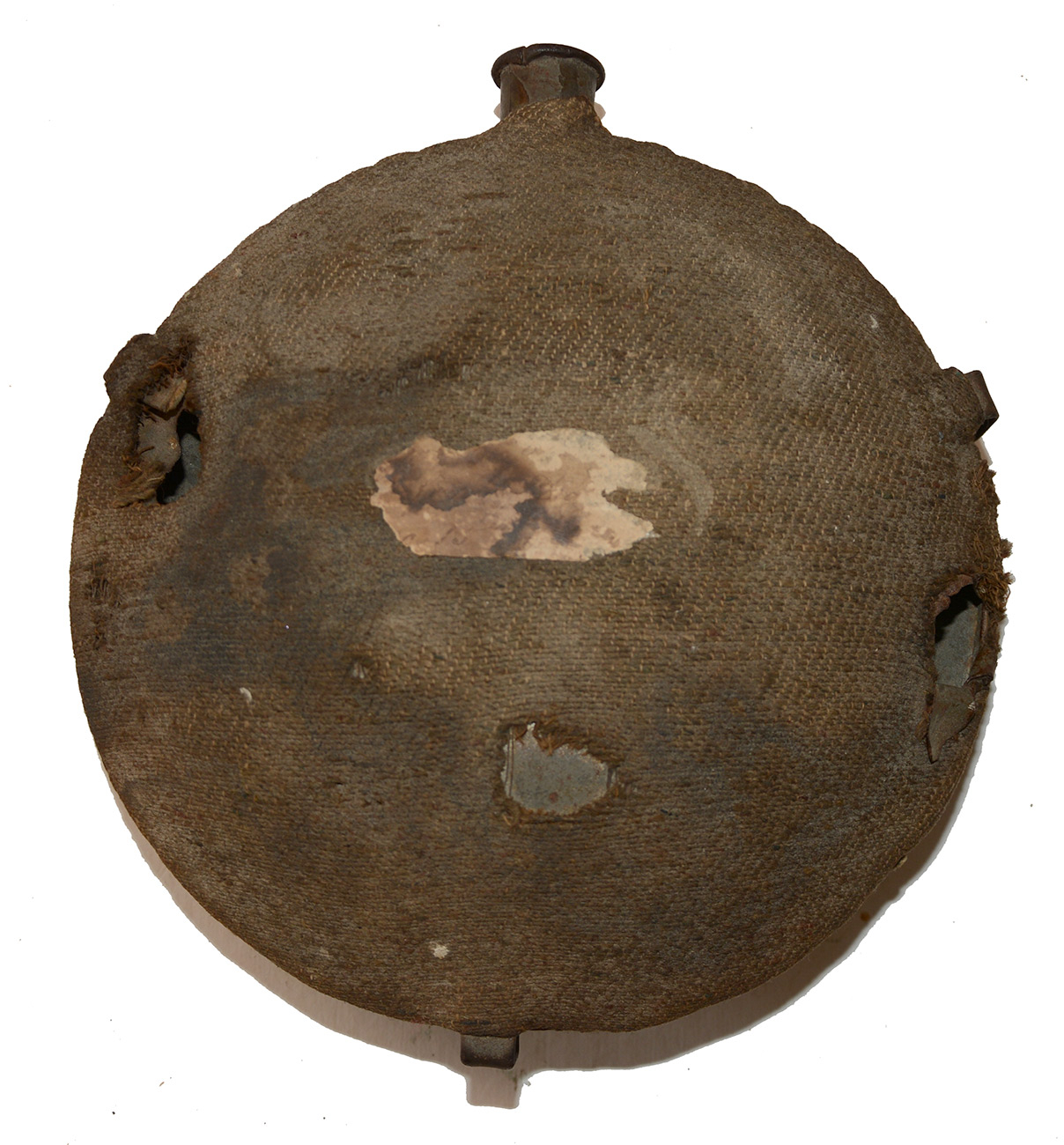
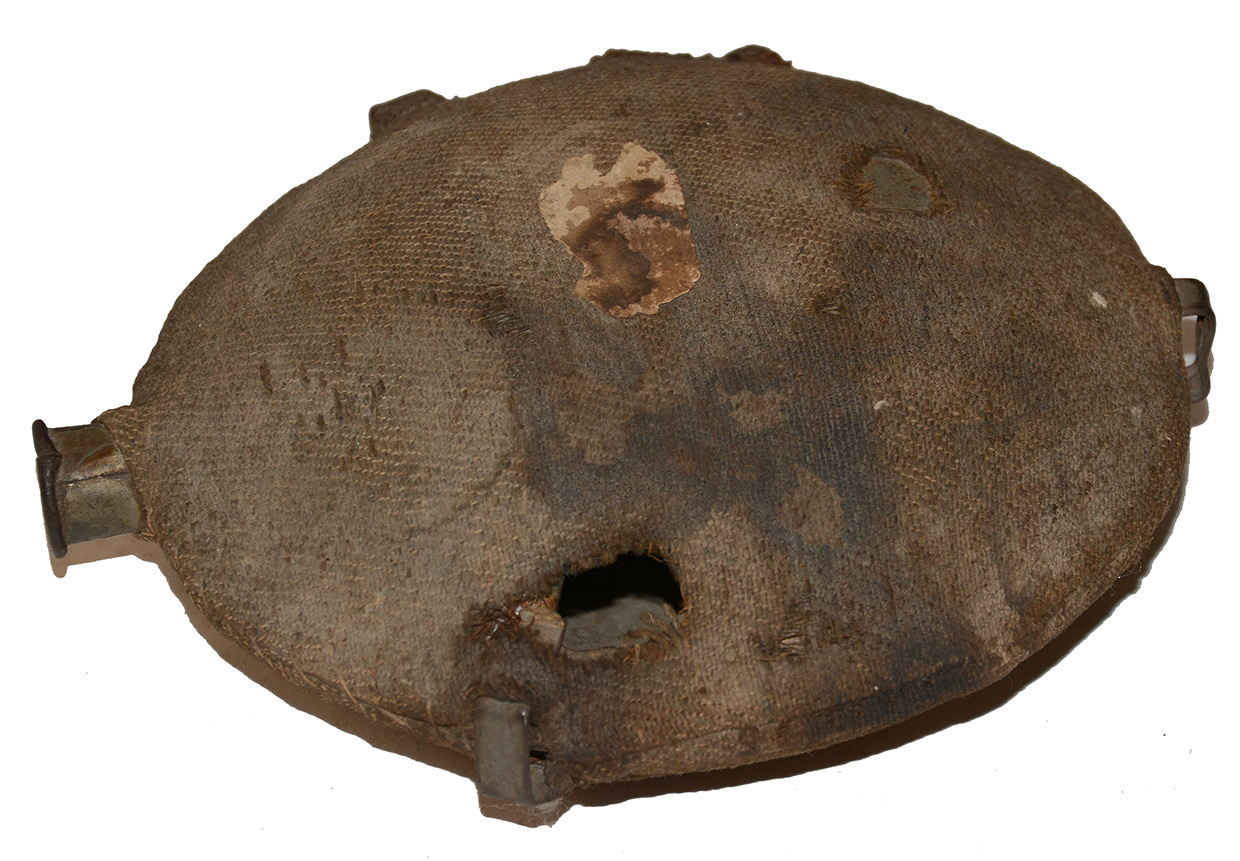
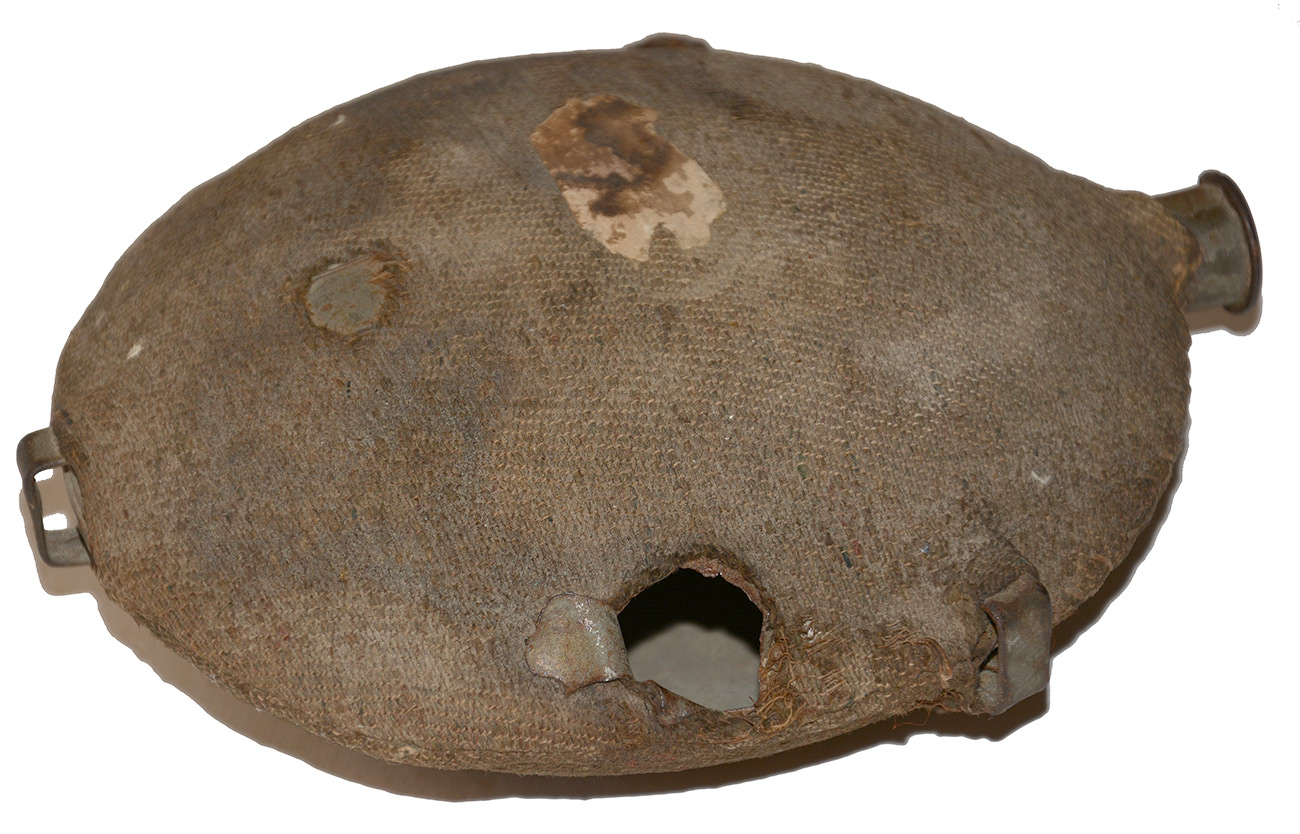
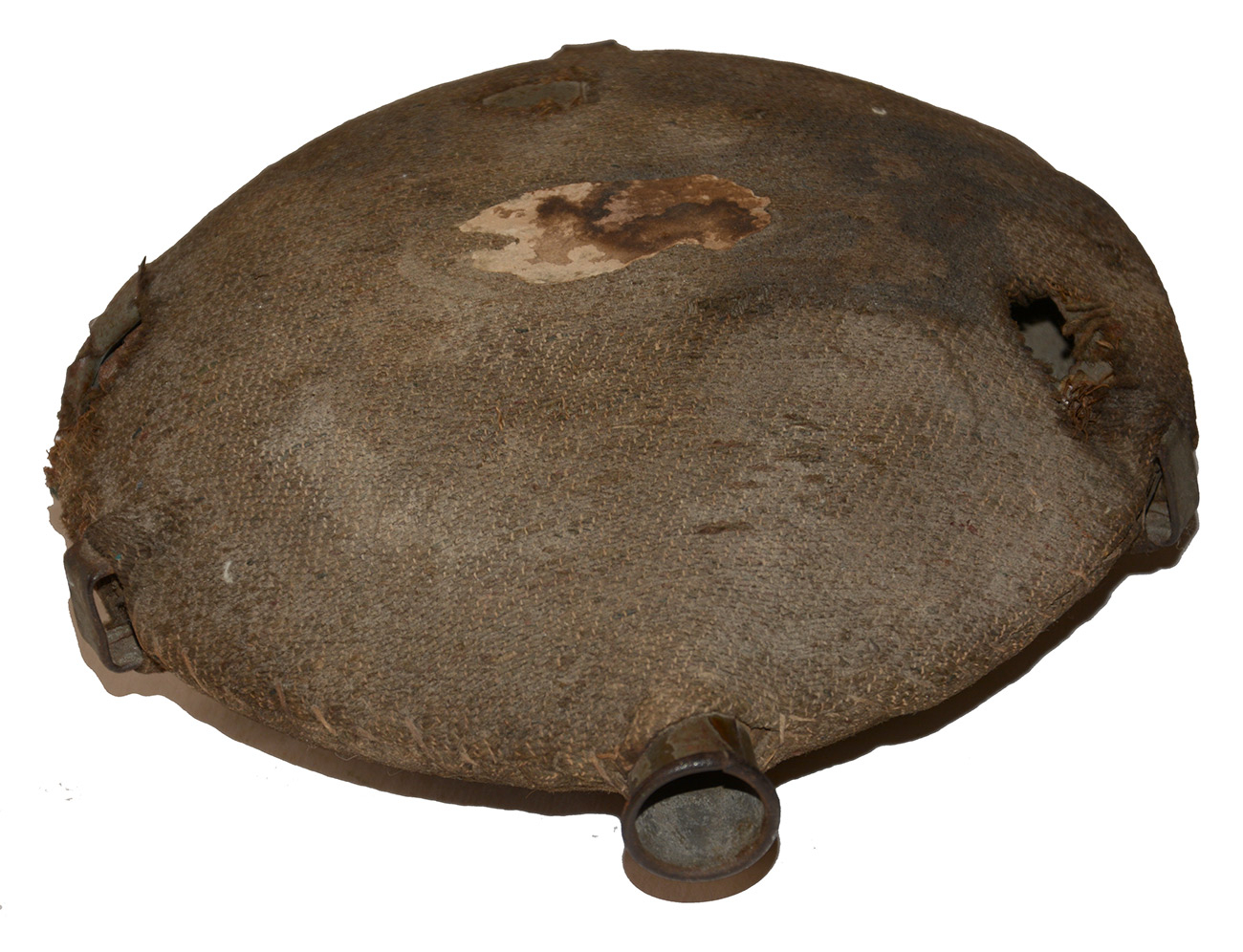
A Federal Model 1858 "smoothside" canteen, coming out of a Pennsylvania regimental family, retains its original cloth cover and is struck through by a large-caliber ball, with a body that is of the standard Model 1858 form: two circular sections of pressed tin drawn to an oblate spheroid and soldered together along the rim, with a pewter spout and reinforcing collar at the neck. All three sheet-iron sling guides are present and firmly attached — one at either side of the rim and one at the base. The stopper, retaining chain and shoulder sling are absent, as is commonly the case with canteens that came off the field and went home in a family's keeping. No maker's marking is visible on the spout in its present state.
The cover is original, of coarse plain-woven jean cloth in a brown-drab shade, hand stitched and drawn tight over both faces and the rim. It remains substantially complete, with the soiling, moth nips and scattered small losses to be expected of a piece that saw hard field service. There is no trace of the iron jack chain, nor of an attachment point for one at the side guides — a point in favor of the Philadelphia Depot attribution carried on the collection tag rather than New York Depot manufacture, though with the stopper assembly gone the evidence is suggestive rather than conclusive.
BATTLE DAMAGE
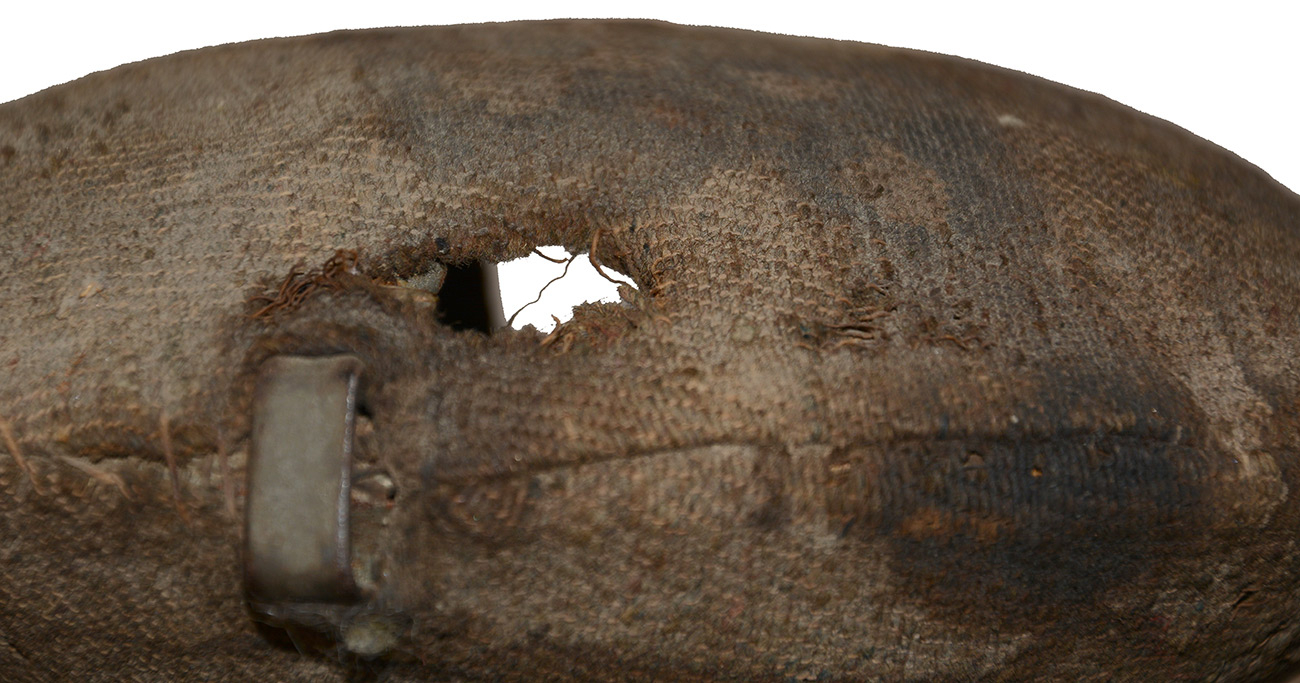
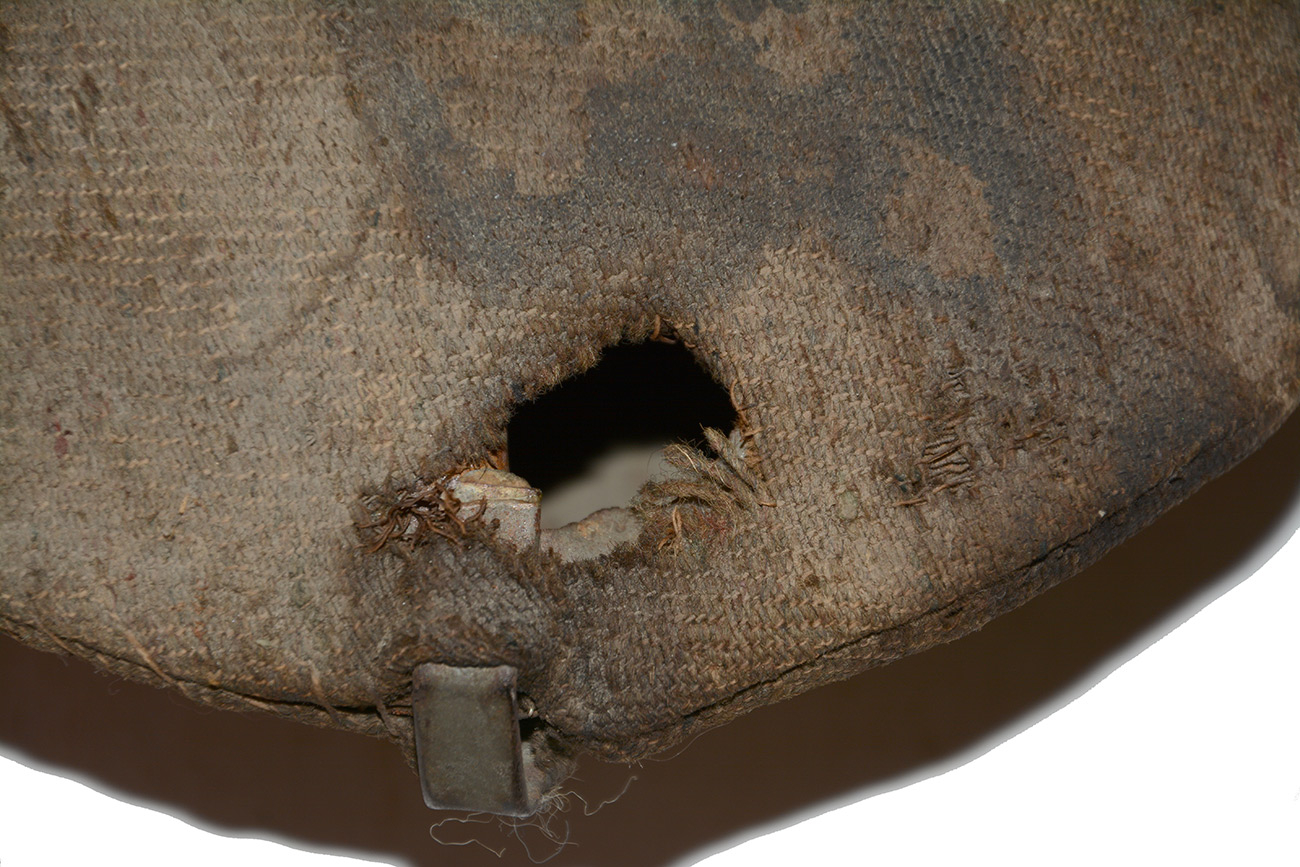
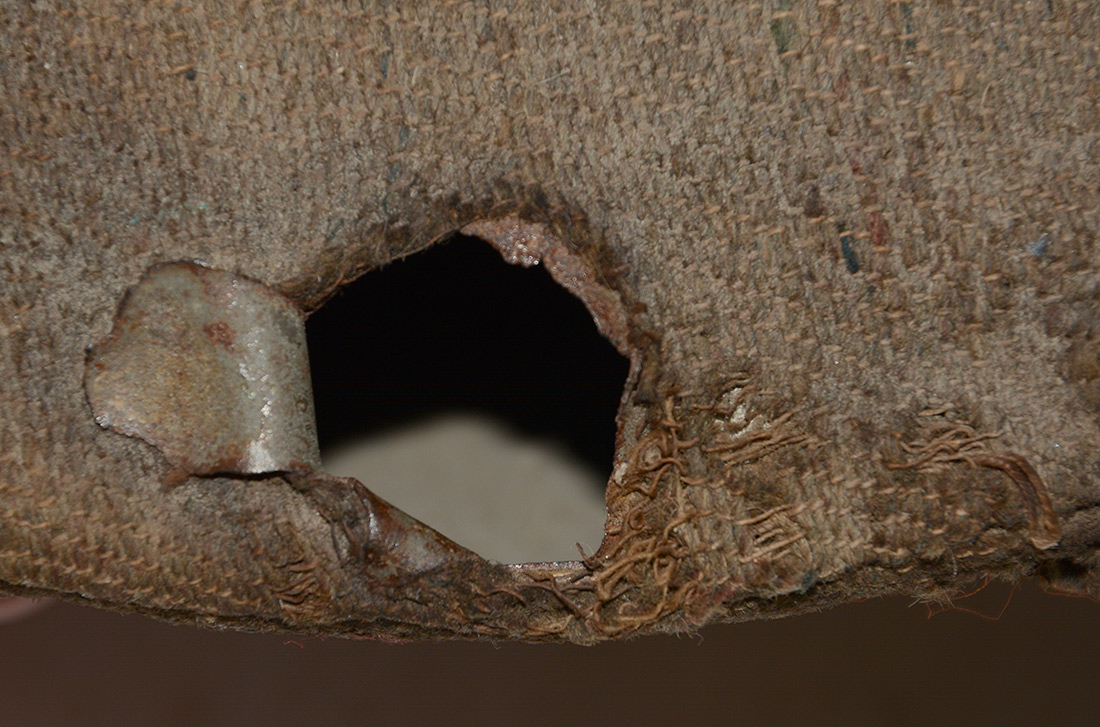
One face carries two perforations at the rim, opposite one another. Both pass cleanly through the cover and through the tin body. At one side the cover fibers are drawn inward around the margin and the metal is turned in beneath them; opposite, the tin is petalled outward with a tongue of metal folded back and the cover fibers splayed out over it. The two lie on a common axis, and the direction of the metal and fiber displacement is that of a single ball entering the first side and passing out the second. Neither opening shows any finishing or stitching that would suggest anything other than damage taken in the period, and nothing remains lodged within the body.
Both openings measure approximately one inch. The size is consistent with a large-caliber ball — a .69 caliber ball or a small canister ball among the possibilities — though the tearing of thin sheet tin makes any opening a poor gauge of a projectile's true diameter, and no attribution as to type is asserted here.
A third area at the lower center of the same face shows the cover worn and torn through in a roughly rectangular patch exposing bare tin beneath. This reads as wear and loss rather than as a second strike.
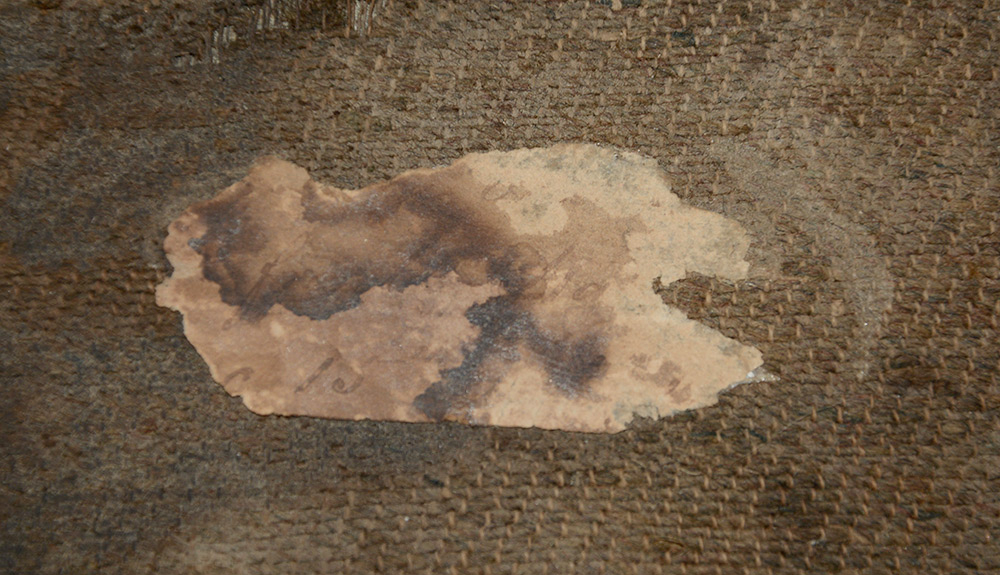
Adhering to the same face is an irregular torn fragment of period paper, approximately 2 1/4 x 3/4 inches, heavily stained and foxed. No writing is legible. Faint darker traces at one end may be the remains of ink. The fragment appears to be what survives of a tag once secured to the canteen; the collection tag records it simply as illegible, and it is offered as found, without conjecture as to what it once read.
PROVENANCE
By descent in the family of Lieutenant Colonel Thomas Chamberlin, 150th Pennsylvania Volunteers, and acquired from his descendants. The canteen is offered on that line of descent. Nothing in the piece itself identifies a user, and it is not represented as Colonel Chamberlin's own canteen.
The 150th Pennsylvania Volunteers was the second regiment of the Bucktail Brigade — the "New Bucktails" — and served in Colonel Roy Stone's brigade of the First Corps. Company K was detached for the whole of its term as guard at the Soldiers' Home, where President Lincoln passed his summers. The regiment took the field with Stone's brigade on the first day at Gettysburg, holding the ground about the McPherson farm and the Chambersburg Pike, and is counted among Fox's Three Hundred Fighting Regiments.
Thomas Chamberlin, of Union County, Pennsylvania, was commissioned captain of Company D, 34th Pennsylvania Infantry (5th Pennsylvania Reserves) in June 1861. He was wounded at New Market Cross Roads on June 30, 1862, taken prisoner, and held some two months before exchange. Discharged for promotion in September 1862, he was commissioned major of the 150th Pennsylvania and joined the regiment while still lame from his Peninsula wound. He was wounded again on July 1, 1863, at Gettysburg. He was promoted lieutenant colonel shortly before resigning in March 1864. In later years he served as historian of the regiment's Survivors' Association and wrote the standard History of the One Hundred and Fiftieth Regiment Pennsylvania Volunteers, Second Regiment, Bucktail Brigade, first published in 1895 and issued in a revised and enlarged edition with complete roster in 1905.
A canteen shot through and kept, rather than thrown away, is a piece a family had a reason to hold on to. [ss][ph:L]
~~~~~~~~~~~~~~~~~~~~~~~~~~~~~~~~~~~
THIS ITEM, AS WITH ALL OTHER ITEMS AVAILABLE ON OUR WEB SITE,
MAY BE PURCHASED THROUGH OUR LAYAWAY PROGRAM.
CLICK HERE FOR OUR POLICIES AND TERMS.
THANK YOU!
Inquire About FEDERAL MODEL 1858 SMOOTHSIDE CANTEEN, SHOT THROUGH — PHILADELPHIA DEPOT, FROM THE FAMILY OF LIEUTENANT COLONEL THOMAS CHAMBERLIN, 150TH PENNSYLVANIA VOLUNTEERS, "SECOND BUCKTAILS"
Most Popular
Historical Firearms Stolen From The National Civil War Museum In Harrisburg, Pa »
Theft From Gravesite Of Gen. John Reynolds »
Selection Of Unframed Prints By Don Troiani »
Fine Condition Brass Infantry Bugle Insignia »
Rare Identified 65Th Ny Sergeant’s Jacket, With Manscript Material: 1St U.s. Chasseurs »
featured item
A CONFEDERATE SURGEON'S GREATCOAT, SASH AND SHIRT
Dr. J. P. Rasser was contracted by the Confederacy and among his duties in Georgia was the examination of Conscripts for the Army. THE OVERCOAT or army great coat is certainly "Homespun" that is a woven woolen fabric originally made from homespun… (1268-706). Learn More »
site search