

site search
online catalog
THE ESTILLVILLE DAVIS GUARDS: THE PRESENTED COMPANY COLOR OF CAPT. HENRY CLINTON WOOD, COMPANY D, 37TH VIRGINIA INFANTRY, WITH THE FAMILY ARCHIVE DOCUMENTING ITS SUBSCRIPTION, PURCHASE, PRESENTATION AND ACCEPTANCE — SCOTT COUNTY, VIRGINIA, 1861
Hover to zoom
$85,000.00
Quantity Available: 1
Item Code: 1268-335
Shipping: Determined by Method & Location of buyer
To Order:
Call 717-334-0347,
Fax 717-334-5016, or E-mail
THE FLAG
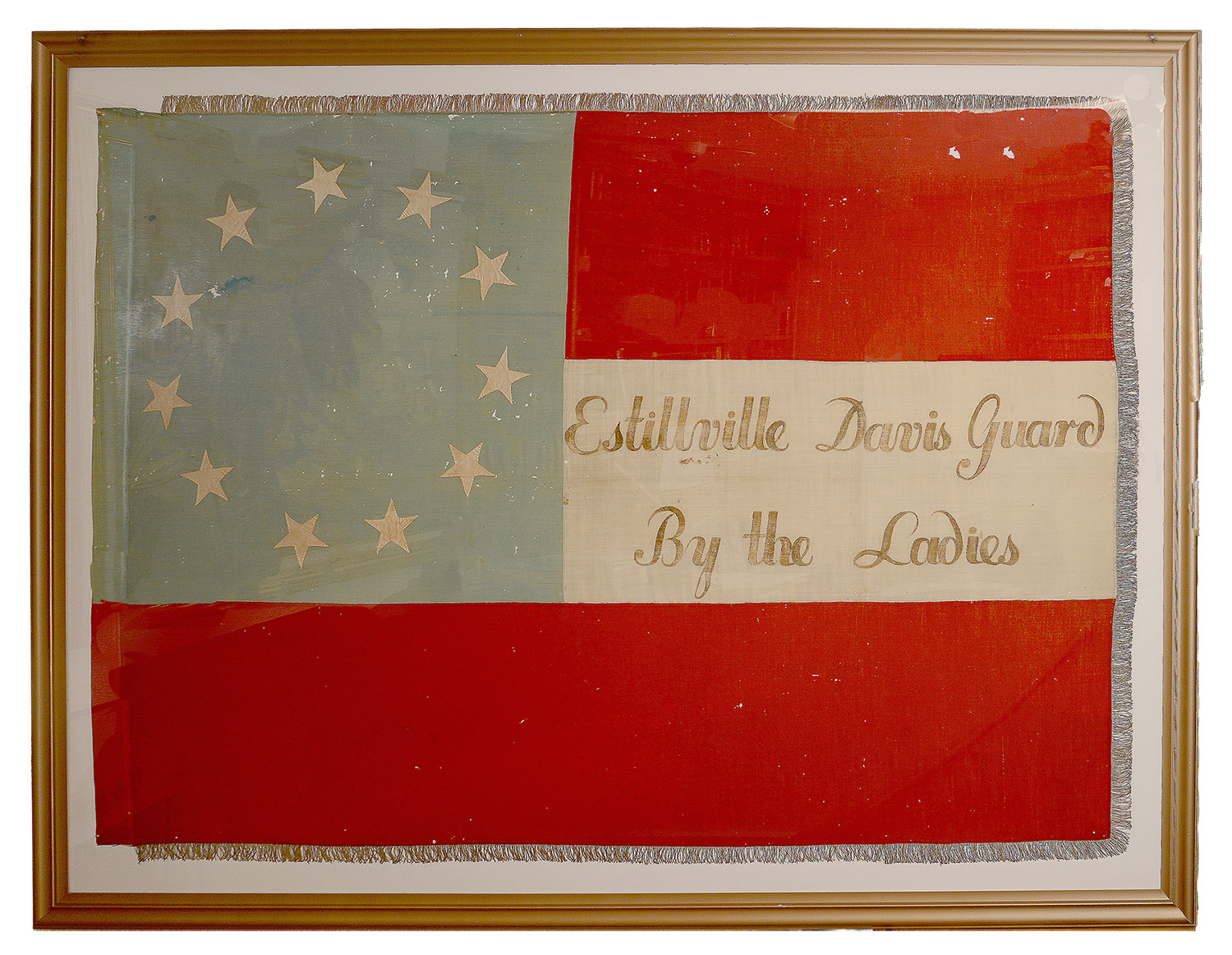
Confederate national flag of the First National pattern, eleven stars, made as a company color and presented in the summer of 1861 to the volunteer company raised at Estillville, Scott County, Virginia by Henry Clinton Wood.
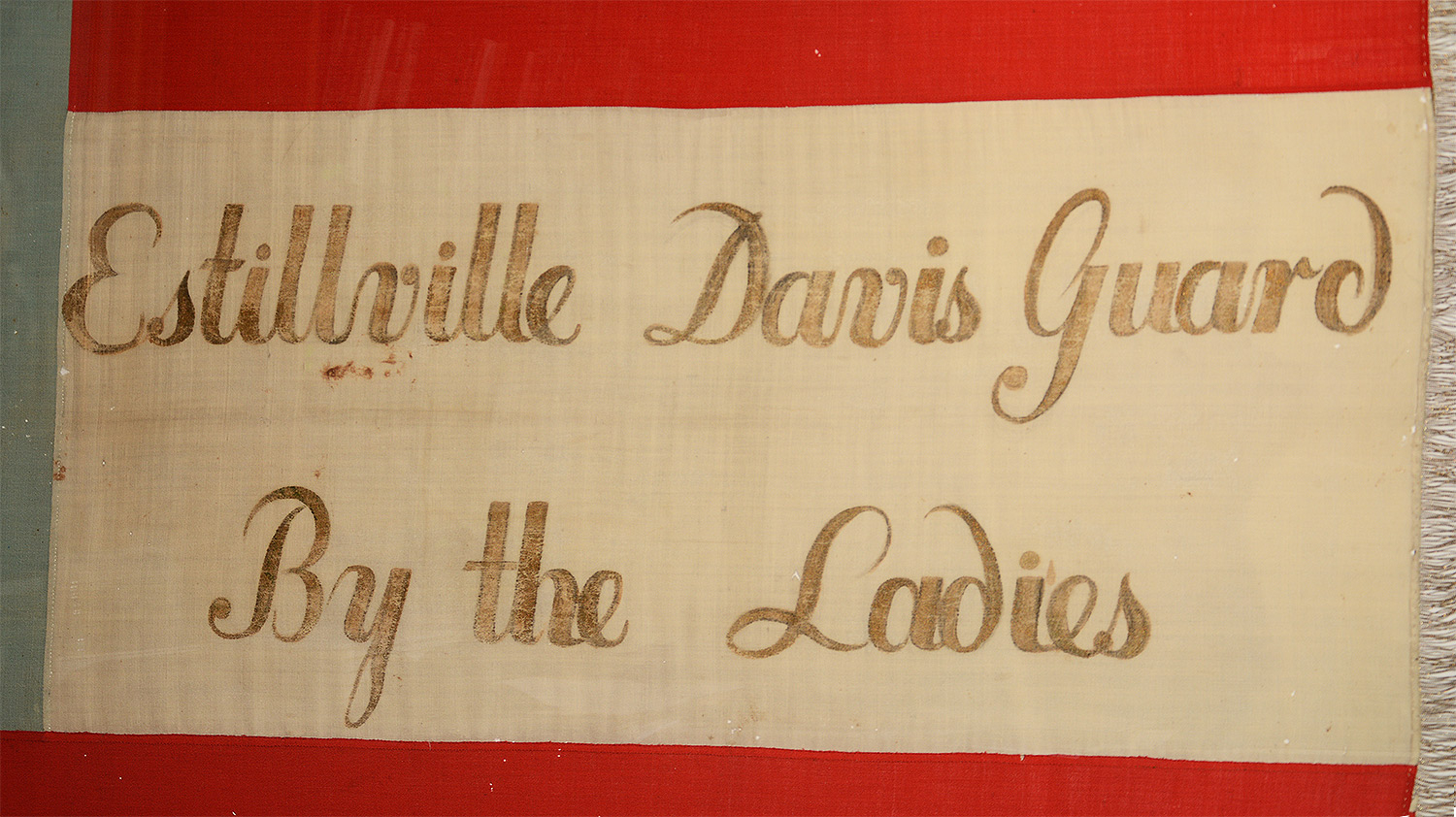
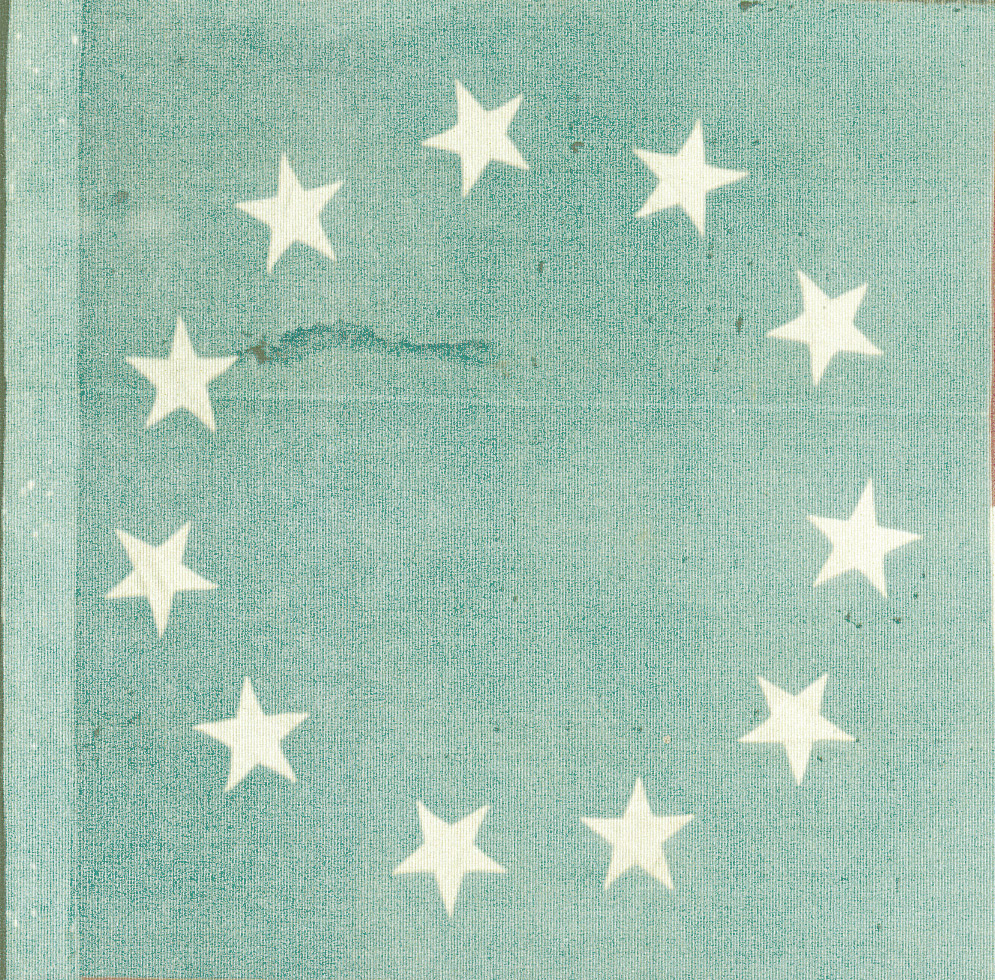
Leading edge 62 1/4 inches, fly 84 3/4 inches after conservation flattening in 2019 (60 by 84 inches as received, figures inclusive of the fringe). The fly is of red and white wool challis in three horizontal bars — top red bar 20 inches, center white bar 19 1/4 inches, bottom red bar 19 5/8 inches. The canton, of two pieces of blue-green wool challis joined by a horizontal seam 16 3/8 inches from the top, measures 39 1/2 by 39 inches and carries eleven five-pointed stars of polished off-white plain-woven cotton, appliqued to both faces with the edges turned under and running-stitched around the perimeter, each 4 1/4 to 4 1/2 inches point to point, set in a circle 32 inches in diameter. The center bar bears the presentation inscription in two lines of gold-leaf script, the letters 2 1/4 to 7 inches high:
Estillville Davis Guard
By the Ladies
Gold metallic fringe — two-ply cotton threads wrapped in gold metallic ribbon and joined in a two-ply twist — is sewn to the reverse along the top, fly and bottom edges. The leading edge is rolled into a 3 1/4-inch pole sleeve lined in off-white cotton. The flag is hand sewn throughout in silk thread with flat-fell seams, save for a single row of two-thread chain-stitch machine work down the pole sleeve. Under ultraviolet examination the red dye fluoresces a brilliant orange, indicating madder, a natural mordanted dye consistent with the period.
Conserved and mounted in 2019 in a custom pressure-mount exhibition case behind ultraviolet-filtering Plexiglas, in an aluminum moulding of fluted profile finished in Light Chestnut Metallic. Overall frame dimensions 72 1/2 by 94 1/4 inches.
THE COMPANY AND ITS CAPTAIN
Estillville — renamed Gate City in 1886 for its position in Moccasin Gap, where the Old Wilderness Road passed west — was the seat of Scott County in far southwestern Virginia and the rendezvous of the county's first volunteers.
Henry Clinton Wood (1838-1909), known at home as Clint, raised that first company. His sister Juliett, writing from the family place at Pleasant Hill on April 29, 1861 to their brother Harvey, then a cadet at the Virginia Military Institute, reports that Clint had forty-four names on his list and wanted fifty-five or sixty, that drilling would begin the following Thursday, and that money was being subscribed to uniform the men. She names the neighbors who had come in — Bickley, Smyth, Neil, Morison, the Godseys, Rollins, White, Lawson, Francisco, Fletcher, Dillion — observing that the young men of the county were otherwise backward about volunteering, and that Clint was anxious to get off, saying he wanted to be at the taking of Washington City. In his own hand at the head of the same sheet Clint adds that the company was made up, that the election was Thursday, and that he thought he would be elected captain. He was.
The company entered the 37th Virginia Infantry under Col. Samuel Vance Fulkerson and is indexed as the Estillville Davis Guards, Company D, 37th Virginia Infantry, in the standard concordance of local designations of Confederate organizations (William Frayne Amann, ed., Personnel of the Civil War, Volume I: The Confederate Armies, New York and London: Thomas Yoseloff, p. 49) — the name the company used for itself in its own papers, on its flag, and in its captain's obituary half a century later. The 37th was accepted into Confederate service in July 1861 and fought at First Kernstown and McDowell, through Jackson's Valley Campaign, and on through the Seven Days, Cedar Mountain, Second Manassas, Antietam, Fredericksburg, Chancellorsville and Gettysburg, where the regiment was cut to pieces on Culp's Hill; afterward at Spotsylvania and Cold Harbor, in Early's Valley operations, and in the final campaign to Appomattox. It served successively in Taliaferro's, Colston's, Steuart's and W. Terry's Brigades of the Army of Northern Virginia.
Wood was wounded at Chancellorsville, was credited with forty-two engagements, and ended the war a major. Afterward he sat two terms in the Virginia Senate and was its Speaker in 1881-82, stood for lieutenant-governor on John S. Wise's ticket, and was the Republican nominee for Congress in the Ninth Virginia District in 1892. He never married. His brother Harvey — Capt. James Harvey Wood, later adjutant on Fulkerson's staff — published a memoir of the regiment in 1910.
THE MAKING OF THE FLAG
The archive follows the flag from want to acceptance, and in doing so corrects the story usually told about flags of this kind.
From Camp Fulkerson on May 29, 1861, his company still without uniforms and its orders to Richmond issued and then countermanded, Capt. Wood wrote to his father with a request and a boast:
"I want the Ladies to get us a nice flag before we leave here The Ladies of this county are talking about makeing us one But I told them the Ladies of my own County were going to present us a fine flag."
On June 4 his sister reported the effort underway — twenty-nine dollars subscribed, and cousin Mag already sent off for the flag by a Mr. Clark: "I recon you will get your flag."
On June 18 Mag sent it, with an apology:
"I send you the flag which is the very best that could be done, I wrote to Knoxville and Nashville for satin or silk, but there was nothing to be had anyways suitable for a flag, except the one I send — it was made in Knoxville... We had subscription sufficient to have paid for a fifty dollar flag, but money which moves all things, failed in this instance. Accept then the banner, and be assured that our hearts are with you, and our prayers are for you."
Two months into the war the blockade had already emptied the Knoxville and Nashville dry-goods market of anything the women of Scott County thought fit for a flag. They had the money for a fifty-dollar banner and could not buy one. What they could get was this: dress-weight wool challis, lettered in gold leaf, made up in Knoxville and sent over the mountains. The flag was procured rather than stitched in a Scott County parlor, and the inscription By the Ladies records who raised the subscription and made the presentation — which is exactly what the phrase was understood to mean at the time.
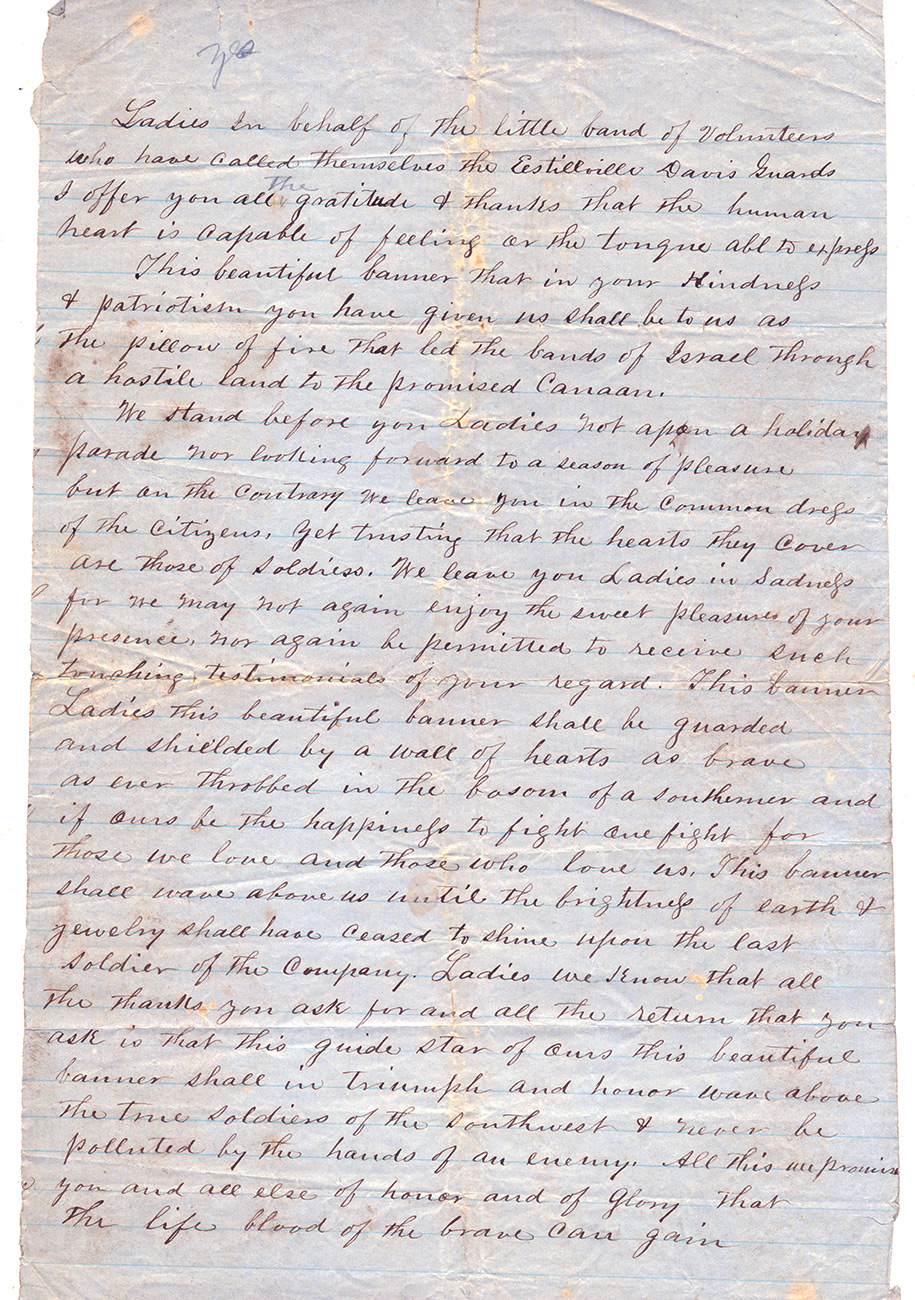
Capt. Wood's acceptance address survives in two versions, a working draft and a retained fair copy headed in his own hand "Capt. H. C. Wood's reply":
"This beautiful banner that in your kindness and patrotism you have given us, shall be to us as the pillow of fire that led the bands of Israel through a hostile land to the promised Canaan.
We stand before you ladies of Estillville not to commemorate an anniversary not upon a holliday parade, nor looking forward to a season of pleasure, but on the contrary we leave you in the Common dress of the Citizen, yet trusting that the hearts they cover are those of soldiers...
This banner Ladies this beautiful banner shall be guarded and shielded by a wall of hearts as brave as ever throbbed in the bosom of a southerner... all this we promise you and all else of honor and of glory that the life blood of the brave can gain."
He was twenty-three. Of the eighty-seven men he listed in his company's own roster that summer, the regiment would lose more than thirty per cent of those it carried onto Culp's Hill two years later.
THE ARCHIVE
Nine contemporary manuscripts and a reference file, all bearing directly on the flag and the company:
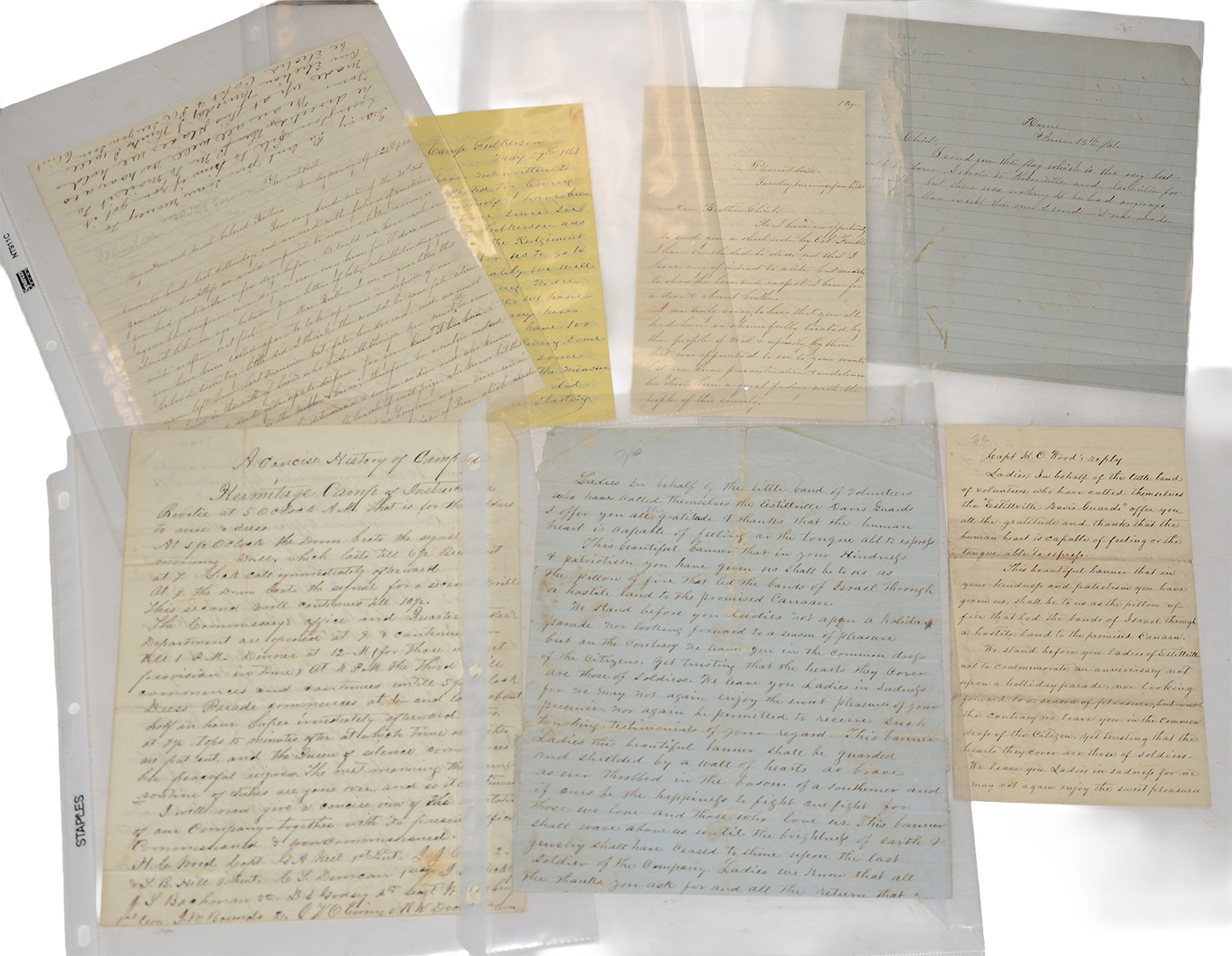
1. Juliett ("Julia") Wood to her brother Harvey, Pleasant Hill, April 29, 1861. 4pp. The raising of the company, the forty-four names, the drilling, the subscription for uniforms, the named volunteers of Scott County, and the note that Estillville already had a flag of its own. With Clint's autograph postscript at the head announcing his expected election as captain. Period docket in pencil.
2. Capt. H. C. Wood to his father, James Osborn Wood, Camp Fulkerson, May 29, 1861. 4pp, signed twice. Fulkerson's appointment as colonel; the order to Richmond and its countermand; eighty-three men present with a hundred expected; uniform measures sent home for Col. Morison; a full hour-by-hour account of the camp day from reveille at five to tattoo at nine; and the request for a flag.
3. Juliett Wood to her brother Clint, Pleasant Hill, June 4, 1861. 4pp, sent by hand with Col. Franklin. The flag subscription at twenty-nine dollars; the failure to get cloth for the uniforms; family news; and word from Harvey that Gov. Letcher and Maj. Gilham held the VMI cadets should not enter the army as privates but should have commissions.
4. "Cousin Mag" to Clint, Home, June 18, 1861. 2pp. The letter that accompanied the flag. The failed search for satin or silk in Knoxville and Nashville, the Knoxville manufacture, the fifty-dollar subscription that could not be spent, and the presentation itself; with East Tennessee news and fears of Federal troops coming up the Sandy and crossing through the county.
5. Capt. H. C. Wood's reply. The acceptance address in two versions — a working draft and the fair copy headed in his hand.
6. "A Concise History of Camp Life, Hermitage Camp of Instruction." 4pp, issued in the name of the company. The camp routine; the full list of commissioned and non-commissioned officers with H. C. Wood at their head; the strength given as four officers, eight non-commissioned officers and seventy-five privates, eighty-seven aggregate; and the entire company listed man by man in its eight messes. The men were quartered in the livestock stalls of the Richmond fairgrounds — "the stalls which were erected to accommodate fine stock raisers now accommodates the Estillville Davis Guards" — and the account closes "Respectfully to our Friends of the county of Scott and especially to the Ladies... Yours truly, Estillville Davis Guards," docketed for delivery home in care of a Scott County gentleman. A company roster in the company's own voice, written for the women who had paid for its flag.
7. Partial letter, n.d., describing the evening presentation of a flag to the Mountain Boys — the company that became Company B of the same regiment — with each seceded state represented by a young lady, and fifty thousand volunteers reported passed through from the South.
8. Reference file. Photocopy of Maj. Wood's obituary, a special dispatch to the Baltimore Sun dated December 8, 1909, recording that he formed the first company of Confederates to march out of Scott County, that he was made its captain, that the flag presented to him on that occasion was still in his home, and quoting its inscription; with modern genealogical printouts identifying the correspondents within the Wood family.
PROVENANCE
Presented to Capt. Henry Clinton Wood, 1861, and retained by him for the remainder of his life; his obituary of December 1909 records the flag still in his house at Bristol and quotes its inscription from the flag itself. Thence by descent in the Wood family, the correspondence remaining with it. Acquired by Ray and Judy Richey of Fort Worth, Texas, and exhibited at the Texas Civil War Museum in White Settlement — the largest Civil War collection west of the Mississippi, which the Richeys founded in 2006 and closed in 2024 on their retirement.
CONSERVATION
Examined and analyzed by Textile Preservation Associates in 1995 and conserved and mounted by the same firm in 2019; both reports accompany the lot. The 1995 analysis, by Fonda Ghiardi Thomsen, Fellow of the American Institute for Conservation, concluded that the materials, condition and method of construction support a mid-nineteenth-century origin and the reported history, that the flag is intact as constructed with no evidence of repairs or alterations, and that the machine work, thread and eleven stars all indicate an early-war date. The 2019 treatment by Cathy L. Heffner comprised sixty-five hours of cleaning, flattening and stabilization, with the fringe re-secured by hand in silk and the flag mounted in the sealed pressure-mount frame described above. Photographic documentation, a sealed particle sample and the conservator's written instructions for lighting, display and handling ship with the flag.
CONDITION
Intact and structurally sound. Scattered small losses throughout, fewer than fifty and none exceeding a quarter inch, the worst along the pole sleeve and attributable to insects. An extensive tide line from an early wetting runs above the canton seam, roughly 1 1/4 by 9 inches; rust-colored staining lies beneath the letters "li" of Estillville, with further light brown staining below the "E," on the canton and on the pole sleeve — all tested and negative for blood. Approximately forty per cent of the gold leaf has fragmented from the lettering, leaving the base layer visible; the inscription remains wholly legible. The fringe is substantially complete with tarnish to the metallic wrap and some historic resewing. Colors remain strong, the madder reds notably so, with some dye loss in the blue wool of the canton. Stabilized, flattened and mounted to museum standard, and in fine displayable condition.
A Confederate company color that survives with the letter that commissioned it, the letter that paid for it, the letter that carried it, the captain's own words accepting it, his company's roster written for the women who gave it, and a published notice half a century later confirming it still hung in his house. Flags of this pattern survive in some numbers. Flags documented to this degree do not. [ss][PH:L]
SPECIAL SHIPPING ARRANGEMENTS REQUIRED.
~~~~~~~~~~~~~~~~~~~~~~~~~~~~~~~~~~~
THIS ITEM, AS WITH ALL OTHER ITEMS AVAILABLE ON OUR WEB SITE,
MAY BE PURCHASED THROUGH OUR LAYAWAY PROGRAM.
CLICK HERE FOR OUR POLICIES AND TERMS.
THANK YOU!
Inquire About THE ESTILLVILLE DAVIS GUARDS: THE PRESENTED COMPANY COLOR OF CAPT. HENRY CLINTON WOOD, COMPANY D, 37TH VIRGINIA INFANTRY, WITH THE FAMILY ARCHIVE DOCUMENTING ITS SUBSCRIPTION, PURCHASE, PRESENTATION AND ACCEPTANCE — SCOTT COUNTY, VIRGINIA, 1861
Most Popular
Historical Firearms Stolen From The National Civil War Museum In Harrisburg, Pa »
Theft From Gravesite Of Gen. John Reynolds »
Selection Of Unframed Prints By Don Troiani »
Fine Condition Brass Infantry Bugle Insignia »
Rare Identified 65Th Ny Sergeant’s Jacket, With Manscript Material: 1St U.s. Chasseurs »
featured item
RARE EBERLE 1796 CONTRACT MARKED BAYONET
This rare bayonet is marked by the maker in a sunken cartouche with raised letters on the base of the blade reading “Eberle.” Charles Louis Eberle emigrated to the U.S. from Germany with brothers George A. and Henry J. in 1794, arriving in… (1052-86). Learn More »
site search