

site search
online catalog
TELEGRAM REPORTING ON IRONCLAD “GUN BOAT FIGHT OFF CHARLESTON” JANUARY 31, 1863
Hover to zoom
$250.00 SOLD
Quantity Available: None
Item Code: 1309-714
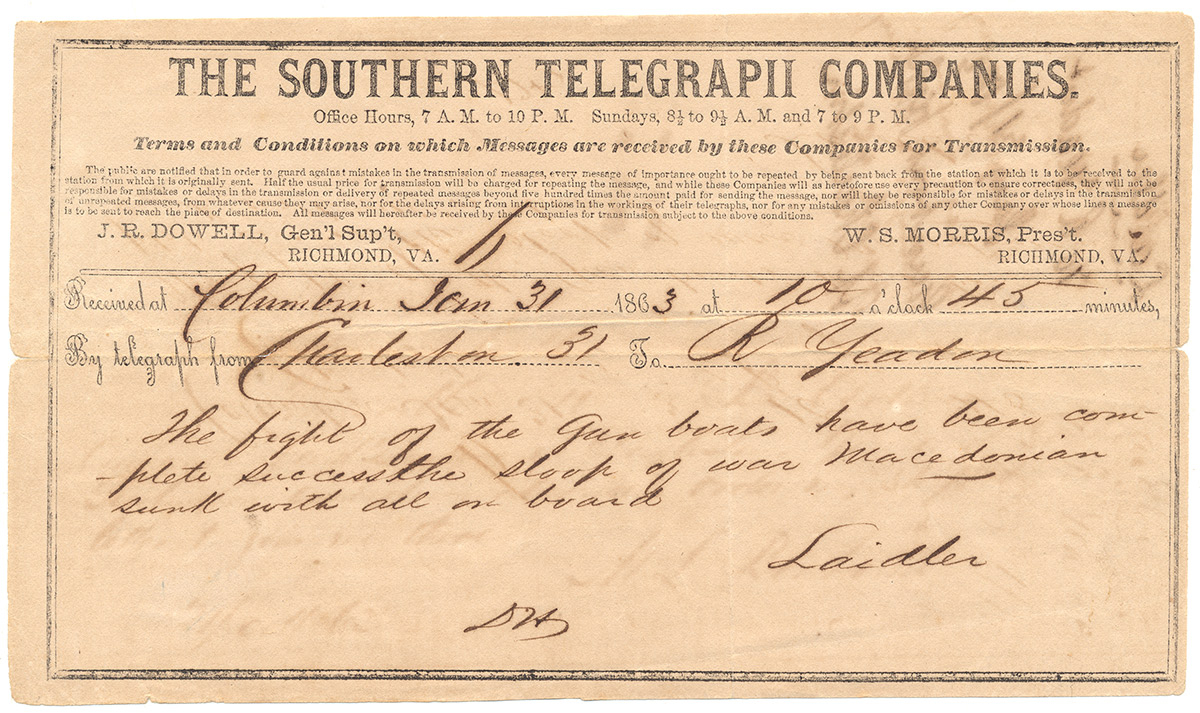
Offered here is an original telegram reporting details of the Confederate ironclad attack on Union blockading ships off Charleston Harbor on January 31, 1863.
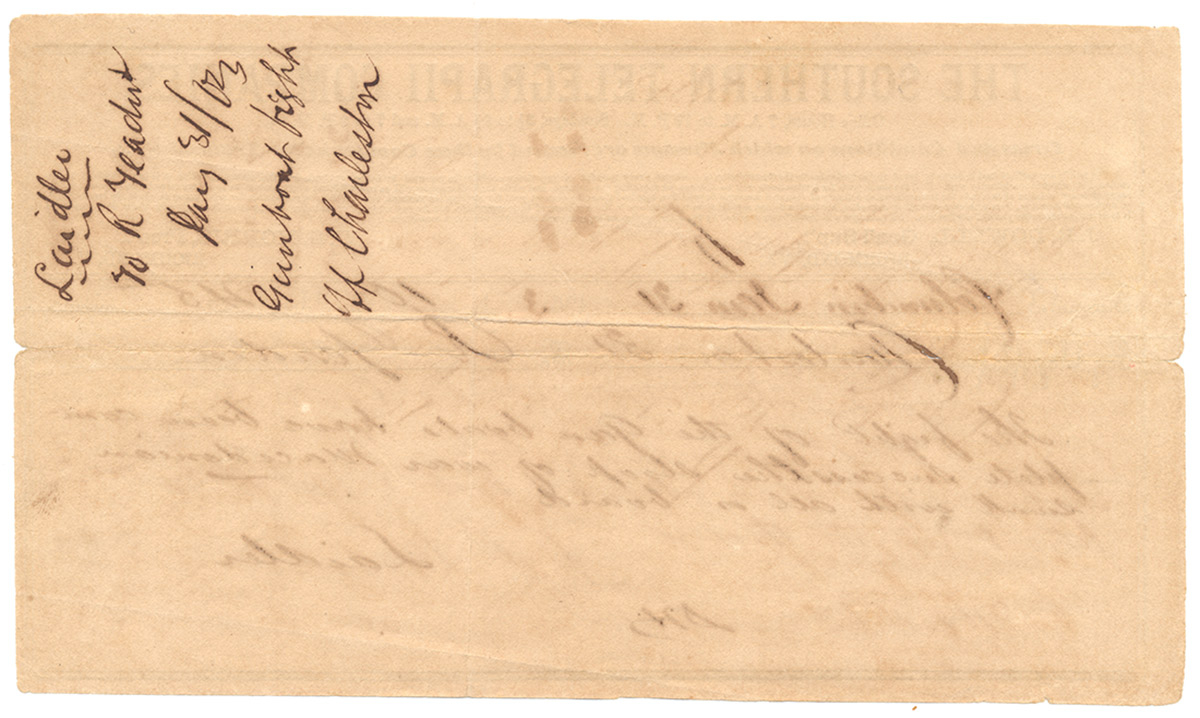
The pre-printed form is from THE SOUTHERN TELEGRAPII [sic] COMPANIES based in Richmond, Virginia. The telegram information is completed in brown ink. Dated January 31, 1863, 10:45 in the morning. Sent from William Laidler to Richard Yeadon: “The fight of the gun boats have been complete success the sloop of war Macedonian sunk with all on board”. File note in ink on reverse. Measures 8” x 4.5”.
This telegram is the Charleston Daily Courier report of the attempt by a pair of Confederate ironclads to lift the U.S. Navy blockade of the Charleston in the early hours of January 31, 1863. The Richmond-class ironclad rams “Palmetto State” and “Chicora” badly damaged four wooden blockaders before being chased back to Charleston Harbor. The “Mercedita” was misidentified in the telegram as the “Macedonia”.
Lieutenant William H. Parker, executive officer of the CSS Palmetto State, states in part: “At 11:30 P.M., January 30th the two vessels quietly cast off… to reach the bar of the main ship channel, 11 miles from Charleston, about 4 in the morning…. We passed between Forts Sumter and Moultrie…and turned down the channel along Morris Island…. As we approached the bar, about 4 a. m., we saw the steamer Mercedita lying at anchor a short distance outside it…. We went to quarters an hour before crossing the bar, and the men stood silently at their guns…. We crossed the bar and steered directly for the Mercedita. They did not see us until we were very near. Her captain then hailed us, and ordered us to keep off or he would fire. Just then we struck him on the starboard quarter, and dropping the forward port-shutter, fired the bow gun. The shell from it, according to Captain Stellwagen who commanded her, went through her diagonally, penetrating the starboard side, through the condenser, through the steam-drum of the port boiler, and exploded against the port side of the ship, plowing a hole in its exit four of five feet square. She did not fire a gun, and in a minute her commander hailed to say he surrendered…. Lieutenant T. Abbott, the executive officer of the Mercedita, came in a boat. I conducted him through the port to the presence of Commodore Ingraham. He reported the name of the ship and her captain, said she had 128 souls on board and that she was in a sinking condition. After some delay Commodore Ingraham required him to “give his word of honor, for his commander, officers and crew, that they would not serve against the Confederate States until regularly exchanged.” This he did—it was a verbal parole. He then returned to his ship…. We finally stood out to the eastward and engaged the Quaker City, Memphis, and some other vessels, as they came up, but they steered off as soon as they felt the weight of our metal. When day broke, I got a chance to get up on the spar-deck. I first looked astern for the Mercedita, and not seeing her, asked our pilot where she was. He said she must have sunk; and that was the general impression on board; but I knew she was not in deep water, and seeing no masts sticking up, “I had my doubts.” The fact is we did not ram her quite hard enough. The panic on board her caused by the shell from our bow-gun was at first so great that they thought she was sinking. One boiler being emptied caused her to heel over, I suppose; but as we stood out to engage the enemy to the eastward, they got matters to rights, and finally went off to Port Royal where she arrived safely. While the Confederate commander at Charleston, General P. G. T. Beauregard, quickly issued a proclamation that the attack had lifted the blockade, he conveniently left out that a surrendered Union ship along with her crew had escaped in the early morning darkness. The status of the Mercedita as well as her officers and men were decided by a Union court of inquiry. It determined that Lieutenant Abbott’s pledge that the crew would not take up arms against the Confederacy until exchanged was binding, but it didn’t apply to the gunboat, which later served in the North Atlantic and West Gulf blockading squadrons.”
William Laidler, the telegram sender, was a co-proprietor and partial owner of the prominent pro-secession newspaper, the Charleston Courier. Laidler acquired a major stake in the newspaper from his sister Letitia in 1854. By 1863, the publication served as a vital propaganda organ for the Confederacy, operating under intense paper shortages caused by the Union blockade.
Richard Yeadon, the telegram recipient, was the influential editor and co-proprietor of the Charleston Courier. He served as a member of the South Carolina Legislature and was a staunch defender of the institution of slavery.
An interested telegram relating a “news flash” for this Confederate daily newspaper. [jet] [PH:L]
~~~~~~~~~~~~~~~~~~~~~~~~~~~~~~~~~~~
THIS ITEM, AS WITH ALL OTHER ITEMS AVAILABLE ON OUR WEB SITE,
MAY BE PURCHASED THROUGH OUR LAYAWAY PROGRAM.
CLICK HERE FOR OUR POLICIES AND TERMS.
THANK YOU!
Inquire About TELEGRAM REPORTING ON IRONCLAD “GUN BOAT FIGHT OFF CHARLESTON” JANUARY 31, 1863
Most Popular
Historical Firearms Stolen From The National Civil War Museum In Harrisburg, Pa »
Theft From Gravesite Of Gen. John Reynolds »
Selection Of Unframed Prints By Don Troiani »
Fine Condition Brass Infantry Bugle Insignia »
Rare Identified 65Th Ny Sergeant’s Jacket, With Manscript Material: 1St U.s. Chasseurs »
featured item
THE BLOODY PILLOWCASE (AND MORE) OF CAPTAIN GOULD – MEDAL OF HONOR RECIPIENT; 5TH VERMONT INFANTRY
The principle and poignant artifact in this grouping is a plain linen "hospital issue" pillowcase stained with the blood of Congressional Medal of Honor winner Captain Charles Gould Company H 5th Vermont Infantry. This incident which occurred on… (1268-755). Learn More »
site search