

site search
online catalog
CPL. DUGOLD C. WHITE, CO. D, 13TH NEW YORK HEAVY ARTILLERY — LETTER ARCHIVE TO HIS WIFE FROM THE PORTSMOUTH AND NORFOLK GARRISON, 1863–1865, WITH AN EYEWITNESS ACCOUNT OF THE EMANCIPATION DAY PARADE AT NORFOLK, JANUARY 1, 1864
Hover to zoom
$300.00
Quantity Available: 1
Item Code: 557-282
Shipping: Determined by Method & Location of buyer
To Order:
Call 717-334-0347,
Fax 717-334-5016, or E-mail
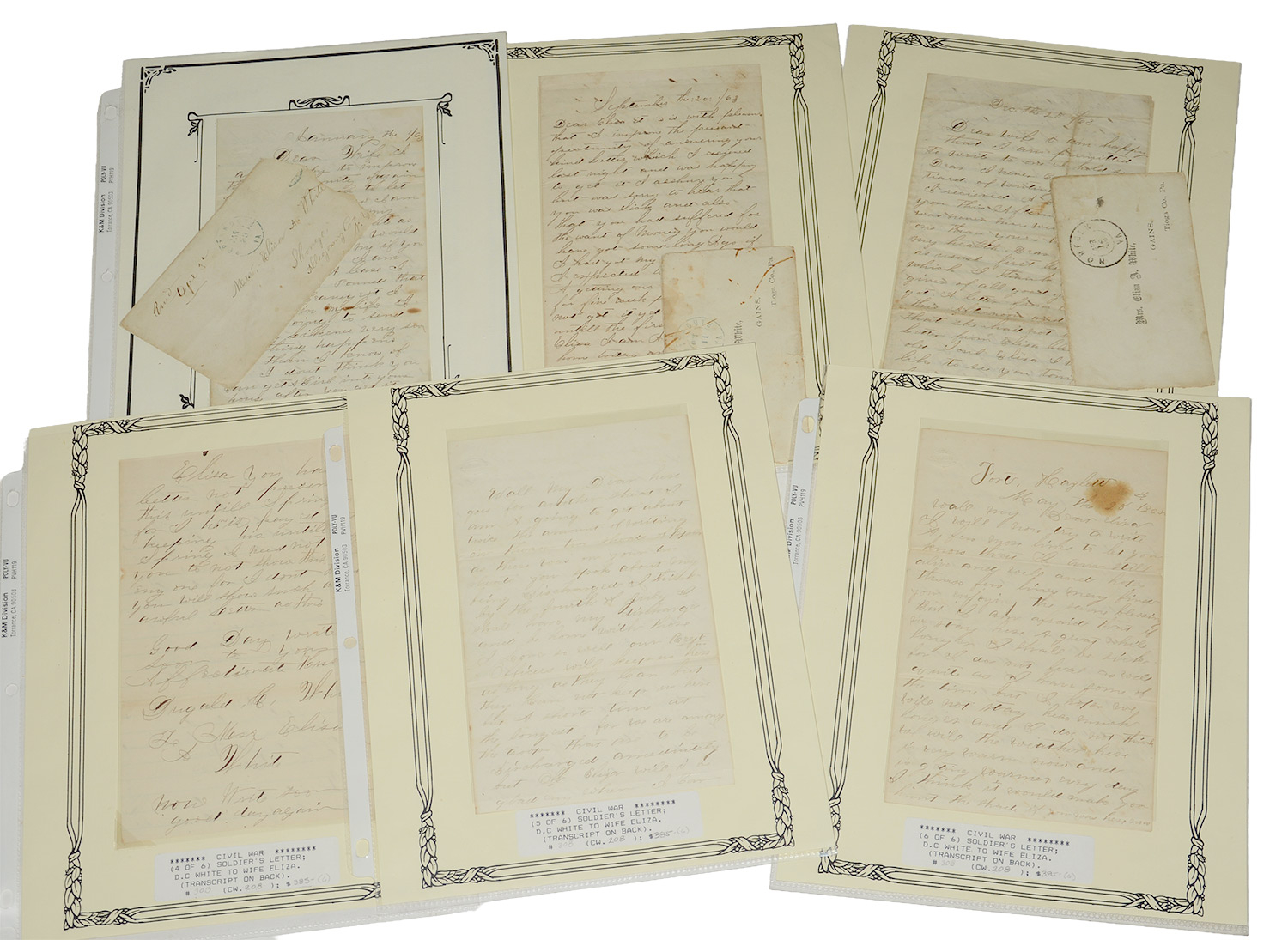
A group of manuscript letters, with three original mailing covers, written by Dugold [Dugald] C. White of Co. D, 13th New York Heavy Artillery, to his wife, Mrs. Eliza (Elisa) A. White. The letters run from September 1863 to May 1865, written throughout from the garrison of Portsmouth and Norfolk, Virginia. They are signed "Dugald C. White" (1863) and "Cameron D. White" and "Cameron White" (1865), evidently one man, Dugald Cameron White, who went by his middle name. Mrs. White is addressed at Shongo, Allegany County, New York, and at Gaines, Tioga County, Pennsylvania.
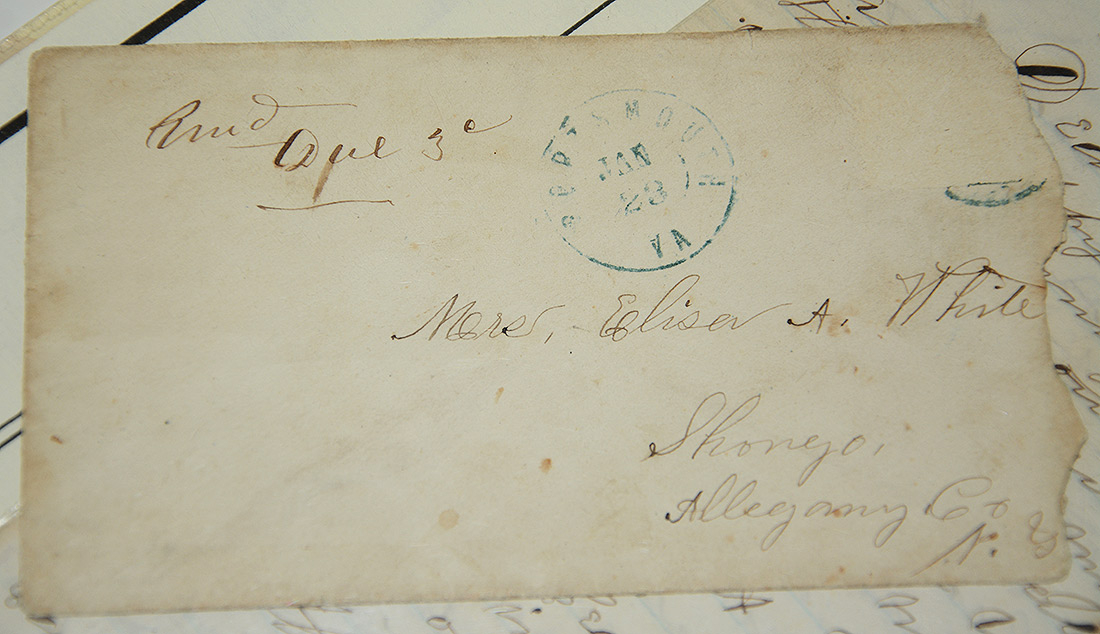
The covers comprise one addressed in manuscript to "Mrs. Elisa A. White, Shongo, Allegany Co., N.Y.," with a blue PORTSMOUTH, VA. JAN 23 circular datestamp and period docketing at left; one printed "Mrs. Eliza A. White, Gains, Tioga Co., Pa.," with a blue PORTSMOUTH, VA. OCT 11 circular datestamp; and a second of the same printed address with a black NORFOLK, VA. APR circular datestamp. The printed covers indicate the family supplied him with pre-addressed envelopes, consistent with his instruction in 1865 to "Direct the same as before."
NOTE ON DATING: White misdated his January letters "/63," an error common in the first days of a new year. Their content and his July 1863 enlistment place them in January 1864.
CONTENTS
First weeks in the garrison, September 1863. Writing September 20, 1863, a little over two months after enlisting, White answers news that his wife has been sick and has suffered for want of money. The men have been expecting their monthly pay for five weeks without receiving it, and he doubts they will see the bounty the rest of the men already received. He asks his father to sell his bull and send her the proceeds. He describes a week of fever and ague, and a rotation of guard, fatigue duty unloading ships, and guard again, with the company's old soldiers saying they never saw such hard times. He writes that if it is God's will he shall come home, and if not, he shall "lay my bones in some foreign Clime." The letter closes with a passage of religious resolve: he has seen sin and wickedness he never knew before, is ashamed of his former life, and reads on guard from the pocket book she gave him.
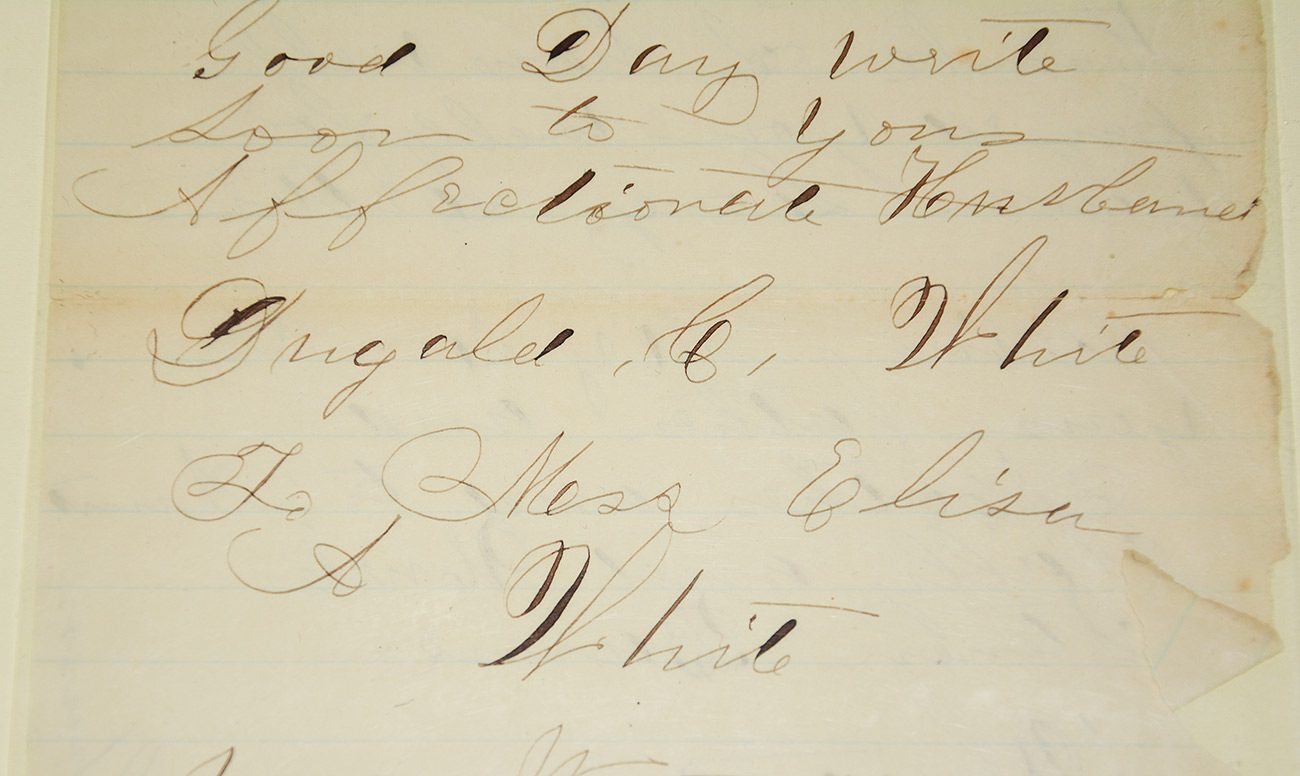
Christmas 1863. A Christmas Day letter describes the garrison's holiday sports: a blindfolded wheelbarrow race, a sack race, a race after a shaved and greased pig won by whoever could catch and shoulder him, and a boxing match. White did not join in, "thinking it would not pay cost." He discusses an order for his cow, which is boarded and paid for until spring. He recounts money sent from home that went missing, which he suspects was taken from the letter by a named neighbor or at the Gaines post office, and reports five dollars more sent. He sends his love to her father and mother and to "Aunt Sally and Uncle Stephen Barnes." A rueful closing note asks her not to show anyone "such an awful letter as this is," signed "Affectionate Husband, Dugald C. White."
Emancipation Day at Norfolk, January 1, 1864. White writes that he has been to Portsmouth and Norfolk on a pass and went down on the cars. He reports a grand review of the colored troops of the place, which he puts at seven regiments of "Negroes," some 7,000, with about the same number of white soldiers and inhabitants. The return to Portsmouth was met by a "Fantastick party of Horsmen" in all kinds of costume, and the children ran and screamed, having more fun at New Year's than at Christmas. The occasion was the first anniversary of the Emancipation Proclamation. By then U.S. Colored Troops were organizing and serving at Norfolk and Portsmouth, including Wild's African Brigade, so newly enlisted Black soldiers now marched in the city's freedom celebration.
Heavy ordnance at the fort, January 1864. A companion letter of the same month describes a working party of about twenty men mounting large pivot guns at the fort. Each ball weighed 200 pounds and the gun was marked at several thousand pounds, raised on a pivot seven feet high. The gin ("try angle") broke and the gun came down, with the poles some thirty feet long, "but it was a mercy all of us escaped." Another letter of January 1864 reports his health "first rate" and his weight at 190 pounds, "the heaviest I ever was in my life," and promises to send his likeness. It also mentions a cold taken on guard that settled on his lungs.
War's end, 1865. The final letters, on embossed letter paper, include one datelined Fort Hazlett, May 25, 1865, the Portsmouth work named for Lt. Charles E. Hazlett, killed on Little Round Top. White expects his discharge by the Fourth of July and complains that the officers will keep the men as long as they can. He recalls the day they last parted on the corner by a neighbor's house. He reports the start of a sickly season, with a number of cholera cases, most of them fatal, though no soldier has yet taken it. He notes that he is "thoroughly tested in regard to drinking," having to draw and issue liquor to about thirty men twice a day without touching any himself. With the war ended there is "no news here," the weather grows hotter daily, and he hopes they will not stay much longer. He promises their boy a good education "if I live and have my health," discusses the farm, and closes with teasing banter about the kisses she may expect on his return.
THE WRITER
Dugold C. White, age 23, enlisted as a private at Wellsville, Allegany County, N.Y., July 13, 1863, and was mustered into Co. D, 13th New York Heavy Artillery, August 4, 1863. He was promoted corporal in Co. D. The 13th N.Y. Heavy Artillery spent much of its service garrisoning the forts and defenses of Norfolk and Portsmouth. On July 18, 1865 White was transferred to Co. L, 6th New York Heavy Artillery, and he was mustered out at Washington, D.C., August 24, 1865, about seven weeks after the Fourth of July date he had hoped for. (Source: New York, Report of the Adjutant-General.)
CONDITION
Letters on ruled letter sheets and embossed letter paper, written in iron-gall ink now browned. Original folds, scattered foxing and spotting, some ink blots, and a few small losses at folds and edges. Covers with toning, edge wear and chipping, one with a corner loss. Overall good and very legible. Accompanied by typwritten transcriptions.
An identified heavy artilleryman's view of two years' garrison duty in occupied Tidewater Virginia, from enlistment through war's end, highlighted by his eyewitness account of the first anniversary Emancipation Day parade at Norfolk. [ss][ph:L]
~~~~~~~~~~~~~~~~~~~~~~~~~~~~~~~~~~~
THIS ITEM, AS WITH ALL OTHER ITEMS AVAILABLE ON OUR WEB SITE,
MAY BE PURCHASED THROUGH OUR LAYAWAY PROGRAM.
CLICK HERE FOR OUR POLICIES AND TERMS.
THANK YOU!
Inquire About CPL. DUGOLD C. WHITE, CO. D, 13TH NEW YORK HEAVY ARTILLERY — LETTER ARCHIVE TO HIS WIFE FROM THE PORTSMOUTH AND NORFOLK GARRISON, 1863–1865, WITH AN EYEWITNESS ACCOUNT OF THE EMANCIPATION DAY PARADE AT NORFOLK, JANUARY 1, 1864
Most Popular
Historical Firearms Stolen From The National Civil War Museum In Harrisburg, Pa »
Theft From Gravesite Of Gen. John Reynolds »
Selection Of Unframed Prints By Don Troiani »
Fine Condition Brass Infantry Bugle Insignia »
Rare Identified 65Th Ny Sergeant’s Jacket, With Manscript Material: 1St U.s. Chasseurs »
featured item
A CONFEDERATE SURGEON'S GREATCOAT, SASH AND SHIRT
Dr. J. P. Rasser was contracted by the Confederacy and among his duties in Georgia was the examination of Conscripts for the Army. THE OVERCOAT or army great coat is certainly "Homespun" that is a woven woolen fabric originally made from homespun… (1268-706). Learn More »
site search