

site search
online catalog
"GEN JOHNSTON WAS SO SERIOUSLY WOUNDED THAT HE COULD NOT STAY ON THE FIELD" — SOUTH CAROLINA CAVALRYMAN'S SEVEN PINES LETTER, JUNE 3, 1862
Hover to zoom
$475.00
Quantity Available: 1
Item Code: 557-304
Shipping: Determined by Method & Location of buyer
To Order:
Call 717-334-0347,
Fax 717-334-5016, or E-mail
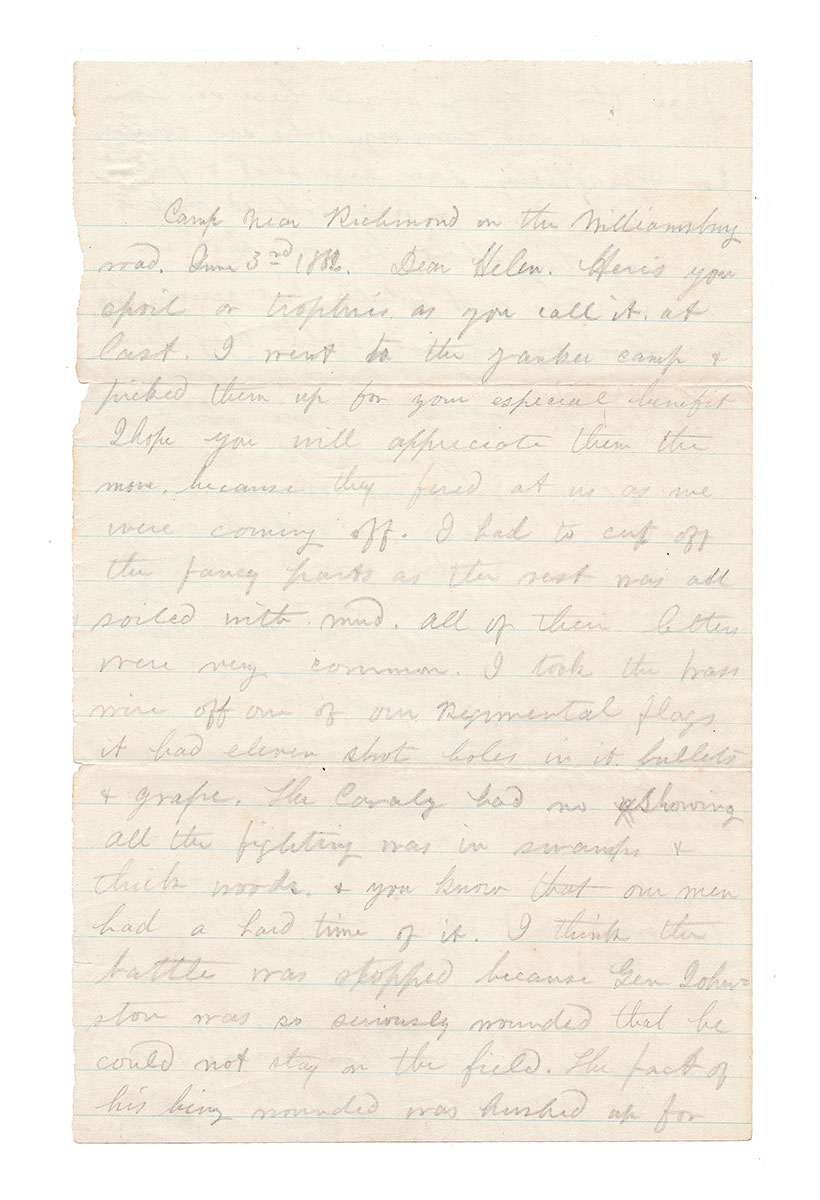
Two-page letter written in pencil on both sides of a single leaf of blue-ruled paper, headed "Camp near Richmond on the Williamsburg road. June 3rd 1862," to "Dear Helen" and signed "Wooddie" — Woodward Barnwell, writing to his sister three days after the Battle of Seven Pines (Fair Oaks), May 31–June 1, 1862.
The accompanying typed transcript identifies the writer as a sergeant of Company H, 2d South Carolina Cavalry. That regiment was not organized until August 22, 1862, when the cavalry battalion of Hampton's Legion was consolidated with the 4th South Carolina Cavalry Battalion; Company H was the former Congaree Troop of Columbia, Company D of the Legion's cavalry. At the date of this letter the writer would have been serving under the Legion designation, with the army then drawn up east of Richmond after Seven Pines.
Barnwell opens by sending Helen the "spoil or trophies" she had asked for, gathered in the abandoned Union camp — "I hope you will appreciate them the more because they fired at us as we were coming off." He cut off the "fancy parts" as the rest was soiled with mud, found the Yankees' letters "very common," and took the brass wire off one of the regimental flags, which he reports had eleven shot holes in it from bullets and grape. The cavalry, he writes, "had no showing" — all the fighting was in swamps and thick woods, and the infantry had a hard time of it.
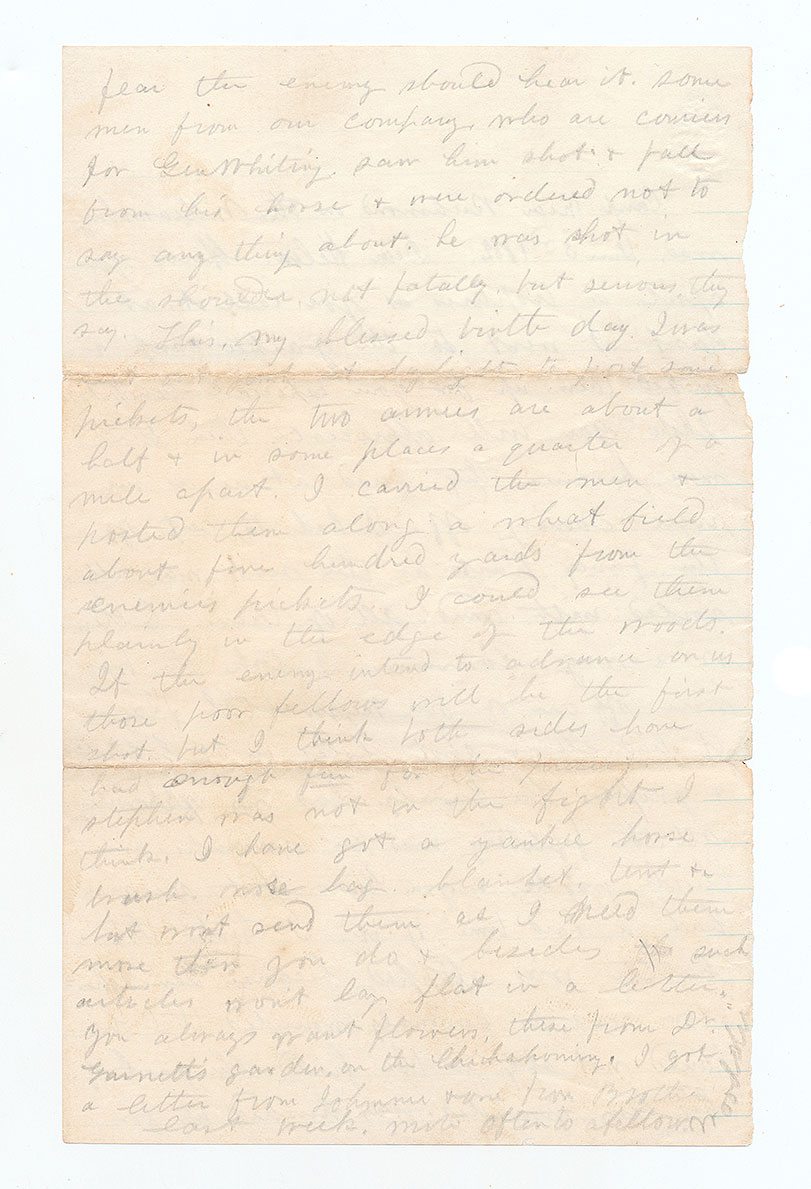
The heart of the letter is his account of Gen. Joseph E. Johnston's wounding, which he believes stopped the battle. The fact was "hushed up for fear the enemy should hear it"; men of his own company serving as couriers for Gen. Whiting saw Johnston shot and fall from his horse and were ordered to say nothing about it. "He was shot in the shoulder not fatally but serious they say." Johnston was in fact struck near Fair Oaks Station at dusk on May 31 — by a ball in the right shoulder and then by a shell fragment in the chest — while with Whiting's division, and command of the army passed to G. W. Smith and on June 1 to Robert E. Lee. The Legion's infantry fought at Seven Pines in Hampton's brigade of Whiting's division, where Hampton himself was wounded.
On his birthday, June 3, Barnwell was sent out at daylight to post pickets, the two armies lying a half mile, and in places a quarter mile, apart. He placed his men along a wheat field about five hundred yards from the Federal pickets, whom he could see plainly at the edge of the woods: "If the enemy intend to advance on us those poor fellows will be the first shot but I think both sides have had enough for the present." He has taken a Yankee horse brush, nose bag, blanket and tent, but will keep them, as he needs them more than she does "and besides such articles won't lay flat in a letter." He closes with flowers for Helen from "Dr. Garnett's garden on the Chickahominy" — Garnett's farm on the south bank of the river, scene of the fighting at Garnett's and Golding's farms three weeks later during the Seven Days — and news of letters from Johnnie and Brother. The trophies and flowers described are not present.
A vivid, candid cavalryman's view of the aftermath of Seven Pines, with first-hand camp knowledge of the concealment of Johnston's wound on the eve of Lee's assumption of command.
CONDITION
Approx. 5 x 8 in. Pencil, legible throughout, fainter in places. Two horizontal folds with partial separations at the folds, edge chipping along one side, even toning and light soiling. Accompanied by a modern typed transcript.
TRANSCRIPTION
Camp near Richmond on the Williamsburg road. June 3rd 1862. Dear Helen. Here is your spoil or trophies as you call it, at last. I went to the yankee camp & picked them up for your especial benefit I hope you will appreciate them the more because they fired at us as we were coming off. I had to cut off the fancy parts as the rest was all soiled with mud. all of their letters were very common. I took the brass wire off one of our Regimental flags it had eleven shot holes in it bullets & grape. The Cavalry had no showing all the fighting was in swamps & thick woods, & you know that our men had a hard time of it. I think the battle was stopped because Gen Johnston was so seriously wounded that he could not stay on the field. The fact of his being wounded was hushed up for fear the enemy should hear it. Some men from our Company who are couriers for Gen Whiting saw him shot & fall from his horse & were ordered not to say any thing about [it]. He was shot in the shoulder not fatally but serious they say. This, my blessed birth day I was [sent out at daylight] to post some pickets, the two armies are about a half & in some places a quarter of a mile apart. I carried the men & posted them along a wheat field about five hundred yards from the enemies pickets. I could see them plainly in the edge of the woods. If the enemy intend to advance on us those poor fellows will be the first shot but I think both sides have had enough for the present. Stephen was not in the fight I think. I have got a yankee horse brush, nose bag, blanket, tent &c but wont send them as I need them more than you do & besides such articles wont lay flat in a letter. You always want flowers, these from Dr. Garnett's garden, on the Chickahominy. I got a letter from Johnnie & one from Brother last week. Write often to a fellow Wooddie
[ss][ph:L]
~~~~~~~~~~~~~~~~~~~~~~~~~~~~~~~~~~~
THIS ITEM, AS WITH ALL OTHER ITEMS AVAILABLE ON OUR WEB SITE,
MAY BE PURCHASED THROUGH OUR LAYAWAY PROGRAM.
CLICK HERE FOR OUR POLICIES AND TERMS.
THANK YOU!
Inquire About "GEN JOHNSTON WAS SO SERIOUSLY WOUNDED THAT HE COULD NOT STAY ON THE FIELD" — SOUTH CAROLINA CAVALRYMAN'S SEVEN PINES LETTER, JUNE 3, 1862
Most Popular
Historical Firearms Stolen From The National Civil War Museum In Harrisburg, Pa »
Theft From Gravesite Of Gen. John Reynolds »
Selection Of Unframed Prints By Don Troiani »
Fine Condition Brass Infantry Bugle Insignia »
Rare Identified 65Th Ny Sergeant’s Jacket, With Manscript Material: 1St U.s. Chasseurs »
featured item
AN ASSEMBLAGE BOTH WAR AND POST WAR OF A GETTYSBURG "WOLVERINE” – WILLIAM H. DUNN, 5TH AND 10TH MICHIGAN CAVALRY
William H. Dunn of Ganges, Michigan served in both the 5th and 10th Michigan Cavalry during the Civil War. He enlisted on Aug. 14, 1862 in Co. "I" 5th Michigan Cavalry. At Gettysburg Dunn, a trooper in the famous charge lead by Custer, gallantly… (1268-779). Learn More »
site search