


site search
online catalog
CRIMEAN WAR PERIOD LONDON MADE COLT POCKET REVOLVER AND INTERESTING HOLSTER
Hover to zoom
$795.00 SOLD
Quantity Available: None
Item Code: 2026-2067
For the best "deep dive" into the subject we defer to the research of Mr. Tim Prince of College Hill Arsenal. "The Colt Model 1849 Pocket Revolver was the most successful percussion handgun ever produced by Colt, with more than 325,000 being manufactured in the United States between 1850 and 1873, and another 11,000 or so being produced at Colt’s short-lived London manufactory. The 1849 Pocket was an improved version of the Model 1848 Pocket Revolver, better known to collectors as the “Baby Dragoon”, which had first been introduced in 1847 and remained in production through 1850, when the Model 1849 Pocket Revolver superseded it. The “Baby Dragoon” had found a ready market among those who were taking part in the rapid westward expansion of the United States and were prized possessions in the California gold fields of the 1849 Gold Rush. The relatively short barrel (typically 3” to 6”), the compact five-shot cylinder (later production guns offered a six-shot cylinder) and the small .31 caliber chambering all combined to make a relatively light weight (around 22 ounces or 1 pound 6 ounces with a 5” barrel) and compact revolver that could be carried covertly in a jacket or trouser pocket.
The “Baby” did have some drawbacks, the most obvious being the lack of an attached loading lever on the majority of the production. The other issue was the square backed trigger guard, which could be caught on the edge of a pocket when the gun was pulled from hiding. The improved version, the Model 1849 Pocket included a loading lever on all but the shortest barreled versions and a rounded trigger guard. Other changes from the early production “Baby Dragoons” that were standard on the 1849 had appeared as improvements on later Model 1848s and included an improved action with a roller on the bottom of the hammer, grease grooves on the cylinder arbor pin, and rectangular cylinder stop slots with a rounded concave profile along their leading edge. This improvement, which had been patented by Colt in 1850, was incorporated in all of their future percussion revolver designs and is still a feature found on nearly every revolver in production today.
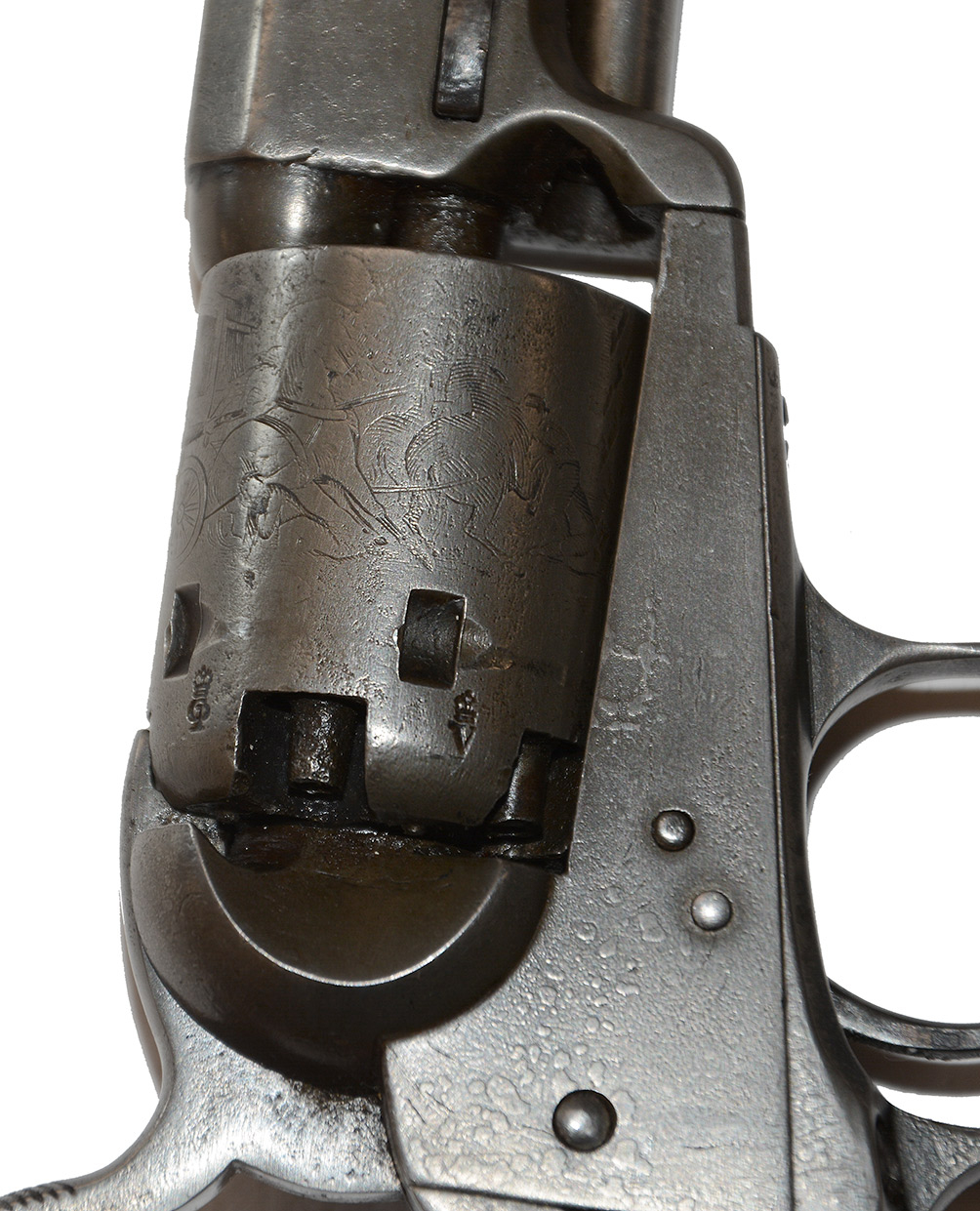
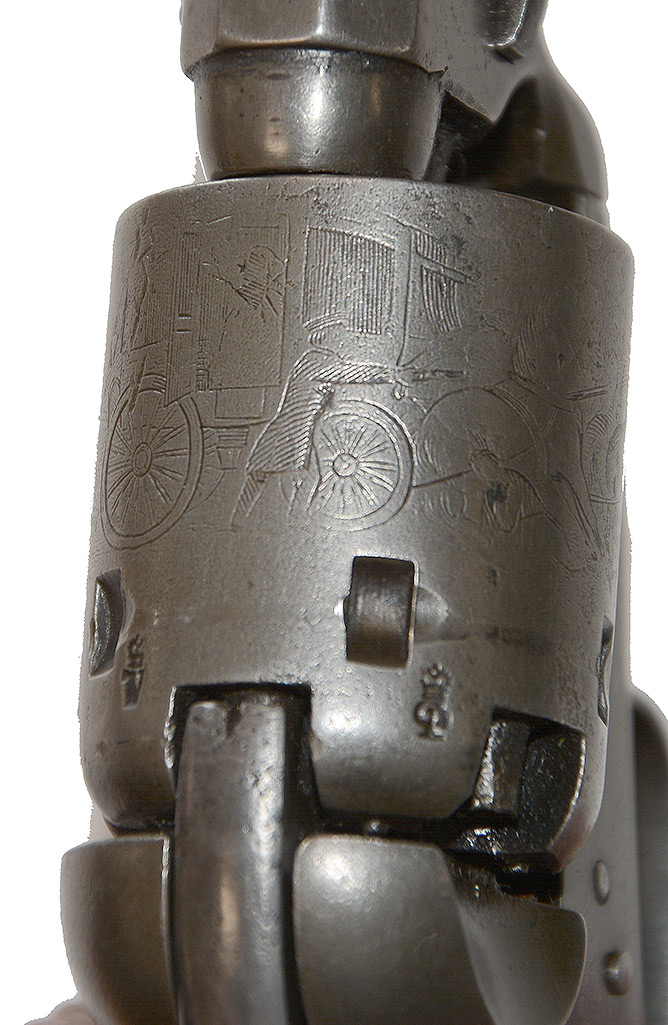
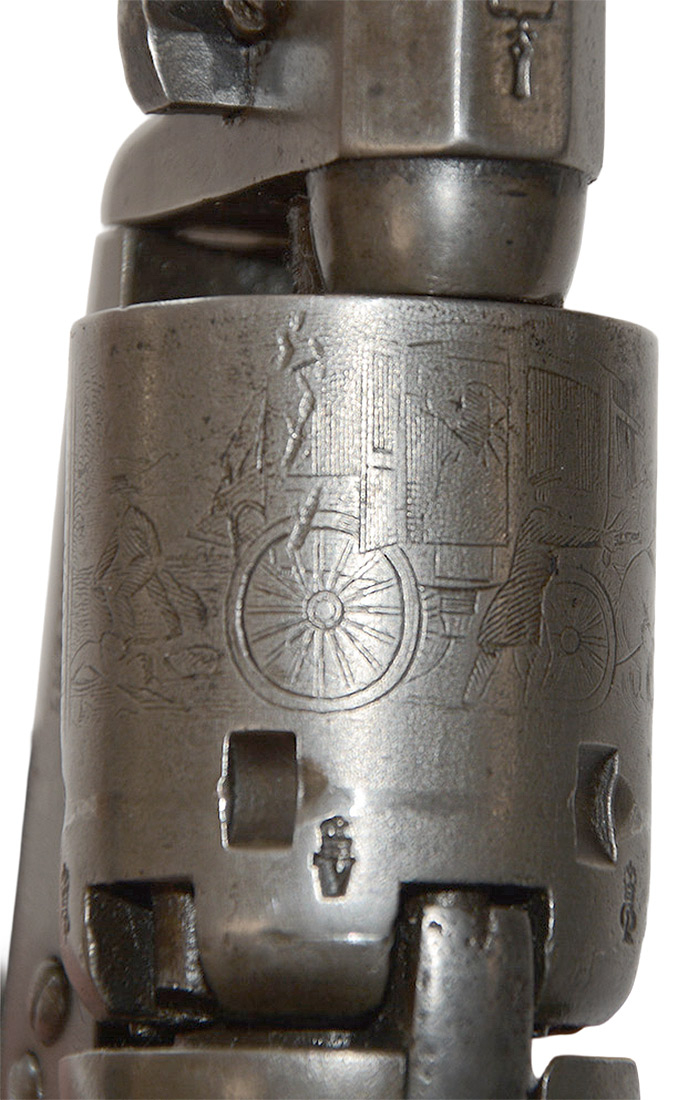
The 1849 Pocket also incorporated the roll engraved “Stagecoach Hold Up” cylinder scene that had been introduced during the latter part of Baby Dragoon production. The Colt Pocket went into production in 1850, concurrently with the Baby Dragoon, and both models continued in production for some months utilizing the same serial number range. This means that early 1850 revolver production (which started around serial number 12,000) contained a mixture of “Baby” and “Pocket” revolver numbers overlapping within the same series, with the “Pocket” finally becoming the only handgun in that serial number range towards the end of 1850 (somewhere in serial number range of 14,000-15,000).
The Colt Model 1849 Pocket was produced in more variations than any other Colt revolver and it is generally estimated that a collection of about two hundred Model 1849s would be necessary to cover all of the primary variants. Due to the wide variety of features available, a “standard” Model 1849 is hard to define, but in general a typical Colt Pocket Revolver was a 5 or 6 shot .31 caliber single action percussion revolver with an octagonal barrel that was typically 3”, 4”, 5” or 6” in length, usually with an attached loading lever. During the latter part of production, particularly during the production of the “one-line New York address” guns, 4” barrels appear to have been standard with 5” and 6” guns less common and 3” guns no longer offered.
The backstrap, grip strap and trigger guard were usually of silver-plated brass, although this went away towards the end of production. The revolver was typically blued with a color case hardened frame, hammer and loading lever. Standard grips were varnished one-piece walnut. The revolvers were, however, available with a dizzying array of finishes, barrel lengths, grip options, and engraving. A dovetailed blade front sight was even a factory available option.
The London produced guns that were manufactured circa 1853 to 1856. Slightly less than 11,000 guns were “produced” at the London manufactory, with at least one reliable source citing a total of 10,755 guns being produced. The earliest “London” Colt Pockets were produced in the Hartford factory, however very quickly the London factory started to assemble guns from American made parts. Research indicates that the first London Colt Pockets that were completely produced in London, from parts made in the London factory, were not available until February of 1854.
During the ramp up to full English production, some of the guns were produced with a mixture of English and American made parts, making for some interesting variants in the lower serial number range of London Colt Pockets. These guns typically appear below serial number 250, although some American made parts do appear in guns as high as serial number 1,000. Interestingly, towards the end of London production, some American made parts do appear in the manufacture of guns, typically in guns above the 8,900 serial number range through the end of production.
The London produced guns did have some differences from the Hartford produced guns. Most of the London guns were produced with iron trigger guards and backstraps rather than brass, and with screws that had more rounded and domed heads than their American counterparts. While the American pistols were available with a large number of finish and grip options, their London counterparts were almost universally produced with blued barrels and color case hardened frames and with varnished walnut grips. Many of the iron backstraps and trigger guards were silver plated, however the silver did not adhere well to the metal, so the silver is rarely encountered on pistols today. In some cases, these iron parts were simply blued.
Most researchers feel that the market pressures in Great Britain forced Colt to produce his London made guns to a higher level of fit and finish than he did in America. This was necessary to compete with the large English handgun makers like Adams, Tranter and Webley, who typically produced revolvers of exceptional quality. The quality of the blued finish on the London guns was clearly superior to that on the American made guns, with the case hardening having a much bluer appearance than the American made guns and with less vivid coloration in the mottling."
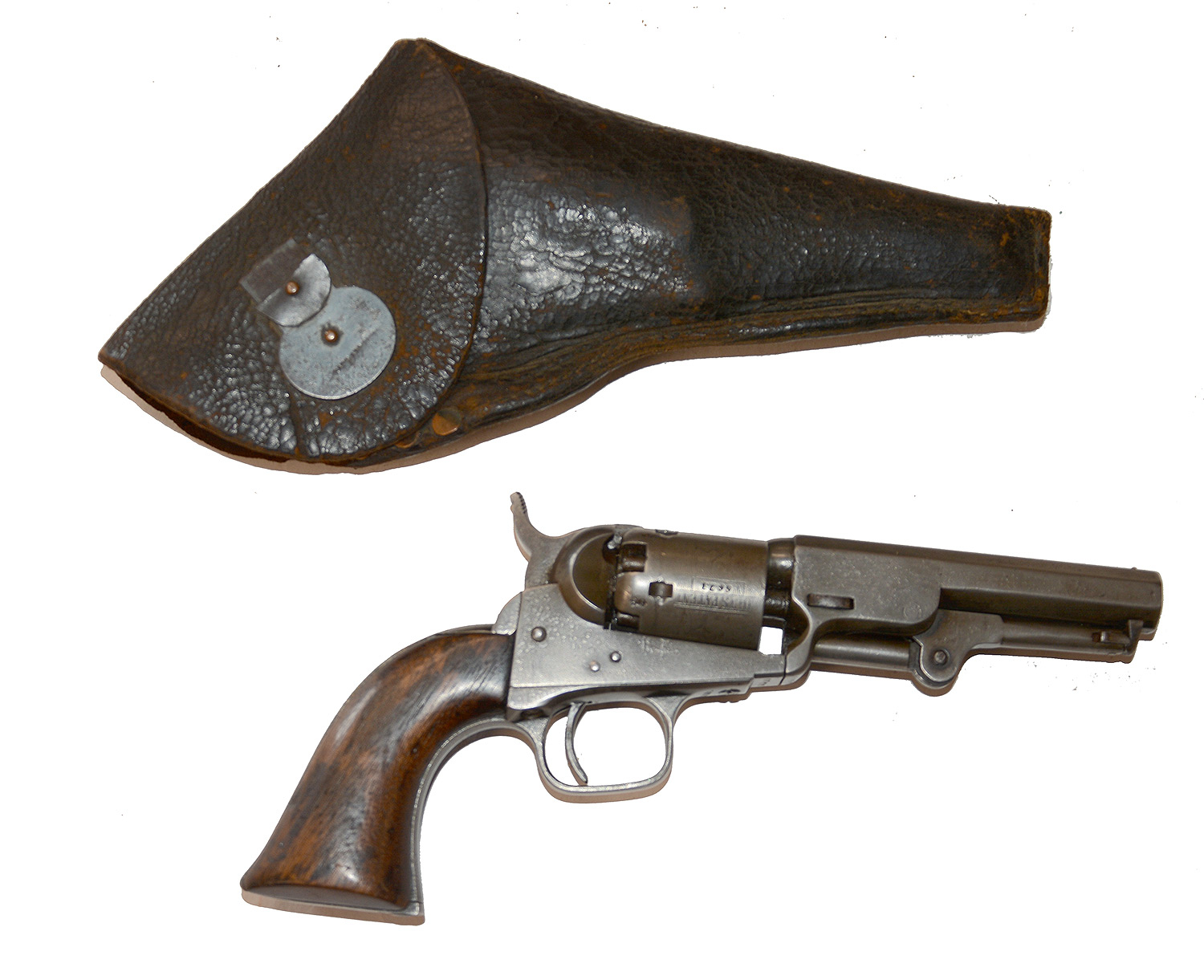
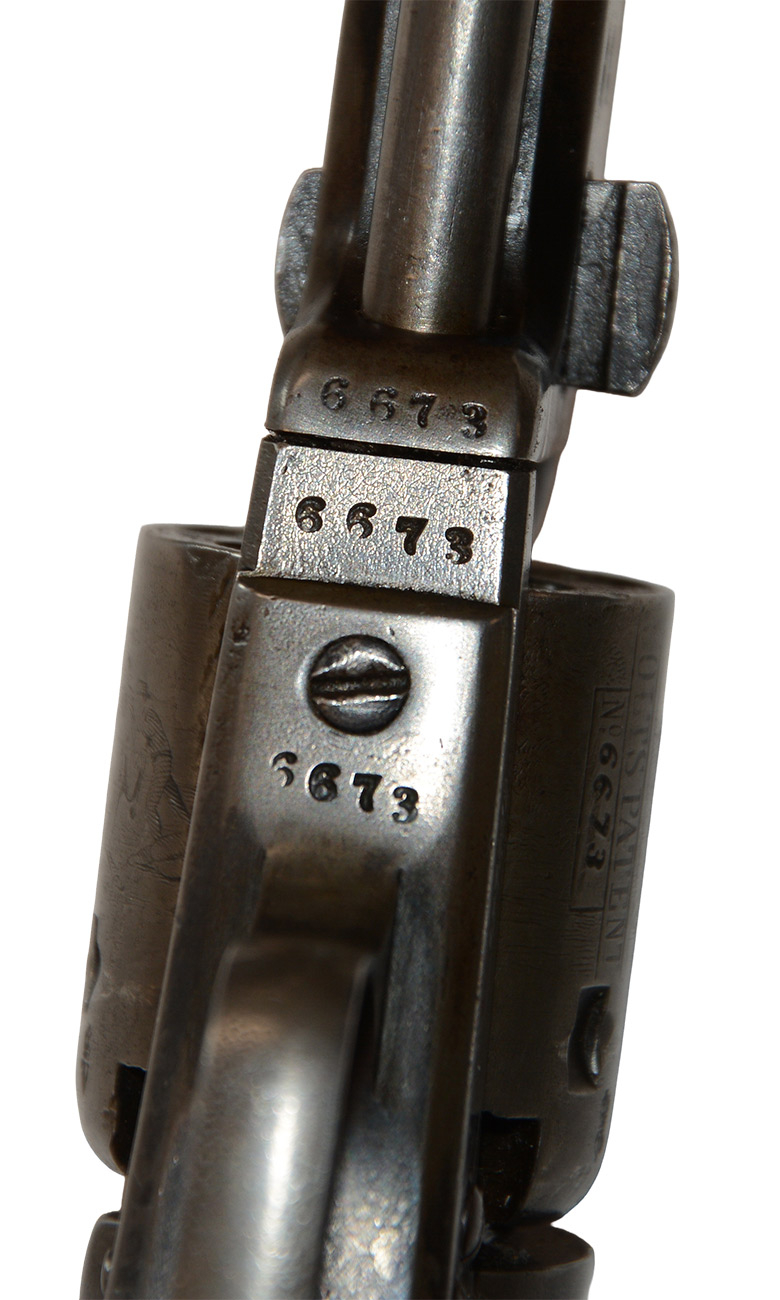
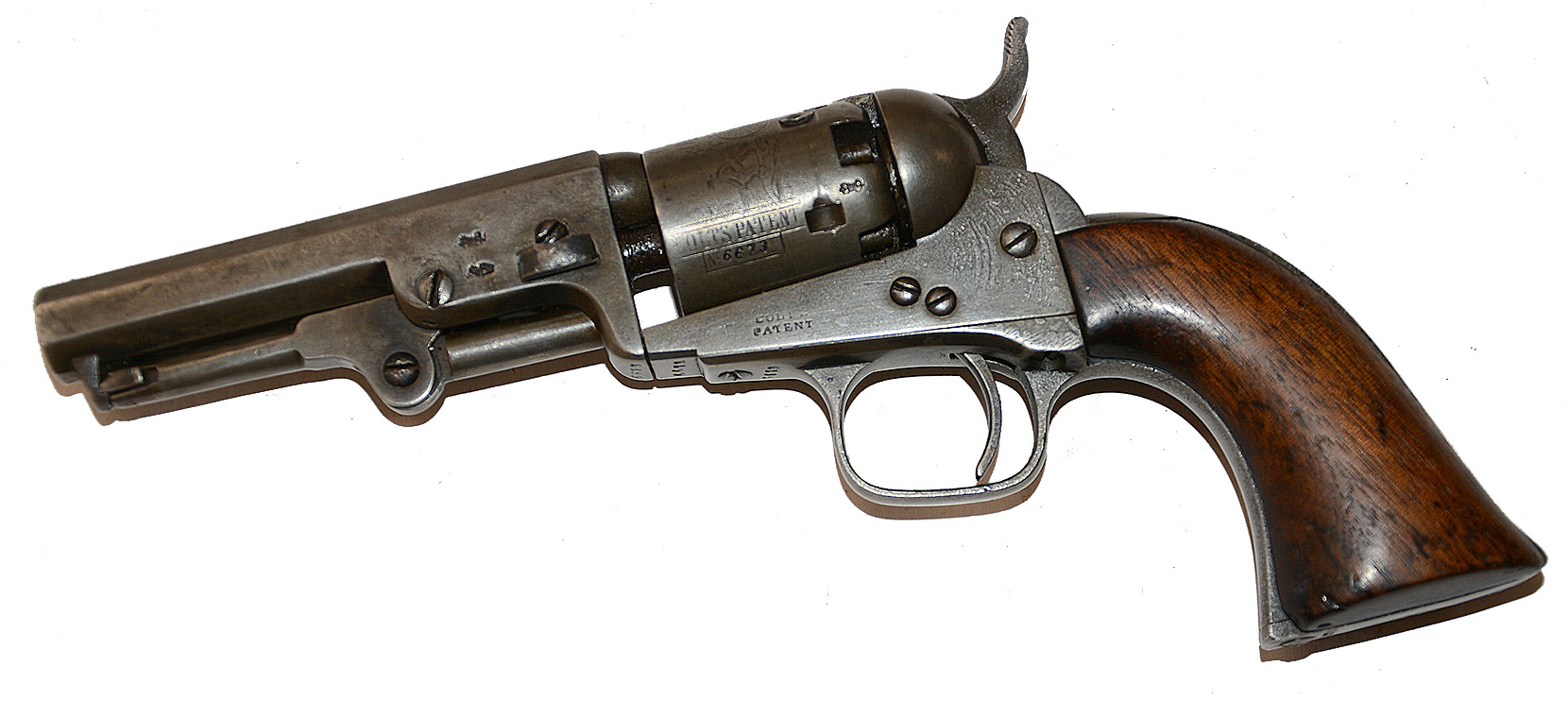
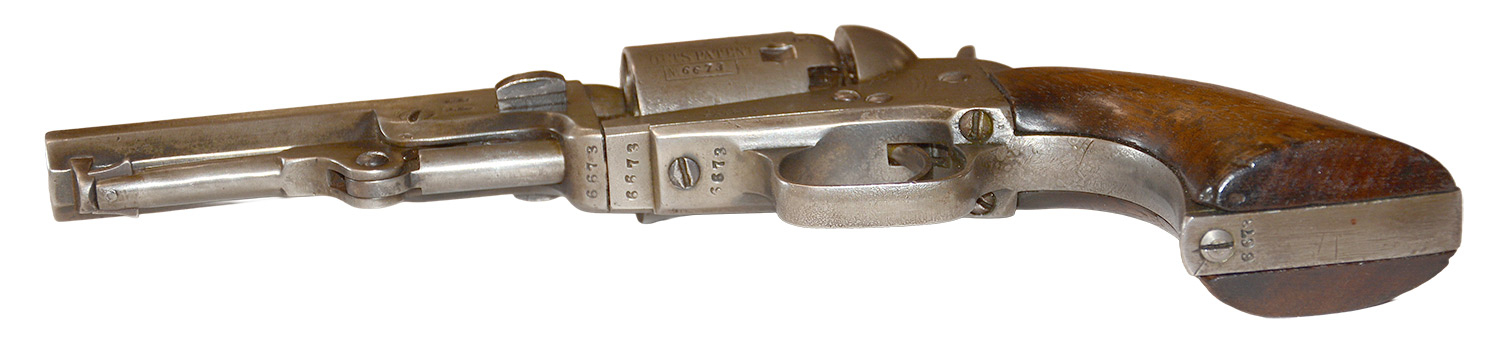
This is a seldom seen English made, iron frame, percussion cap and ball revolver. The sidearm, is in good original condition throughout. The serial number "6673" indicates a production time of the 3rd quarter of 1854. This date corresponds to the opening of hostilities between Britain and Russia in the Crimea and it is possible that a British officer carried it as his personal firearm.
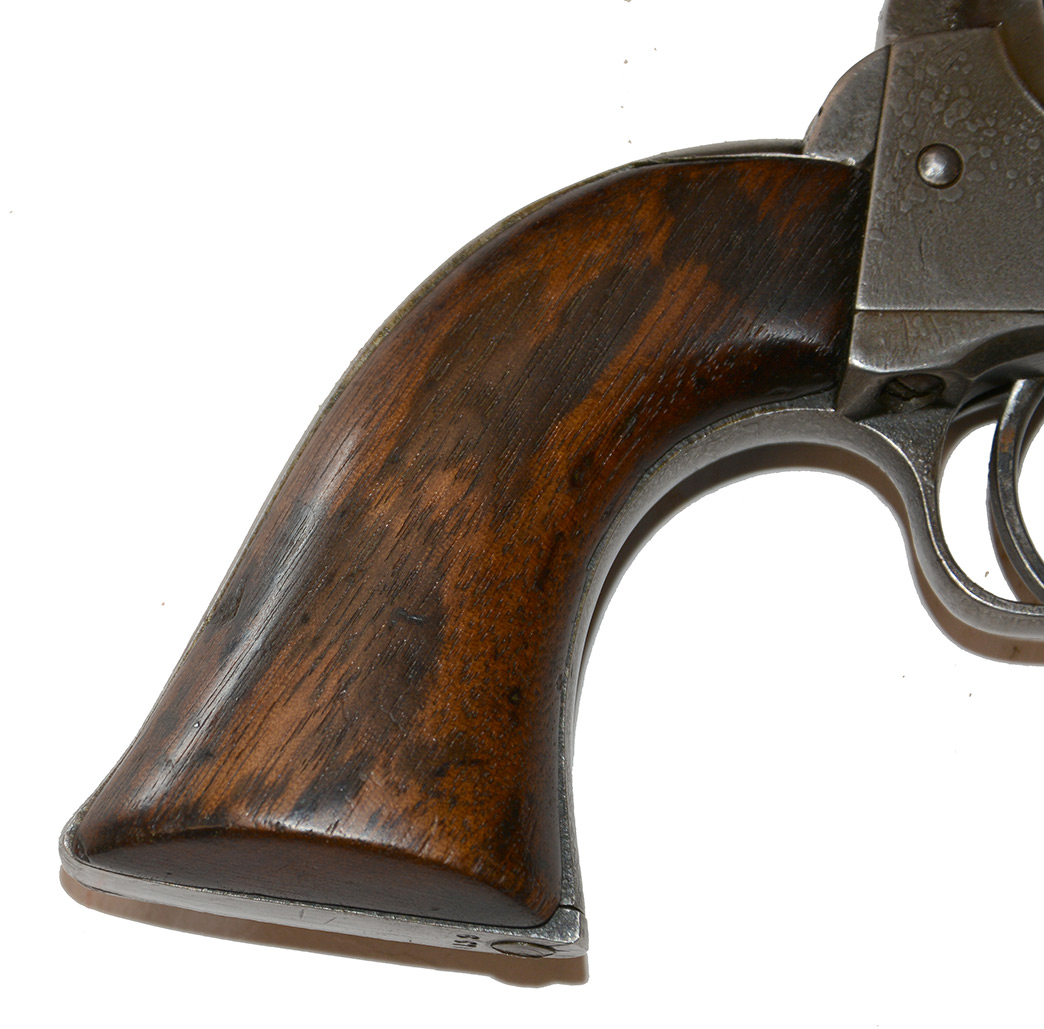
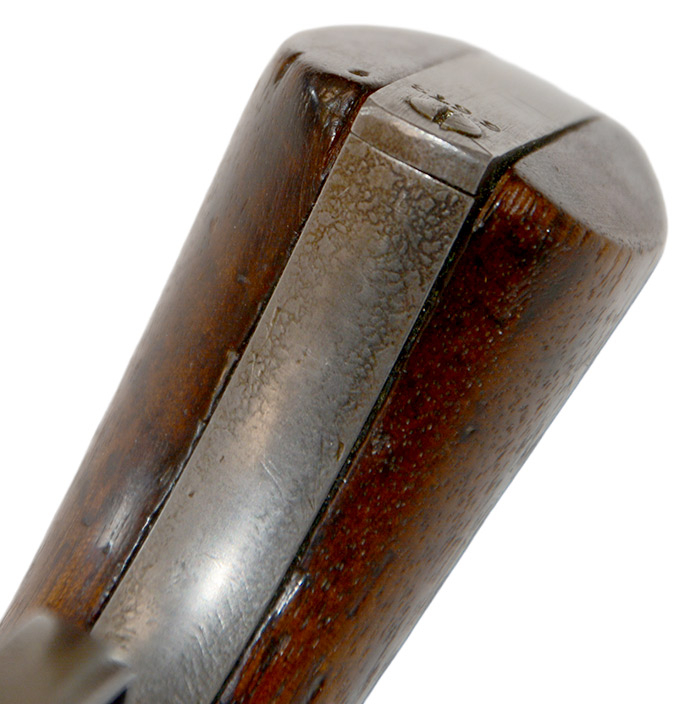
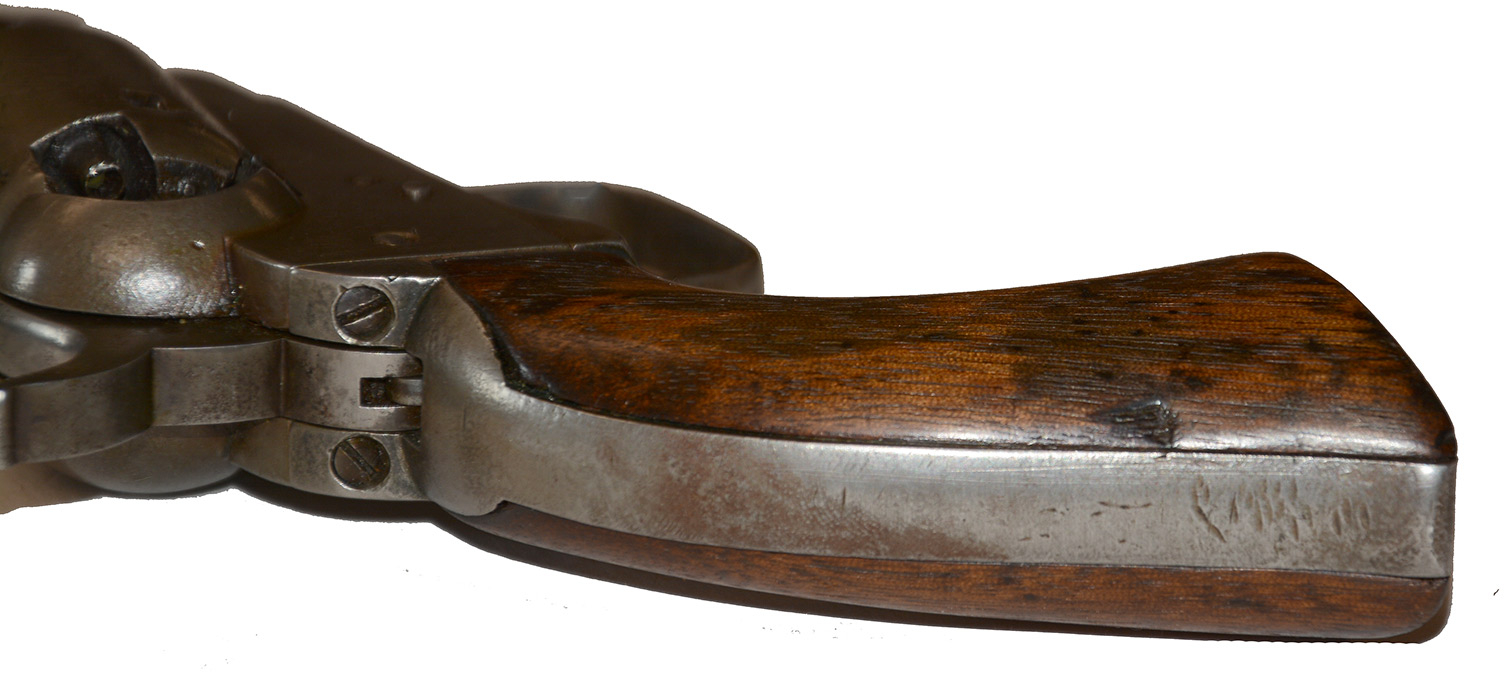
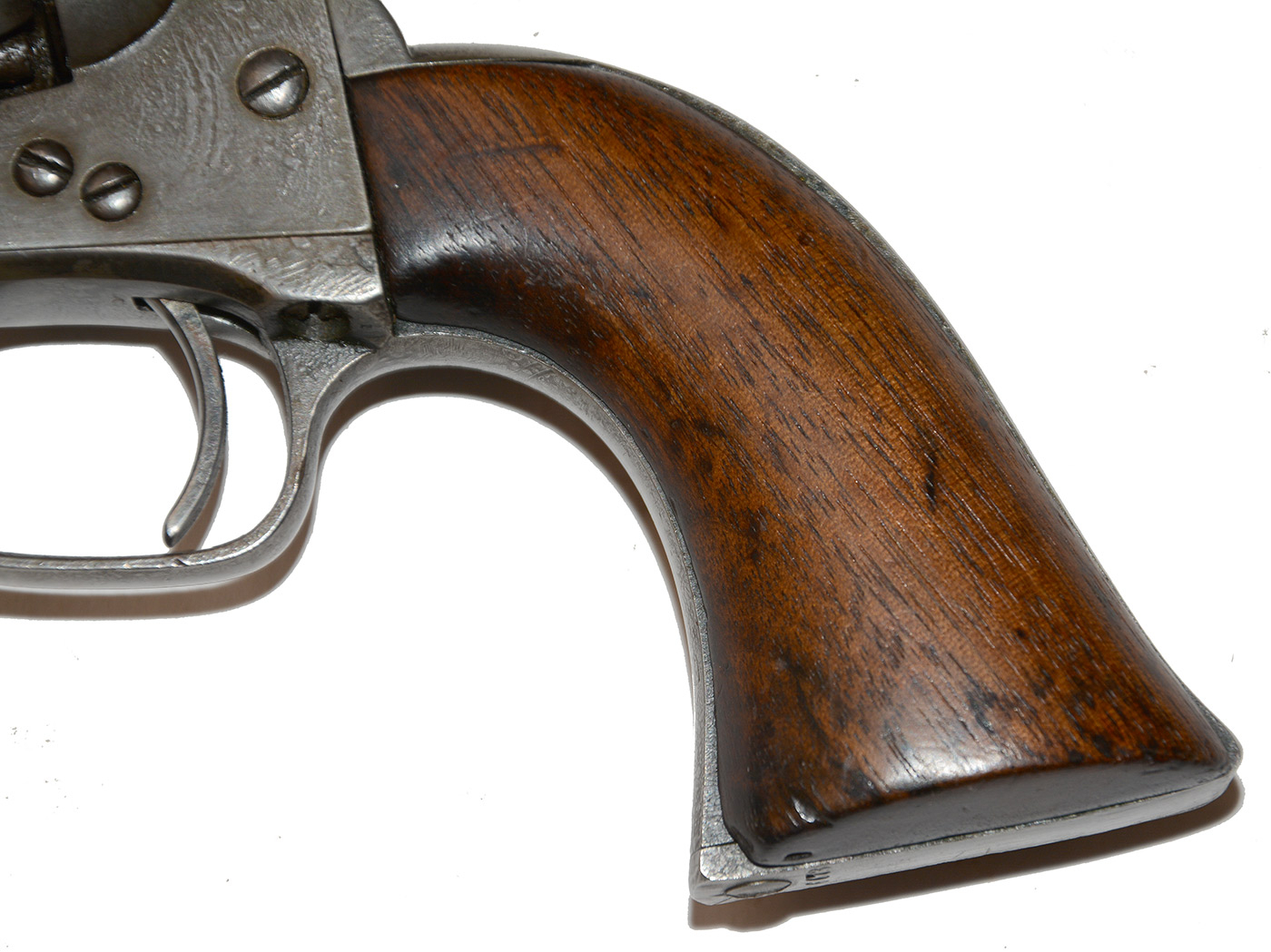
The gun's metal has no original colors visible and has been moderately cleaned a long time back; it is now a gray gun metal color overall. The revolver is mechanically tight with a fine crisp action. The very good original one-piece walnut grip with some original varnish shows moderate scuffing and some shrinkage. The trigger guard is iron as is the backstrap.
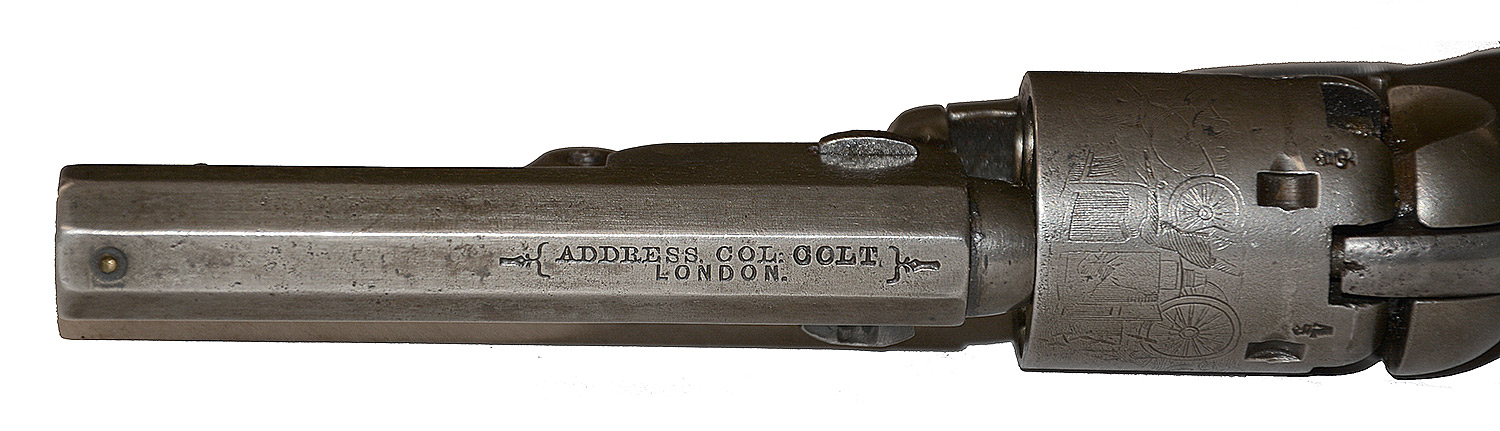
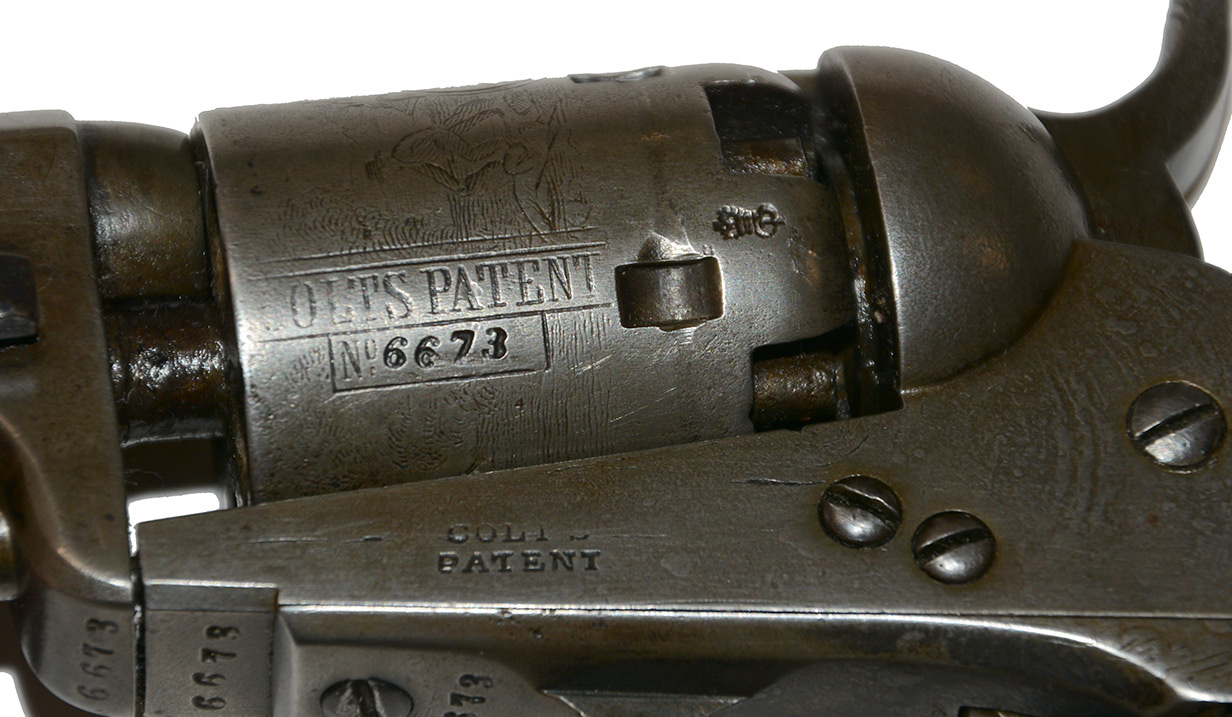
This Colt handgun features a 4-inch-long octagonal barrel of .31 caliber. There are 2 London proof marks on the left side at the wedge. A thin two-line address reads: "ADDRESS. COL. COLT" over "LONDON" is on top flat of the barrel. The five-shot cylinder retains all the rolled "stagecoach holdup scene", Colt's Patent stamp and "6673". All the nipples are intact and unbroken.
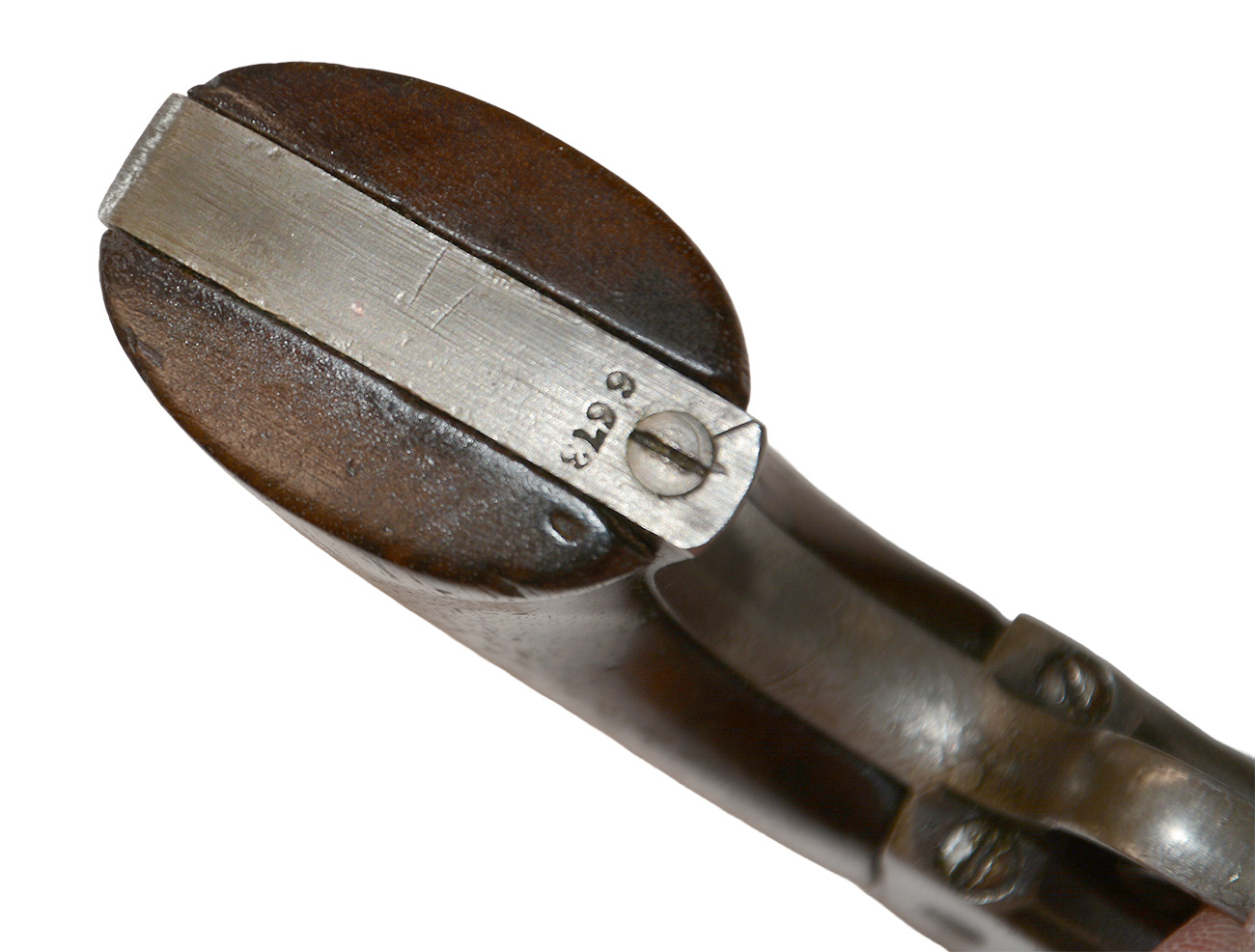
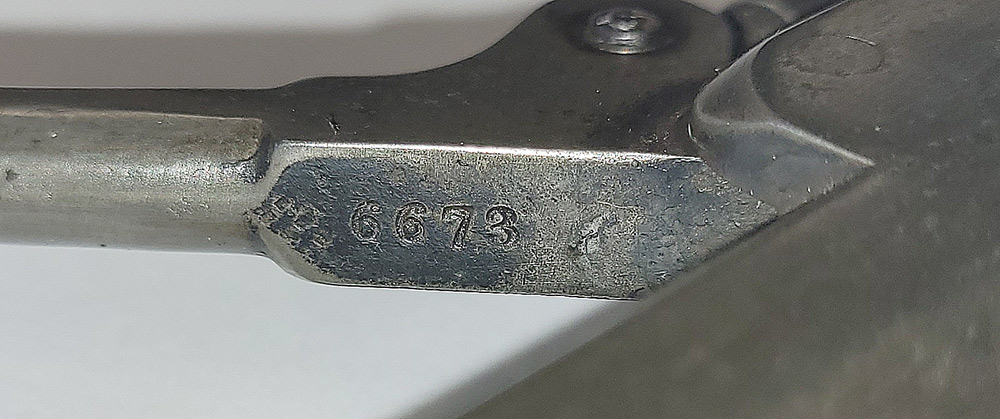
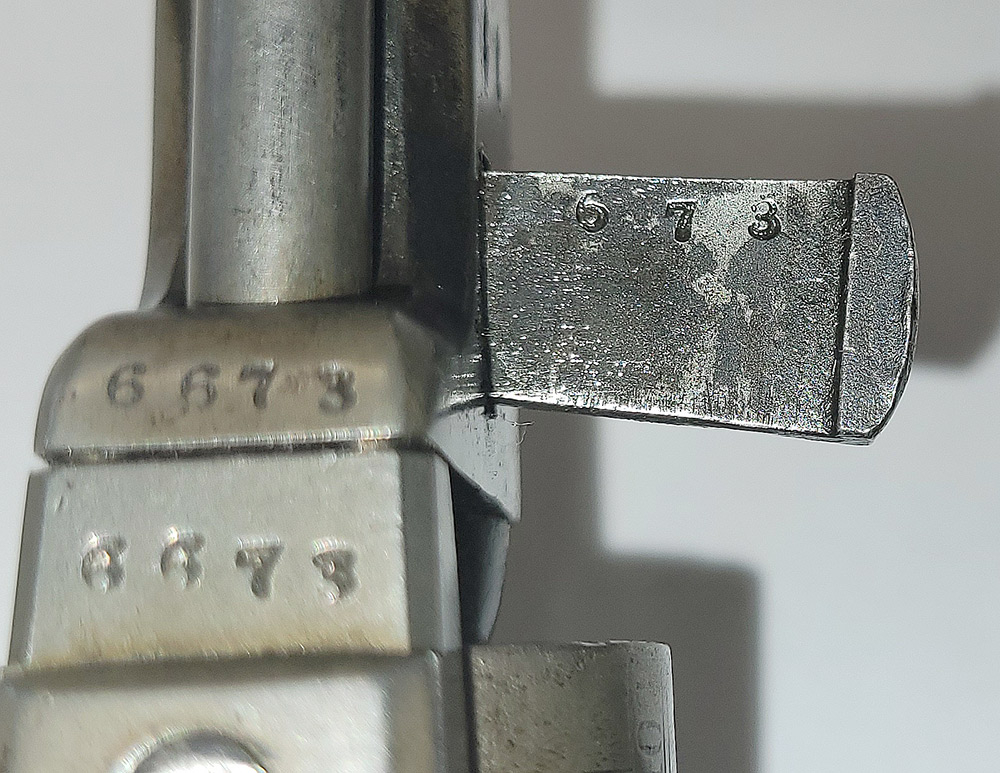
This revolver exhibits matching serial numbers throughout including the loading lever, barrel, wedge, frame, trigger guard, and back strap assembly. "COLTS" over "PATENT" is visible on the left side of the frame. All screws are original, none is distorted.
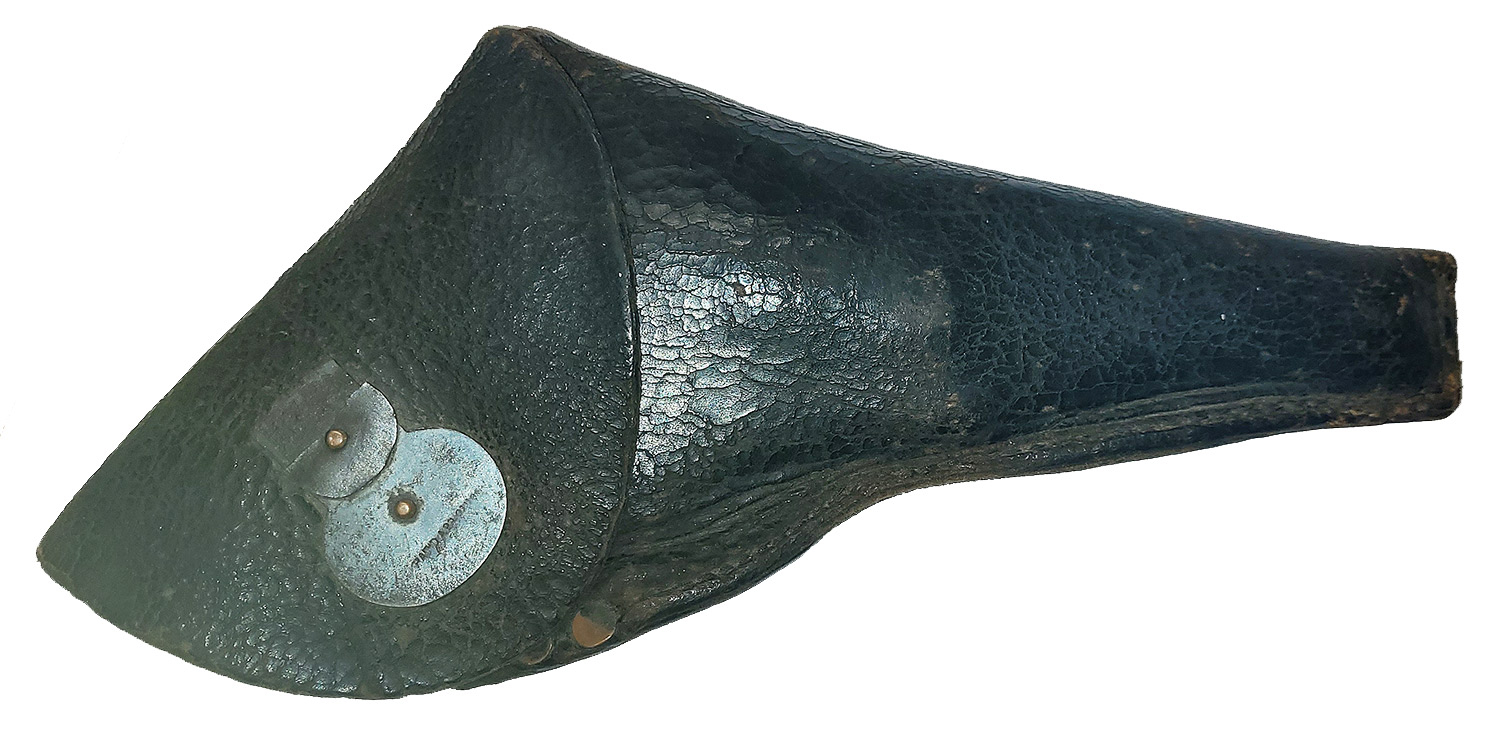
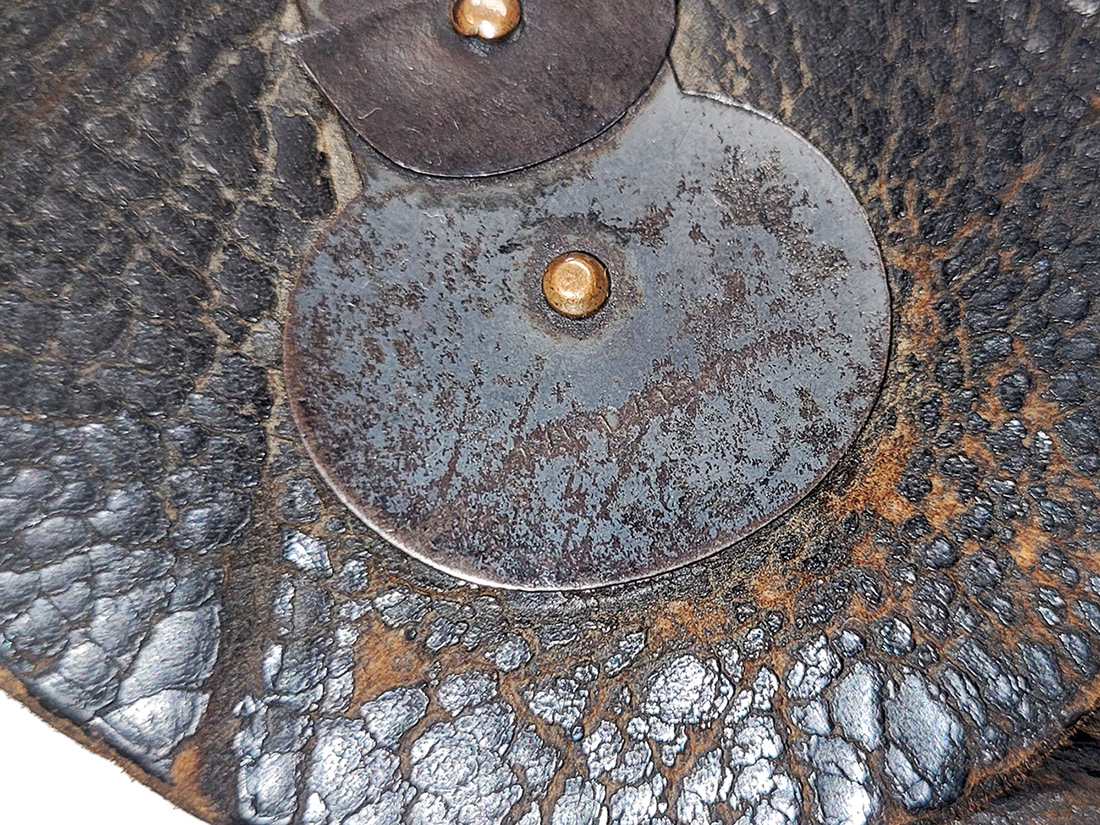
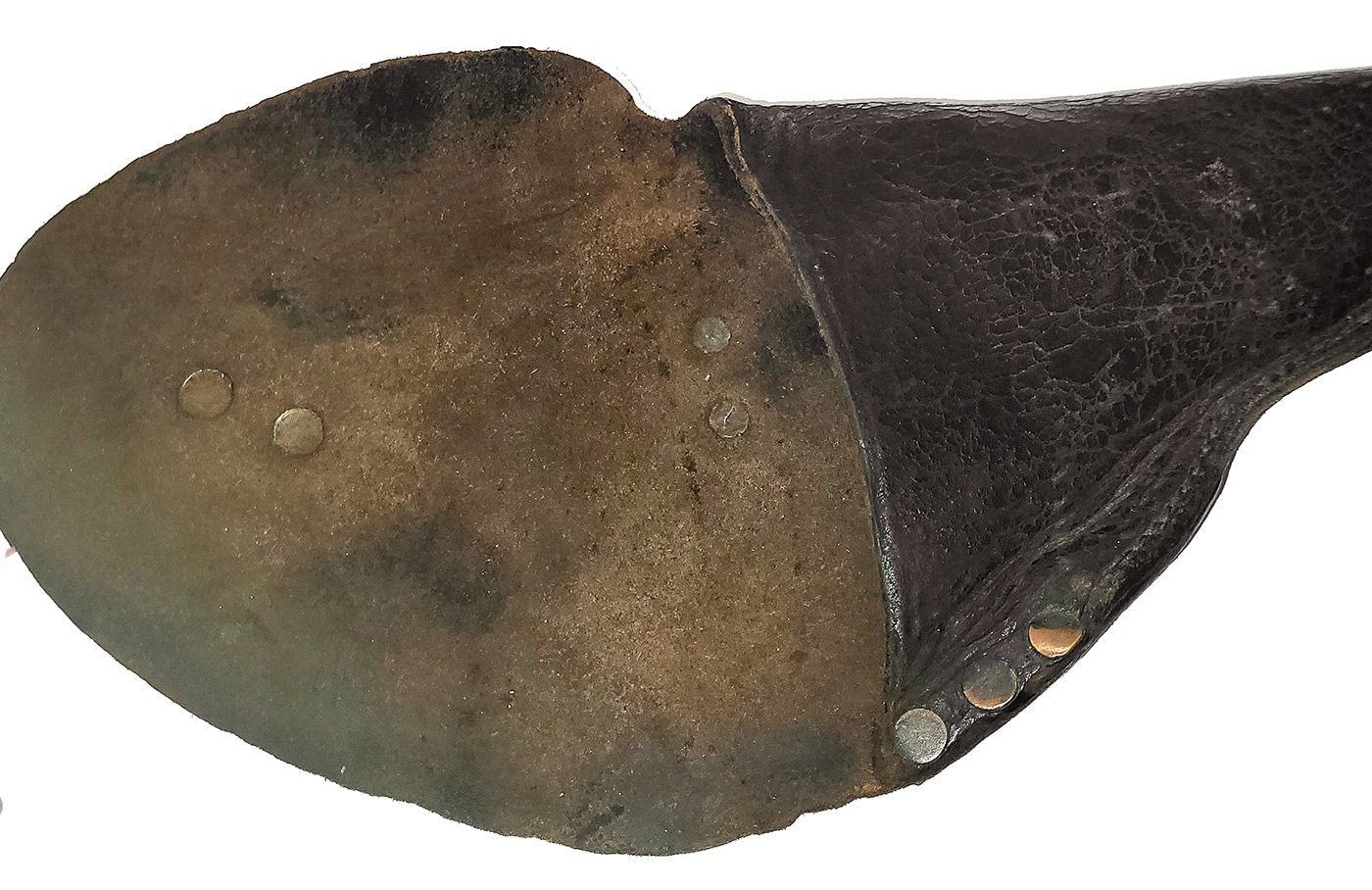
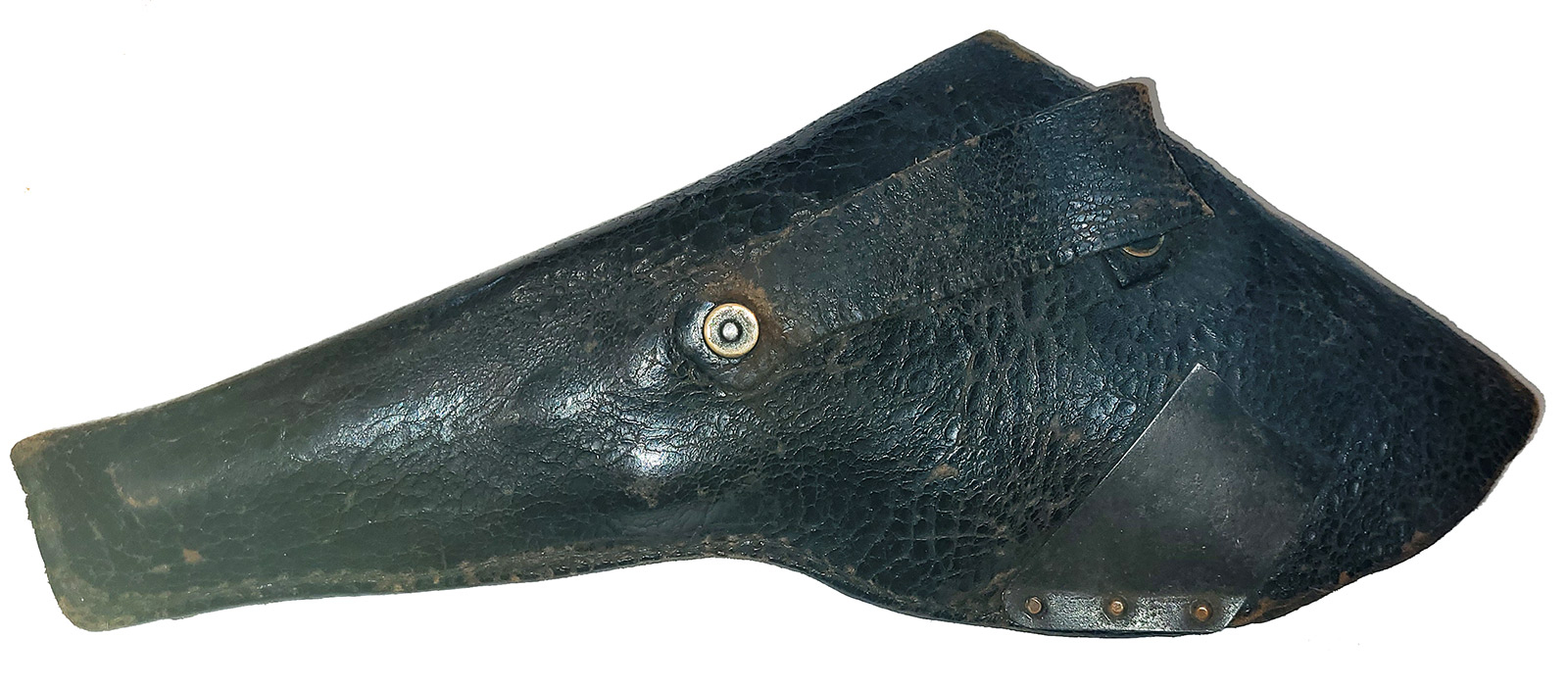
Accompanying this London Colt pocket revolver is its dark brown harness leather holster. It is both riveted and hand sewn. It has a single riveted belt loop in the back. Partially intact is a tin strap-like mechanism intended to hold the flap firmly in place and therefore the pistol securely inside. Stamped on the bottom most portion is "PAT'D APP... followed by I cannot say?
The condition is good and this pistol has been with it a very long time indeed making its impression. These London pocket Colt's do not come along very often. [pe][ph:L]
~~~~~~~~~~~~~~~~~~~~~~~~~~~~~~~~~~~
THIS ITEM, AS WITH ALL OTHER ITEMS AVAILABLE ON OUR WEB SITE,
MAY BE PURCHASED THROUGH OUR LAYAWAY PROGRAM.
CLICK HERE FOR OUR POLICIES AND TERMS.
THANK YOU!
Inquire About CRIMEAN WAR PERIOD LONDON MADE COLT POCKET REVOLVER AND INTERESTING HOLSTER
Most Popular
Historical Firearms Stolen From The National Civil War Museum In Harrisburg, Pa »
Theft From Gravesite Of Gen. John Reynolds »
Selection Of Unframed Prints By Don Troiani »
Fine Condition Brass Infantry Bugle Insignia »
Rare Identified 65Th Ny Sergeant’s Jacket, With Manscript Material: 1St U.s. Chasseurs »
featured item
BEAUTIFULLY CARVED WOUNDED-IN-ACTION VETERAN’S CANE: 12th CT AND 1st ME BATTERY- EX-STONE HOUSE MUSEUM
One of the best G.A.R. Civil War veterans’ canes, combining history, eye-appeal, craftsmanship and art, made for and carried by a veteran with service in the 12th Connecticut Infantry and extended detached duty with the 1st Maine Battery, during… (2026-1457). Learn More »
site search