

site search
online catalog
A HIGHLY SOUGHT AFTER JS AND ANCHOR CONFEDERATE ENFIELD WITH MATCHING NUMBERED RAMROD

Hover to zoom


$6,750.00 ON HOLD
Quantity Available: 1
Item Code: 2026-728
The British made Pattern 1853 “Enfield” rifle-musket was the second most used infantry long arm of the American Civil War. It was the first “small bore” rifled long arm to see general issue to all British military personnel, effectively making every soldier a “rifleman” and the smoothbore musket obsolete. The .577 caliber rifled bore was a significant ballistic development. The Pattern 1853 would significantly influence the design of the new American Model 1855 Rifle-Musket and all arms production going forward. Approaching a million Enfields including rifles, rifle-muskets, musketoons and carbines saw use in the American Civil War. Today, it is difficult to determine if a specific Enfield was exported from Britain to the North or South. Recently, the Horse Soldier acquired a collection of imported British Enfield rifle-muskets that were destined for the Southern Confederacy. This "study collection" offers weapons by various contractors with varying dates of manufacture all having distinctive markings that make them exclusively Confederate imports.
The highly respected and prolific antique arms dealer and author, Mr. Tim Prince must be quoted here at length; he, above all others, is the "go to guy" on Confederate Enfields; this compiler falls far short of his knowledge. Prince says: "The majority of these arms were purchased from the firms of S. Isaac, Campbell & Company (who relied on John Edward Barnett & Sons to deliver many of those arms) or Sinclair, Hamilton & Company, who often routed their sales through S. Isaac, Campbell & Co as well. Additional Pattern 1853s were purchased from William Grazebrook of Liverpool, who made his first sales to Confederate purchasing agent Caleb Huse within 30 days of the opening of the war. Sinclair, Hamilton & Company entered into several contracts with the Confederacy to deliver Pattern 1853 Enfield Rifle Muskets, with the typical contract terms requiring 30,000 stands of arms to be delivered over a six-month period. During the course of the war, Sinclair, Hamilton & Company appears to have received at least five of these contracts for Pattern 1853 Enfield Rifle Muskets from the Confederate central government.
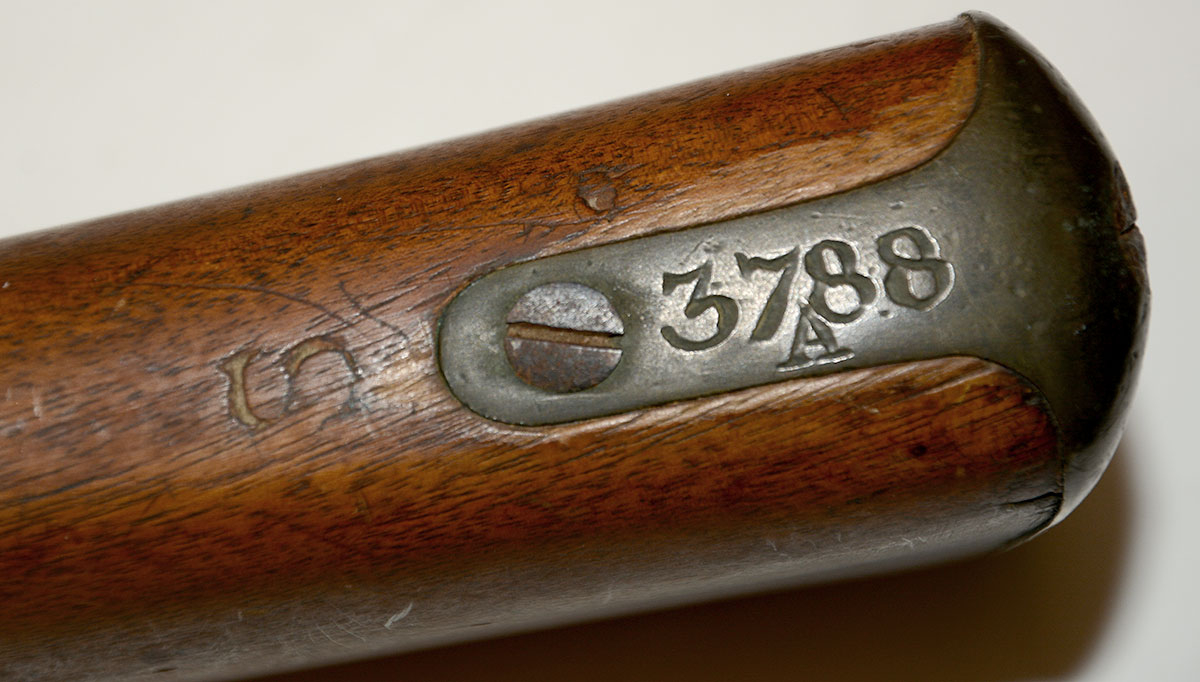
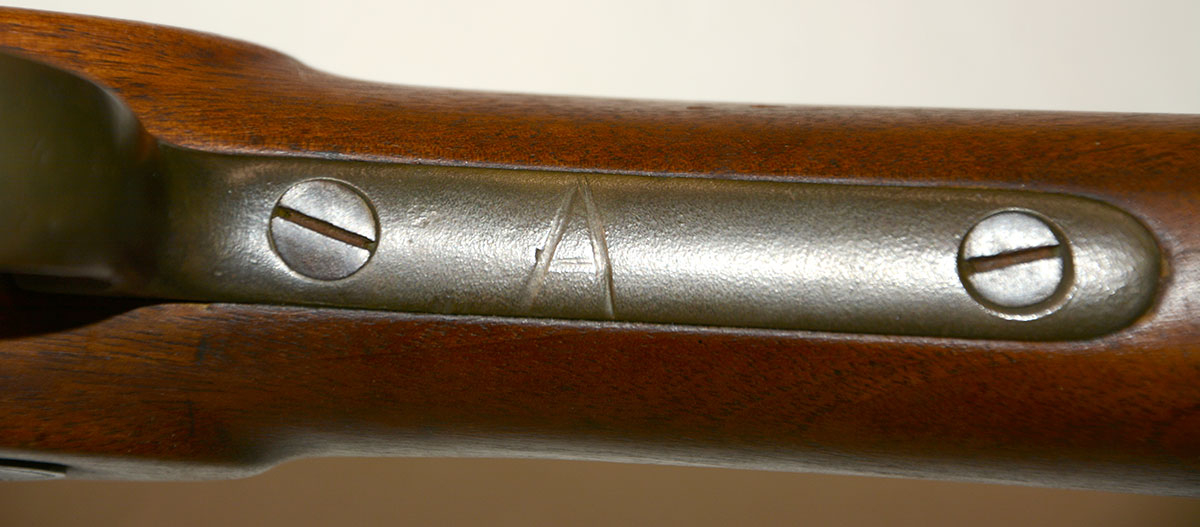
The second of these contracts for 30,000 Pattern 1853 “Long Enfields” is the one represented by the guns with the JS ANCHOR viewer’s mark, along with the engraved butt plate tang inventory numbers. The initials “JS” stand for John Southgate, one of the primary English “viewers” (inspectors) hired by the Confederacy to inspect the arms purchased on contract from the English gunmakers. These inventory numbers ran from 1-10,000 in three series (to date no gun with a 10,000 number is known, although theoretically they existed). The first series had no suffix after the number, while the second series of 10,000 had an “A” suffix under the inventory number and the third series of 10,000 had a “B” suffix. These numbered guns represent the October 1861 contract with Sinclair, Hamilton & Company that is referred to in Confederate documents as the “Second Contract”. This contract required the 30,000 Enfields to be delivered between October 1861 and April 1862. At least two identified B-suffix guns with three-digit inventory numbers have been determined to have been issued in Corinth, MS immediately prior to the battle of Shiloh on April 6-7 of 1862. Thus, is it clear that the contract timeline for production and delivery was closely followed, and the Confederacy did a good job delivering arms through the Union blockade during the first year of the war.
Sinclair, Hamilton & Company acquired their arms through a series of sources referred to as the “Five Furnishers” in period documents. These were well-established gun making firms that were able to fill the large Sinclair, Hamilton & Company orders in a reasonable period of time or at least arrange with additional contractors to make the deliveries needed. The “five furnishers” were the two multigenerational London gunmakers EP Bond, and Parker, Field & Sons, along with James Kerr. Kerr apparently received a tiny portion of the contract, only 500 of the 30,000 guns, due to his relationship with the London Armoury Company. Archibald Hamilton, who was the principal of Sinclair, Hamilton & Company was also the managing director of The London Armoury Company. James Kerr of Kerr revolver fame, was London Armoury Company’s manager, having replaced his revolver designing rival Robert Adams in that position. The balance of the guns was delivered by the Birmingham based firms of C. W, James and W. C. Scott & Son.
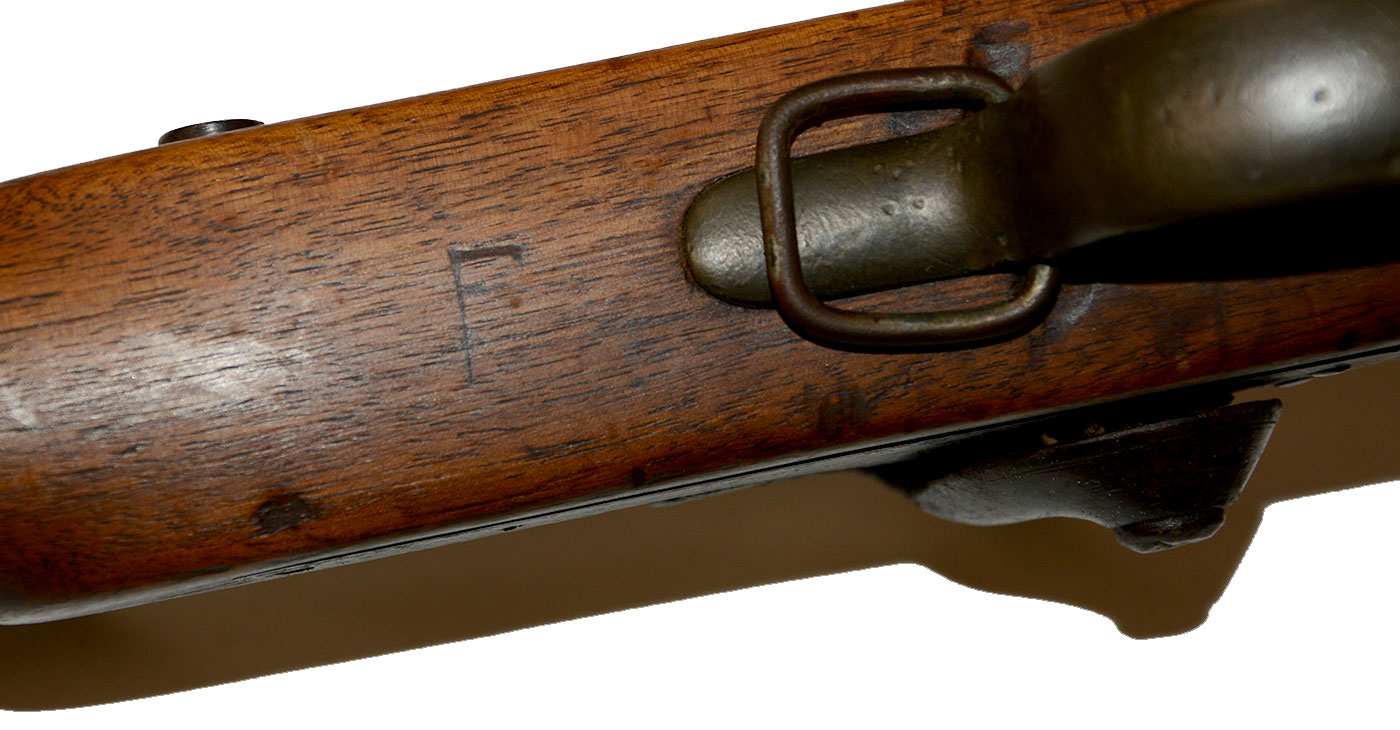
The furnishers often marked the guns that were delivered under this contract with a large single letter on the upper comb of the stock, just forward of the buttplate tang. The guns were marked with a B for Bond, an F for Parker, Field & Sons, a J for C.W. James, a K for James Kerr, and an S for Scott & Son. A sixth single letter mark, P has been noted on a very few extant Confederate Enfields from this contract. This mark was previously thought to be an alternate mark for Parker, Field & Company. However, more recent examinations of extant examples and the other associated marks on those guns have revealed that this was the mark of Francis Preston of Manchester, England. Preston’s relationship within the contracting circle of the “five furnishers” is not clear, but he delivered many socket bayonets for the numbered guns of this contract and may have received a small sub-contract to provide long arms as well. No period documents have shown that Preston delivered the guns directly to Sinclair, Hamilton & Company, so it is most likely that his guns were sub-contracted by James or Scott, who delivered the majority of the guns.
A 31 October 1861 dated letter from Sinclair, Hamilton & Co. notes that the contract was divided between the furnishers as follows: 8,000 guns from Scott & Son, 10,000 from CW James, 6,000 from E.P. Bond, 5,500 from Parker, Field & Sons and 500 from James Kerr. This indicates that the guns delivered by CW James, who was the largest supplier, represented about 33% of the total delivery under this contract. Scott & Sons delivered about 25% of the guns, Bond about 20% and Parker, Field & Sons about 18% of the guns. James Kerr’s deliveries represented less than 2% of all of the Second Contract rifle muskets. An extensive database comprised of more than two decades of collected information related to Confederate purchased Enfields contains approximately 300 numbered Pattern 1853 Enfield rifle muskets, not counting the numbered state purchased guns. Of those guns, the large majority are numbered guns with no suffix, which represent about 77% of the recorded samples. A-suffix guns represent about 16% of the recorded examples, while B-suffix guns represent about 7% of surviving examples that are recorded. To date, about 50 A-suffix and about 20 B-suffix Pattern 1853 Enfields are known to exist. The reason for the paucity of these arms is not clear, but it may simply be the result of attrition and the arms having been used up. With B-suffix guns, which would have theoretically been delivered later than the no suffix or “A” guns, the lack of extant examples may be an indication of the early successes experienced by the Union’s Atlantic Blockading Squadron.
Recorded numbers show a good distribution of engraved numbers from two digits through the mid 2XXX range. Then there is then a nearly 4,000 number gap in the database that seems to indicate that a large quantity of the “B-guns” in the 25XX to 62XX range may well be on the bottom of the Atlantic Ocean. “A suffix” guns, although uncommon and with few examples to study, show a nice even distribution through the entire numbering sequence. This suggests that their scarcity today is the result of them having seen hard use, rather than having been dumped overboard while a Confederate blockade runner tried to elude a pursuing US Naval vessel."-Tim Prince.
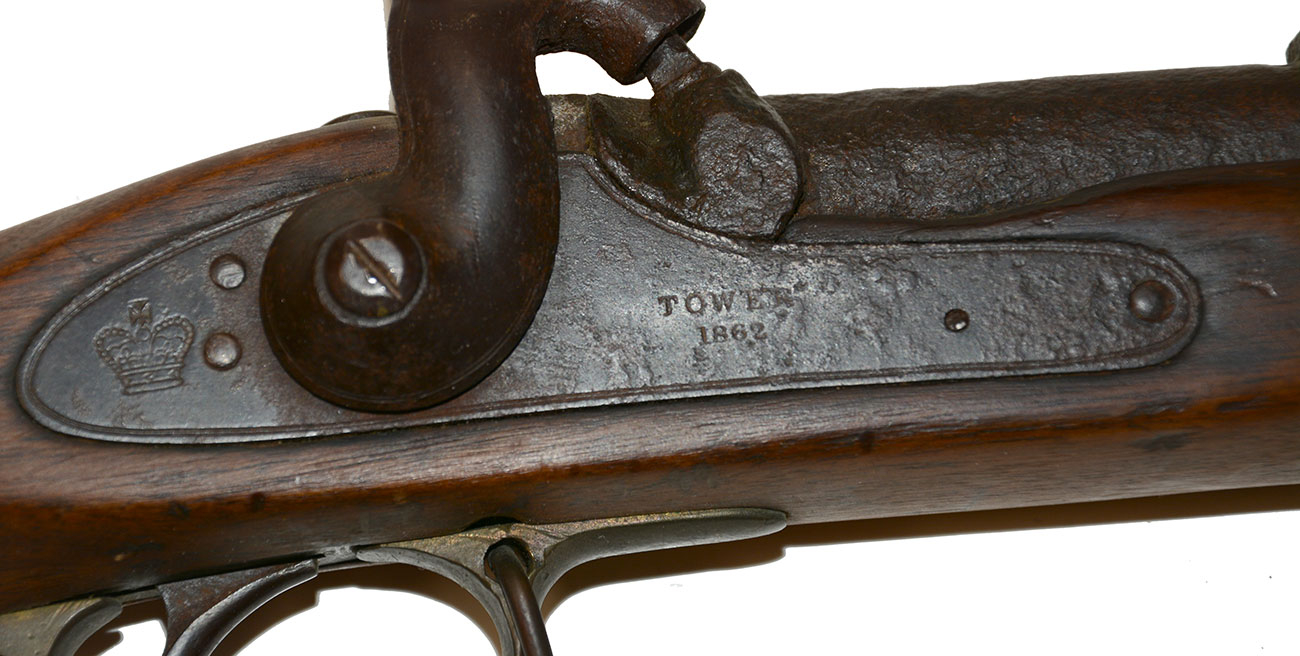
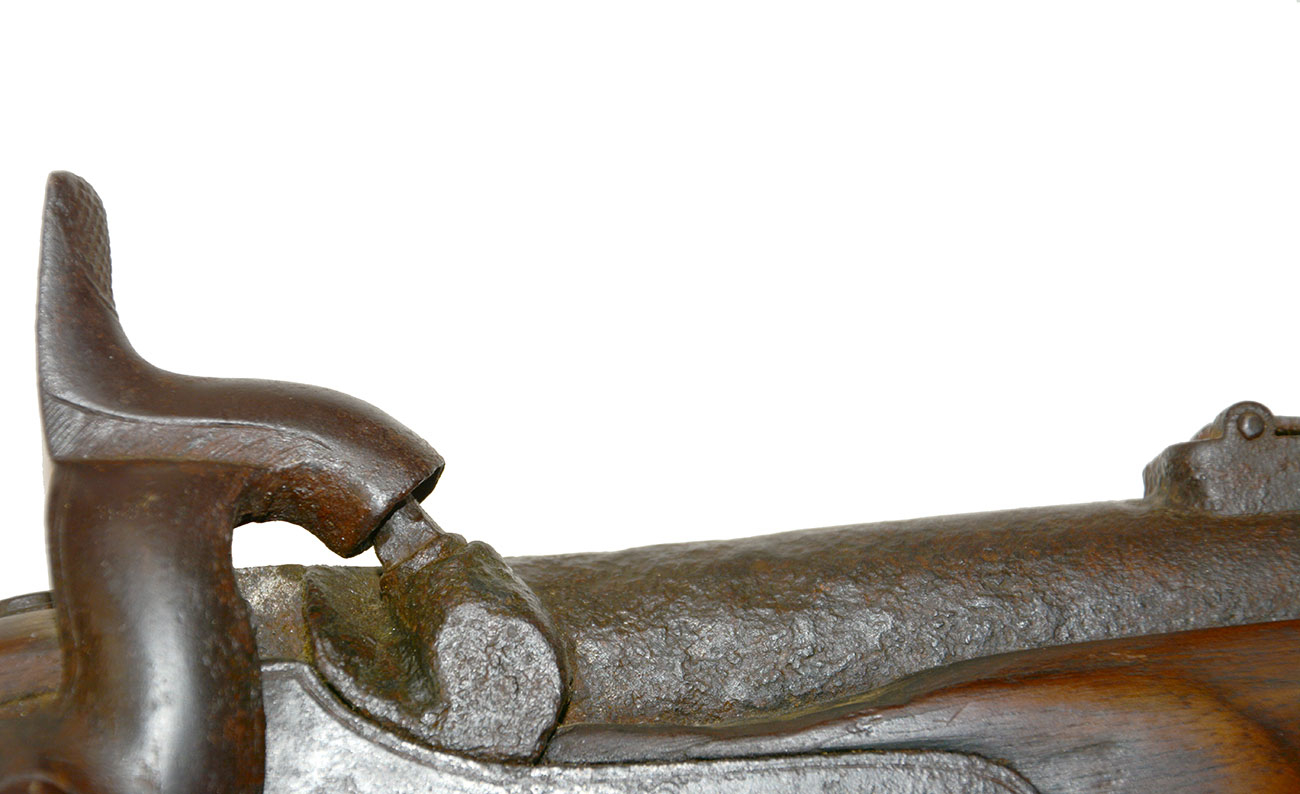
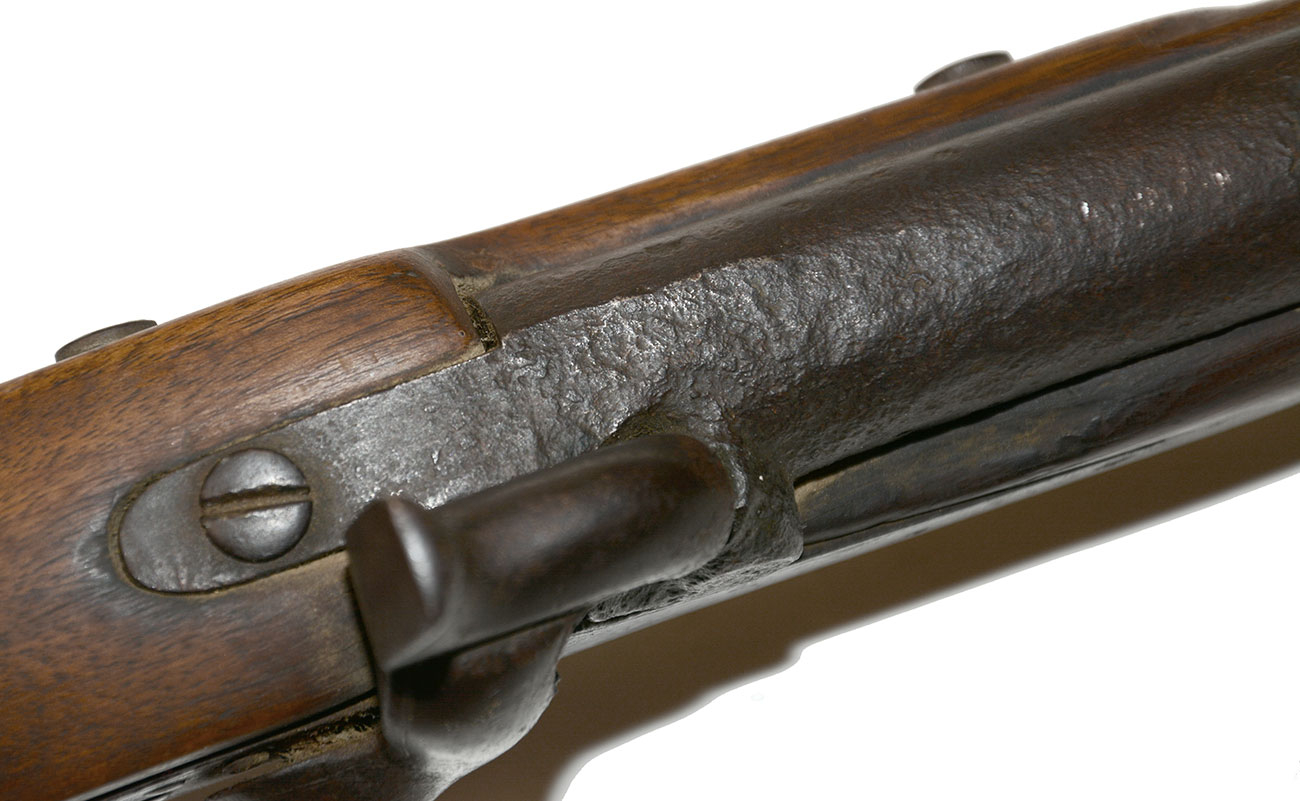
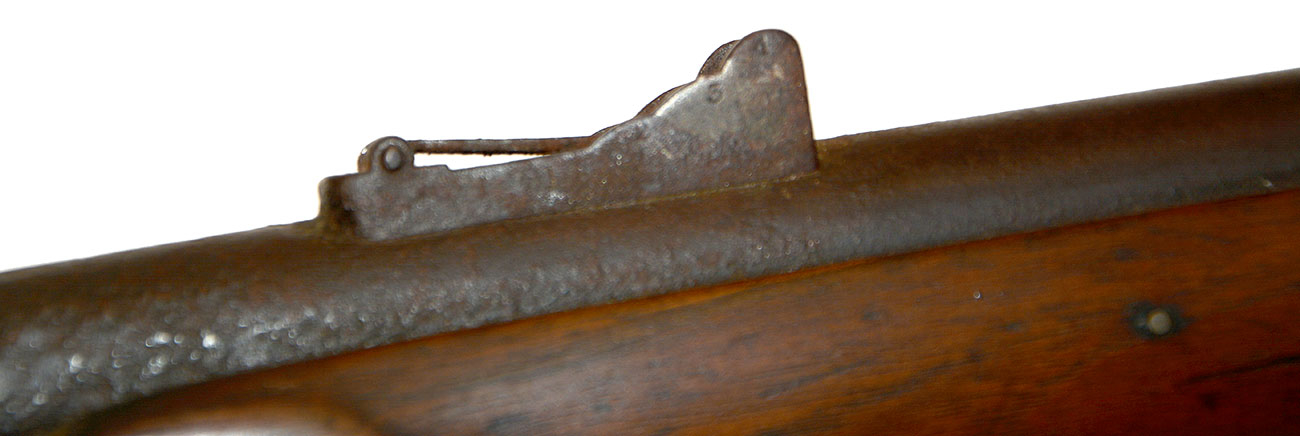
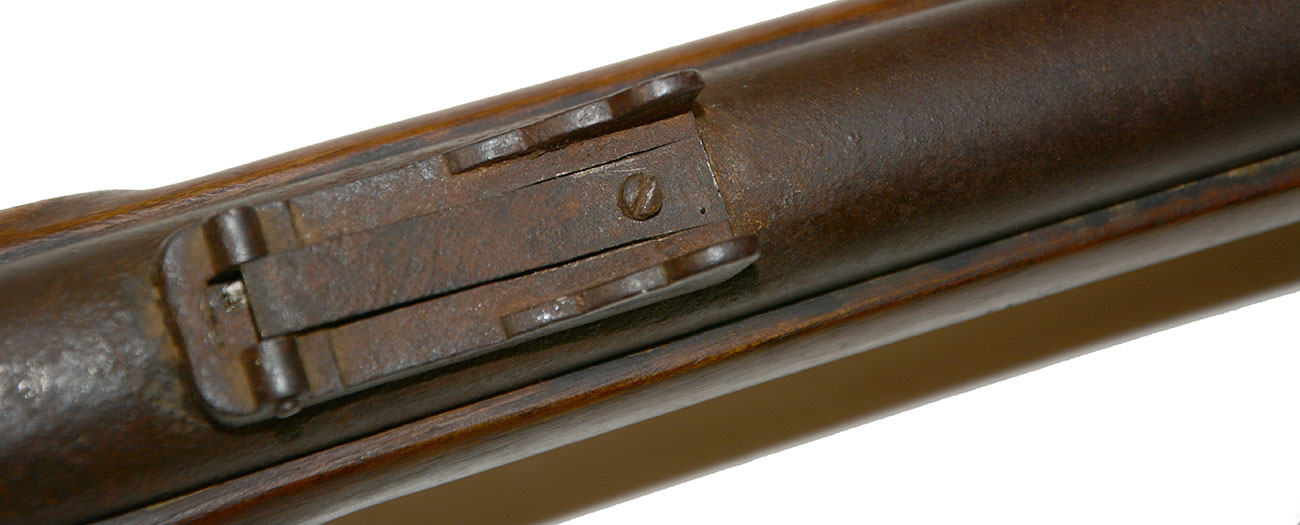
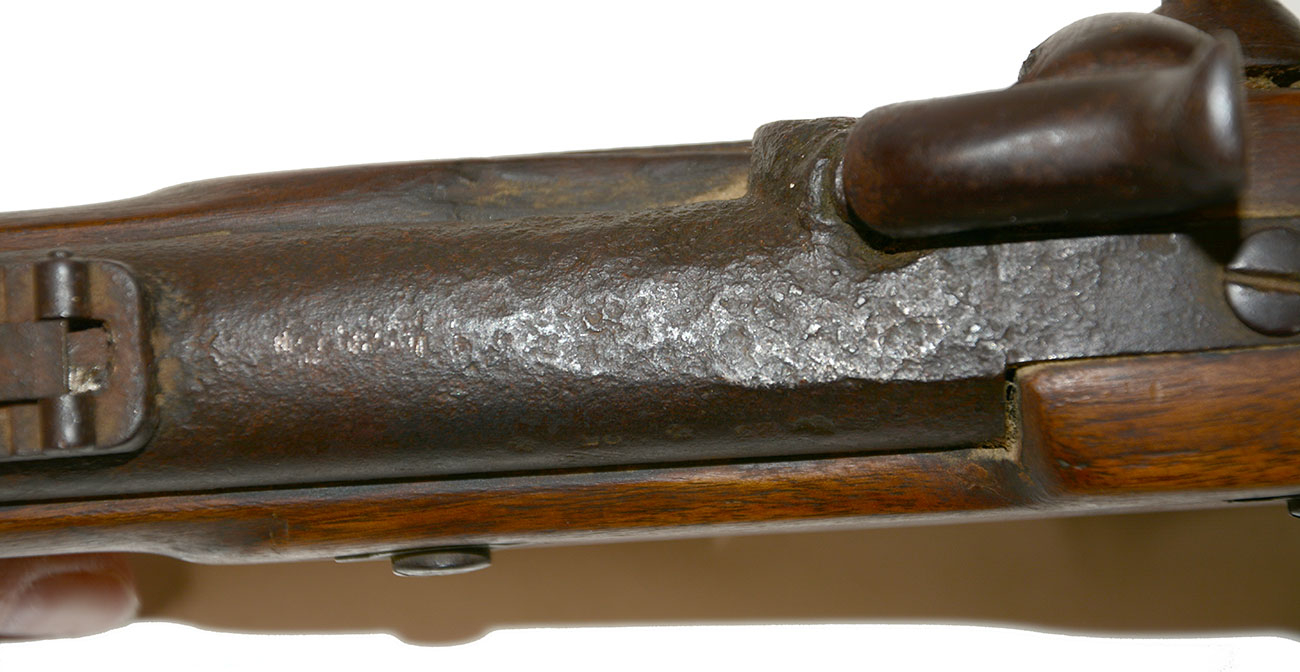
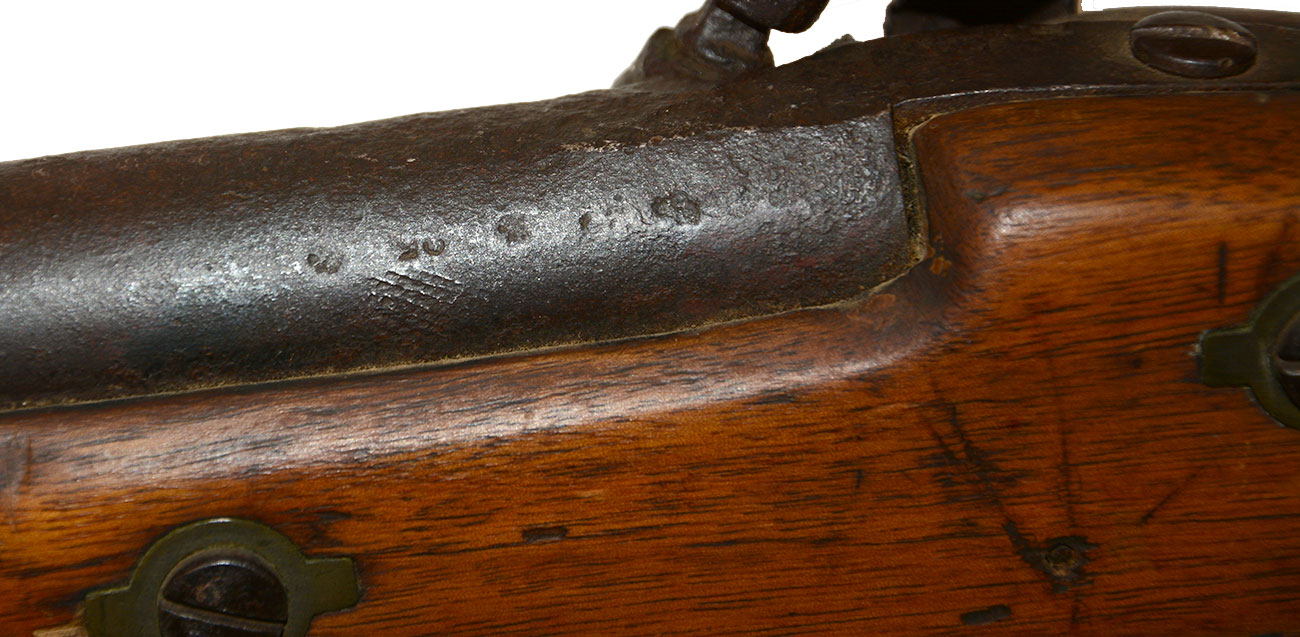
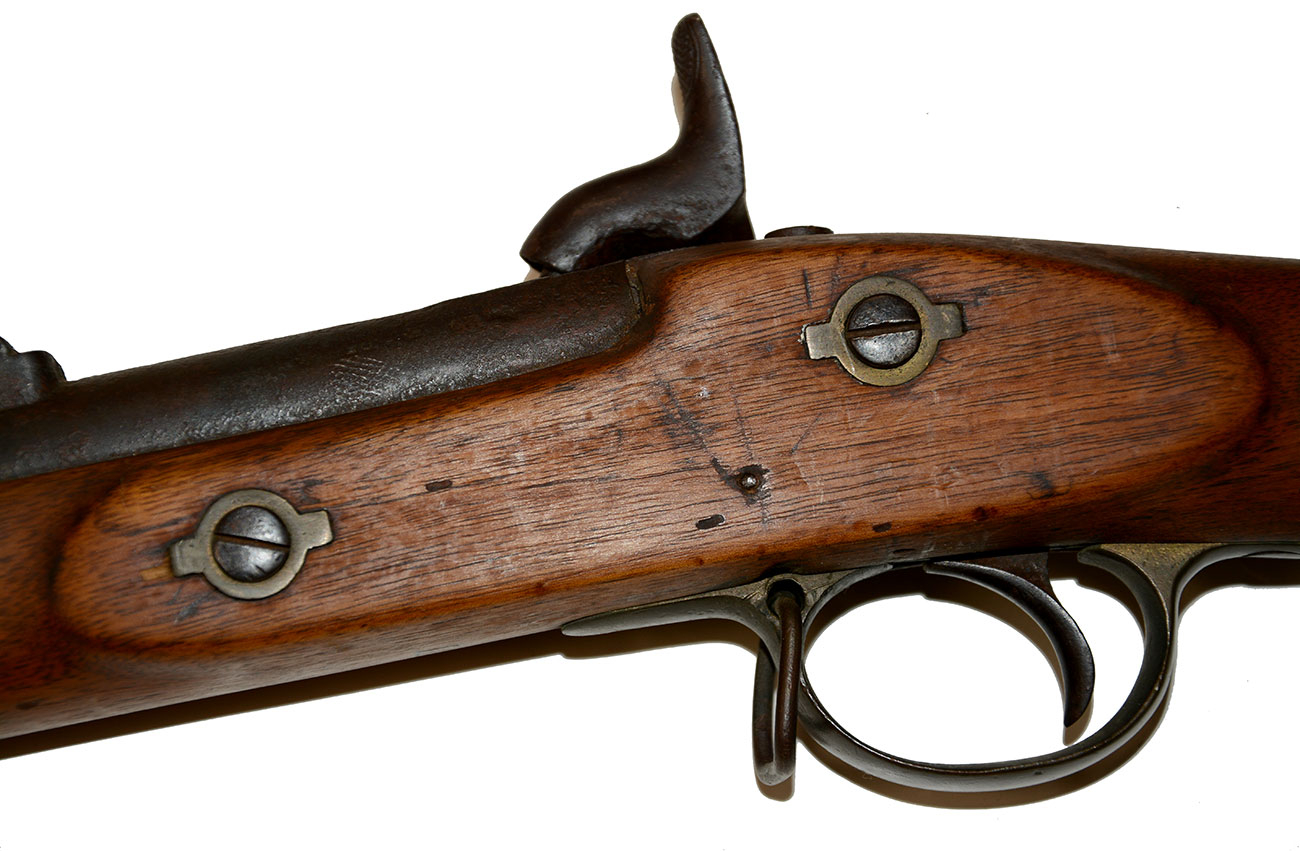
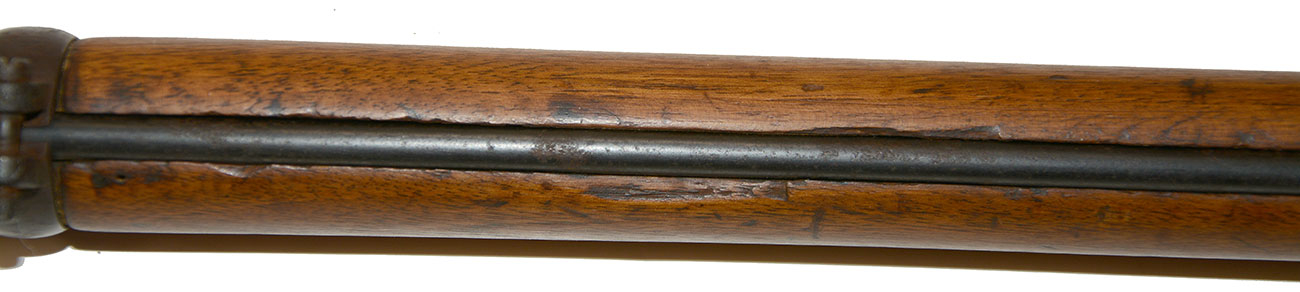
This British Pattern 1853 Enfield (with the modifications based on field use is today called by many collectors the Pattern 1858 or 3rd Pattern) rifle-musket is dated "1862" over "TOWER" on the lock plate. At the rear of the lock plate is the Queen's crown. The gun is devoid of any British military inspection markings and is a typical Birmingham-made contract gun for commercial sale that was destined for export from Great Britain. The mechanics are perfect. The 39-inch barrel is Birmingham proofed and marked "25" for bore or .577 caliber and has dark brown smooth patination with some heavy pitting at the breech. The 3-barrel bands have this same deep brown patination. The bore of the gun is poor. There is a heavily patinated brass butt plate brass nose. The gun has no rear sight ladder or elevator. The combination front sight and bayonet lug is present. The gun has no front sling swivel, and the rear is an old homemade affair. A period full-length ramrod is in place. The stock is solid and free of any breaks or repairs. The wood does show some scattered bumps, dings and minor dents. There is considerable wood percussion cap ignition loss behind the hammer and in front of the lock against the barrel.
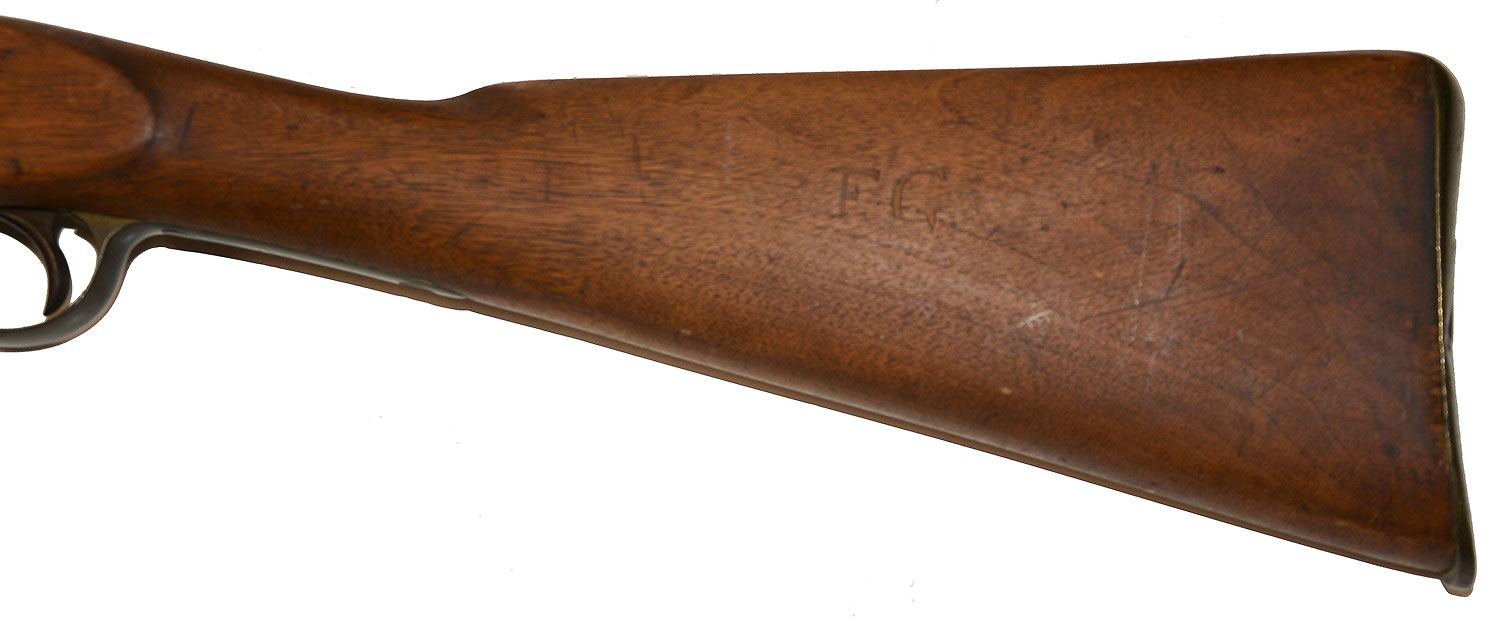
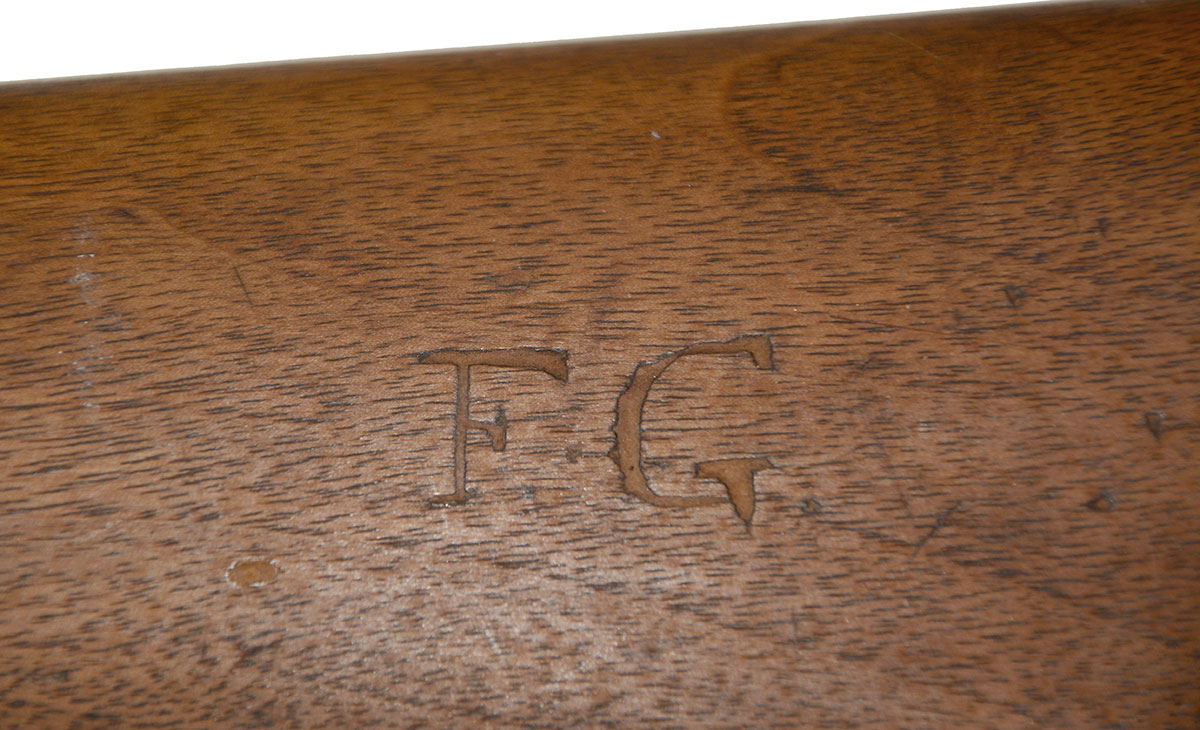
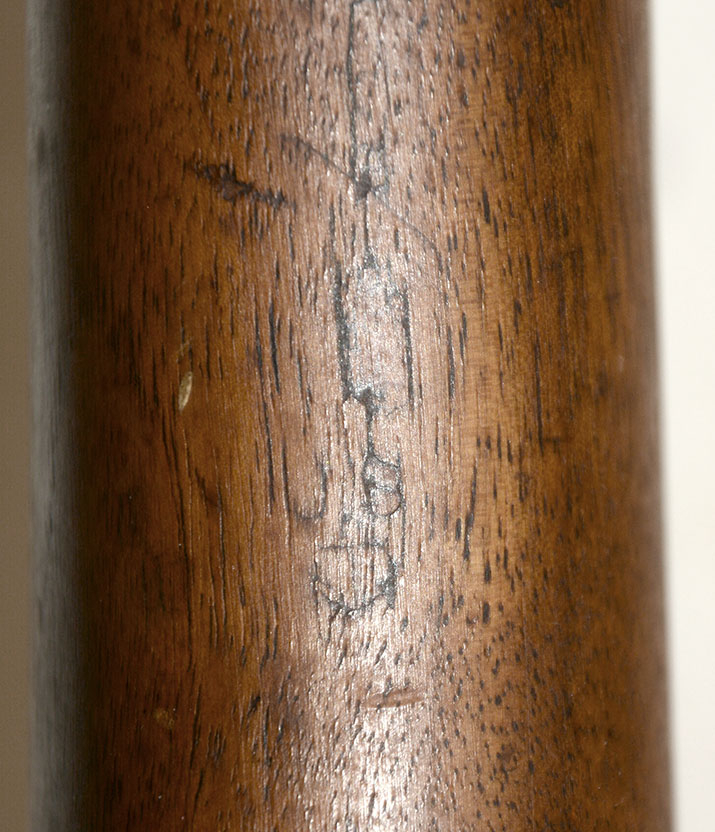
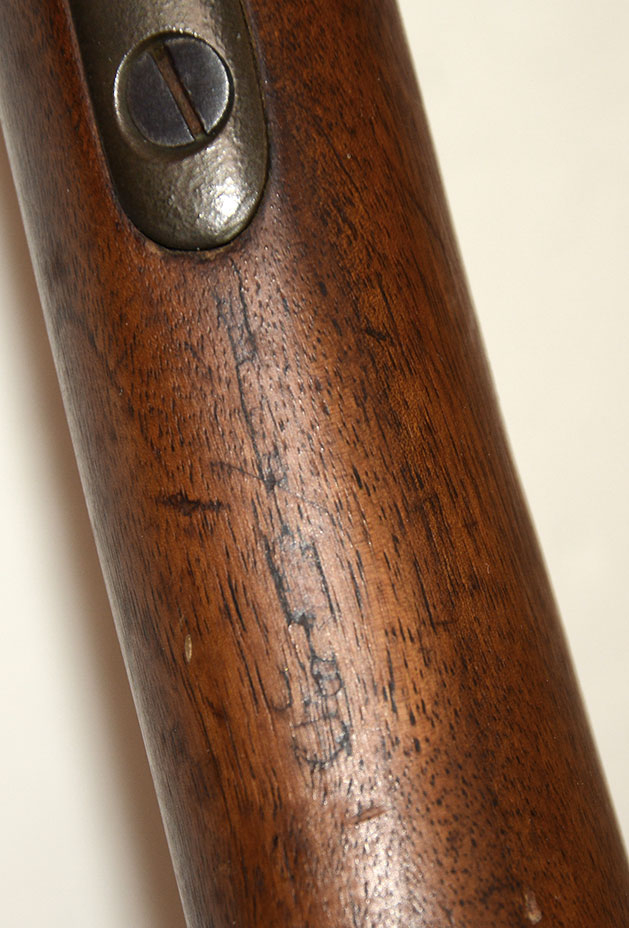
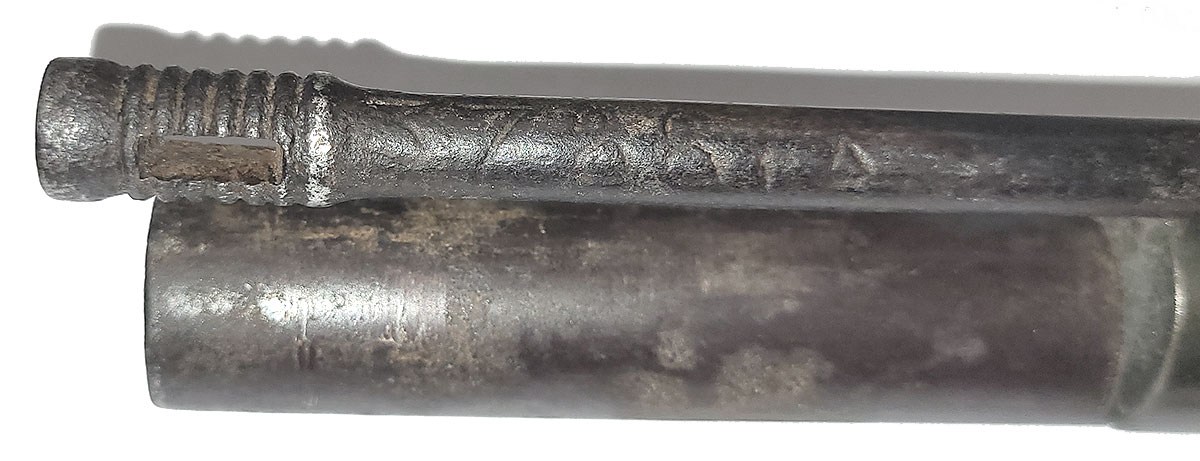
The top of the stock comb has an "S" stamped for Scott & Son the furbisher (supplier). Behind the trigger guard is the ubiquitous "JS" over ANCHOR. The butt plate is engraved "3788" over "A" or (13,788). The iron ramrod is engraved in the same hand "3788 A". Also on the obverse of the butt stock are the 1-inch-high initial "FG". In front of the trigger guard there is a 1 1/4 inch high "F". This weapon was found in Fort Worth, Texas. An old cardboard string tag reads in part " Given to me when I was 10 years old. Used in the Civil War by Corlauff family."
The rarity of a JS and anchor numbered Enfield having its original ramrod in place is "off the charts"; a handful are known. [pe][ph:L]
DISCLAIMER: All firearms are sold as collector's items only - we do not accept responsibility as to the shooting safety or reliability of any antique firearm. All firearms are described as accurately as possible, given the restraints of a catalog listing length. We want satisfied customers & often "under" describe the weapons. Any city or state regulations regarding owning antique firearms are the responsibility of the purchaser. All firearms are "mechanically perfect" unless noted, but again, are NOT warranted as safe to fire!
~~~~~~~~~~~~~~~~~~~~~~~~~~~~~~~~~~~
THIS ITEM, AS WITH ALL OTHER ITEMS AVAILABLE ON OUR WEB SITE,
MAY BE PURCHASED THROUGH OUR LAYAWAY PROGRAM.
CLICK HERE FOR OUR POLICIES AND TERMS.
THANK YOU!
Inquire About A HIGHLY SOUGHT AFTER JS AND ANCHOR CONFEDERATE ENFIELD WITH MATCHING NUMBERED RAMROD
Most Popular
Historical Firearms Stolen From The National Civil War Museum In Harrisburg, Pa »
Theft From Gravesite Of Gen. John Reynolds »
Selection Of Unframed Prints By Don Troiani »
Fine Condition Brass Infantry Bugle Insignia »
featured item
A CONFEDERATE SURGEON'S GREATCOAT, SASH AND SHIRT
Dr. J. P. Rasser was contracted by the Confederacy and among his duties in Georgia was the examination of Conscripts for the Army. THE OVERCOAT or army great coat is certainly "Homespun" that is a woven woolen fabric originally made from homespun… (1268-706). Learn More »
site search