

site search
online catalog
22ND NYNG CHASSEUR-STYLE JACKET, EPAULETS, AND TROUSERS
Hover to zoom
$9,500.00
Quantity Available: 1
Item Code: 410-913
Shipping: Determined by Method & Location of buyer
To Order:
Call 717-334-0347,
Fax 717-334-5016, or E-mail
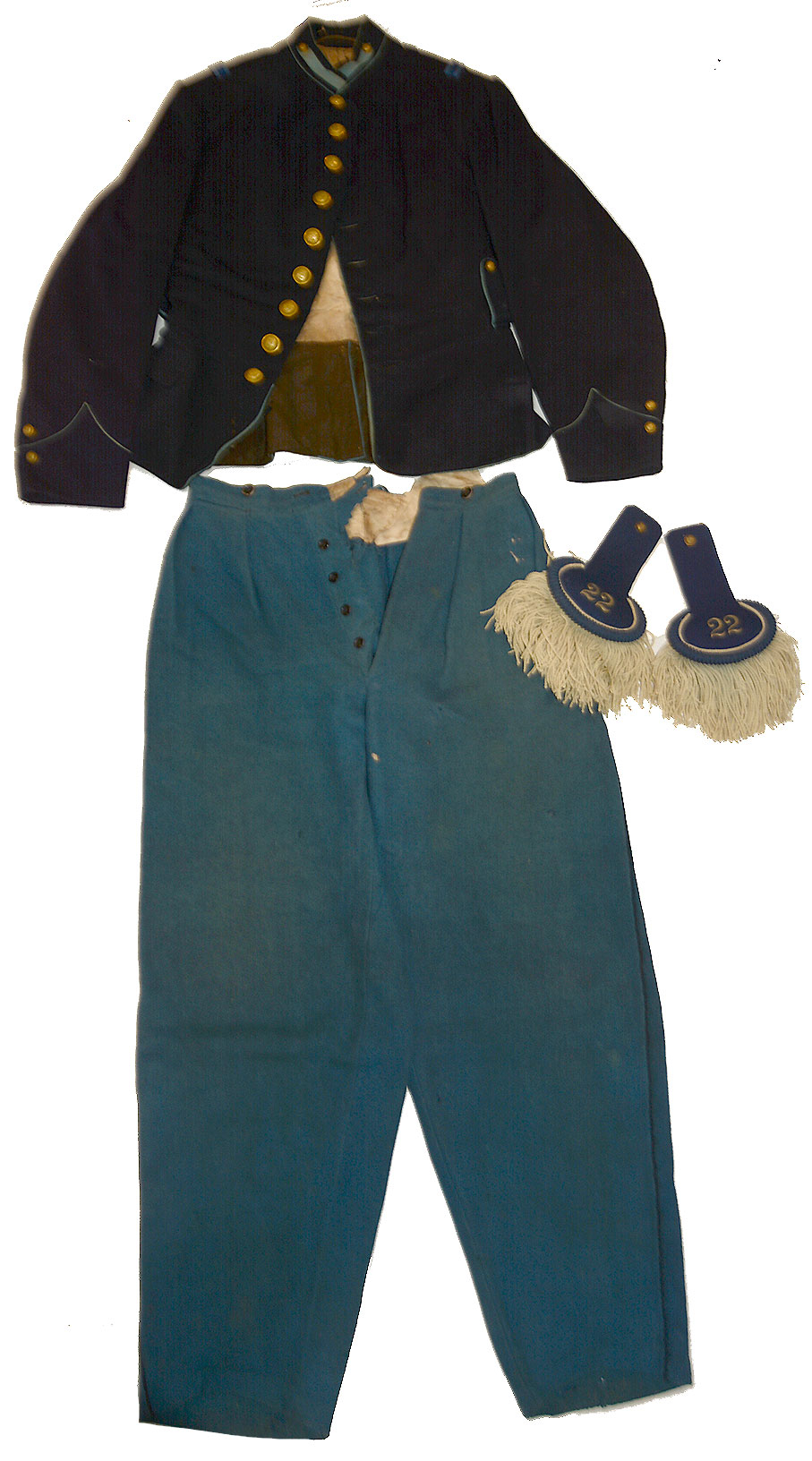
This appealing uniform jacket, epaulets, and trousers came to us from the same source as the identified gray full-dress frock coat from the 22nd NYNG that we listed previously. That coat is identified by an ink inscription in it to John H. Stallmann, who served with the unit when it was Federalized for 90-days active service in mid-1862. We see no name in this uniform. Stallmann’s record picks up only US service, not state service, so it is possible he wore this uniform in subsequent service in the 22nd NYNG, though he appears not to have Federalized with them a second time in mid-1863.
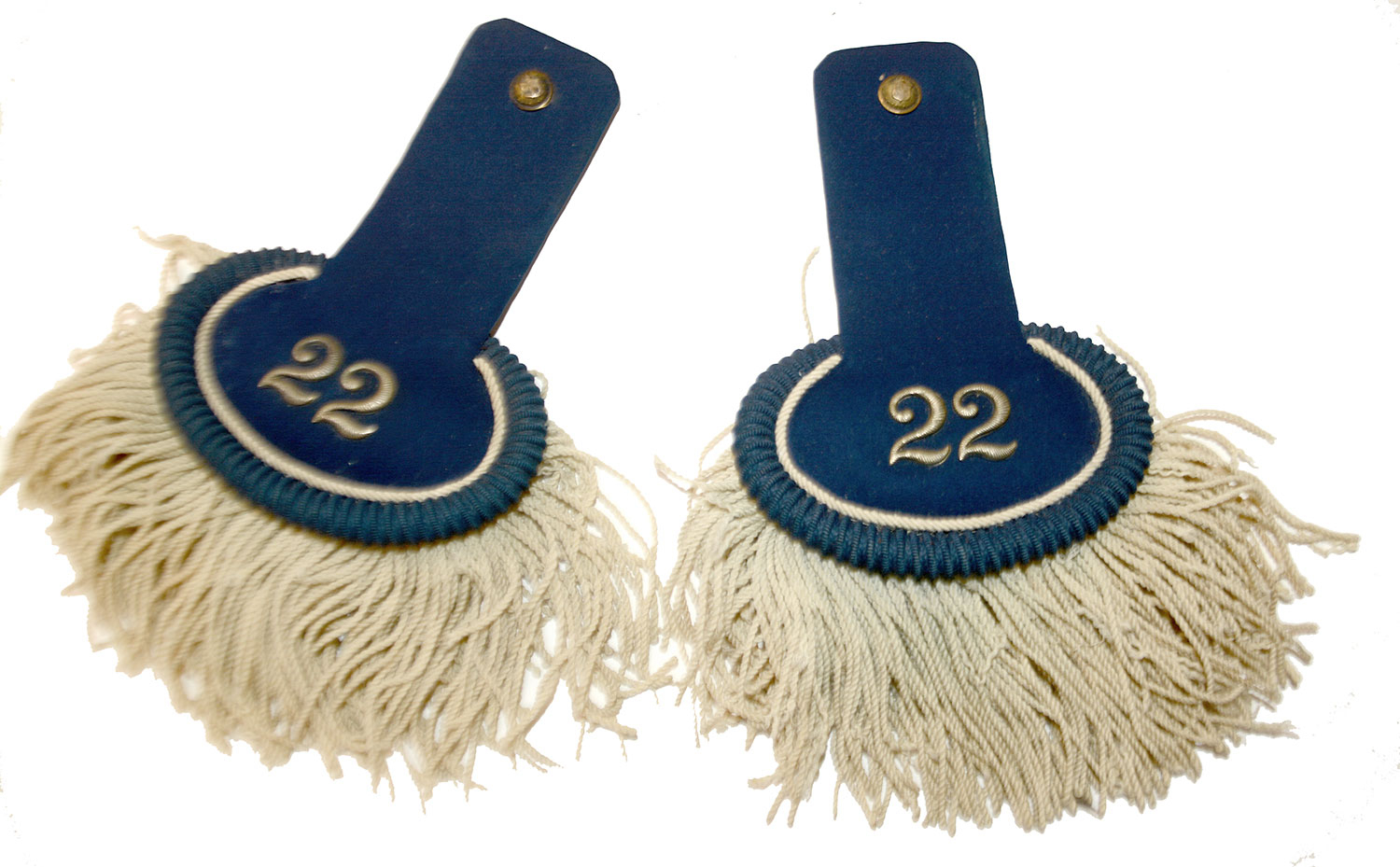
The regiment was privately organized and funded in April-May 1861 to replace militia units in New York City that gone to defend Washington and initially adopted a gray uniform, faced in red and piped in white. The blue chasseur pattern was adopted in its stead on Sept. 29, 1862, after the regiment’s return from three-month’s service at Baltimore and Harpers Ferry, and was its regulation dress uniform at the time of its second deployment in mid-1863 during the Gettysburg Campaign, first fitted with simple shoulder tabs, which were replaced of Nov. 6, 1863, with epaulets, such as this one carries. The set is in great condition overall, with some scattered mothing, but all elements intact, very displayable, and showing strong color.
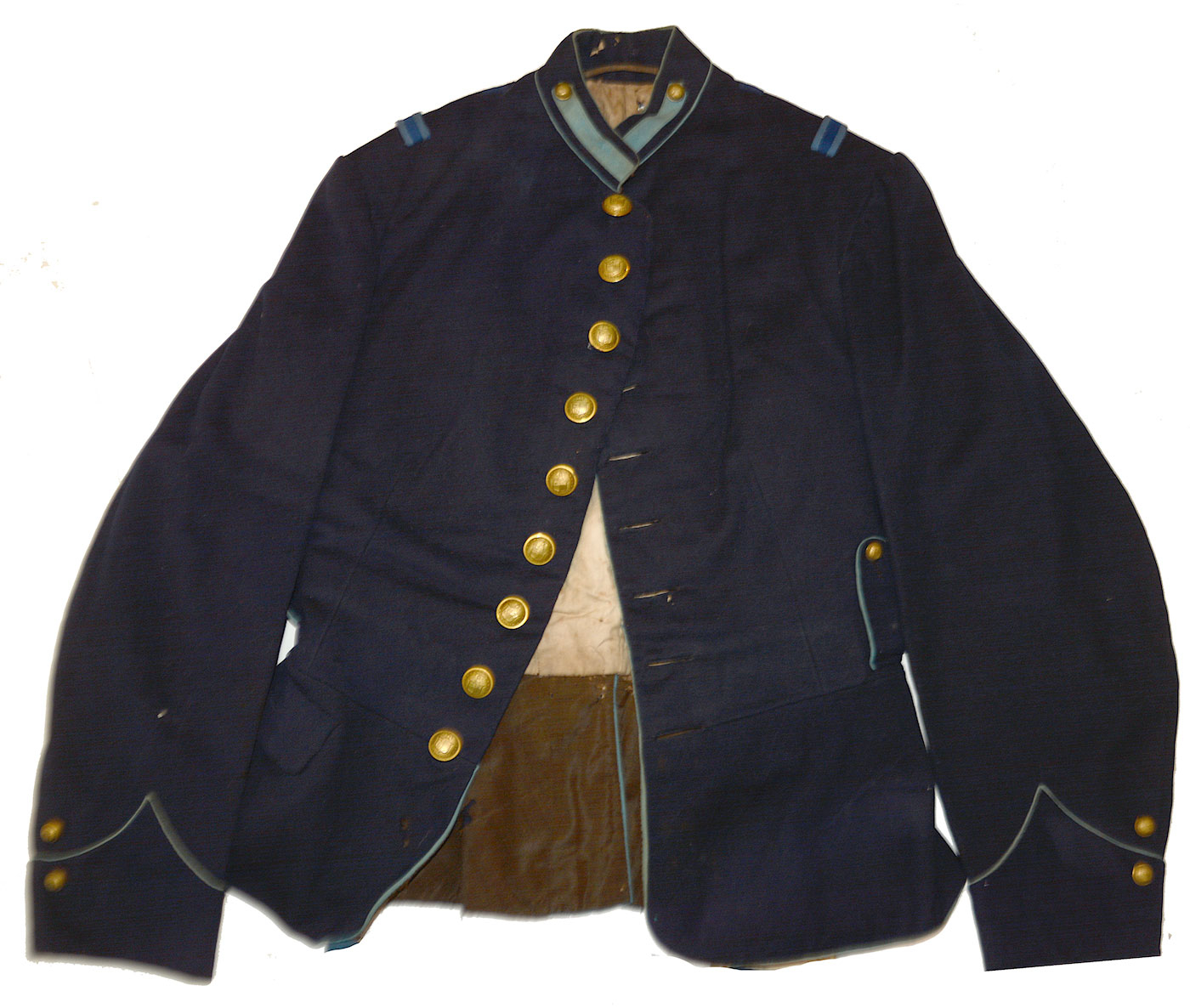
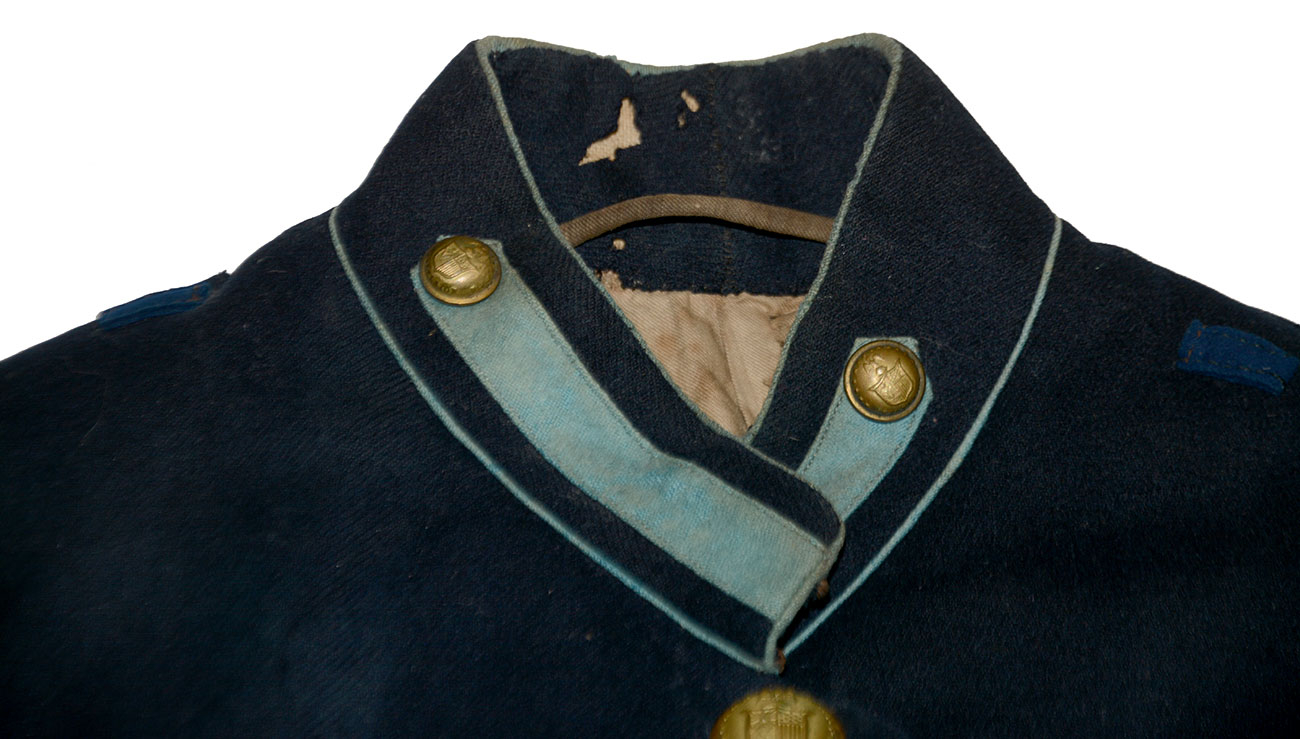
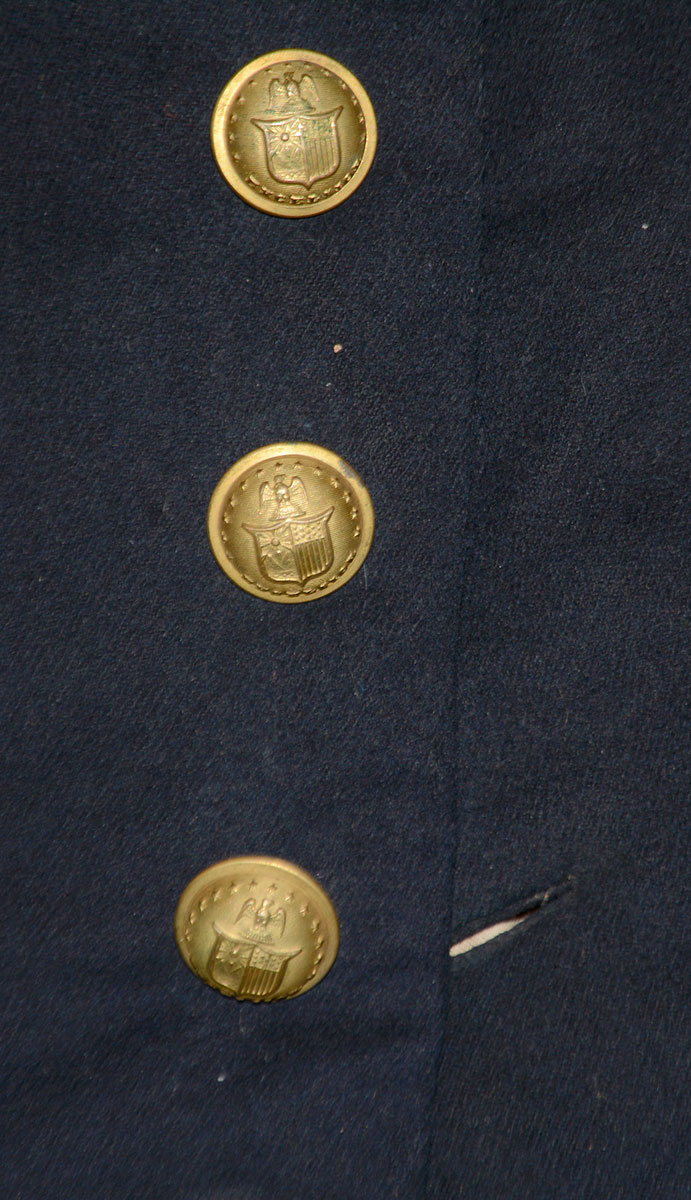
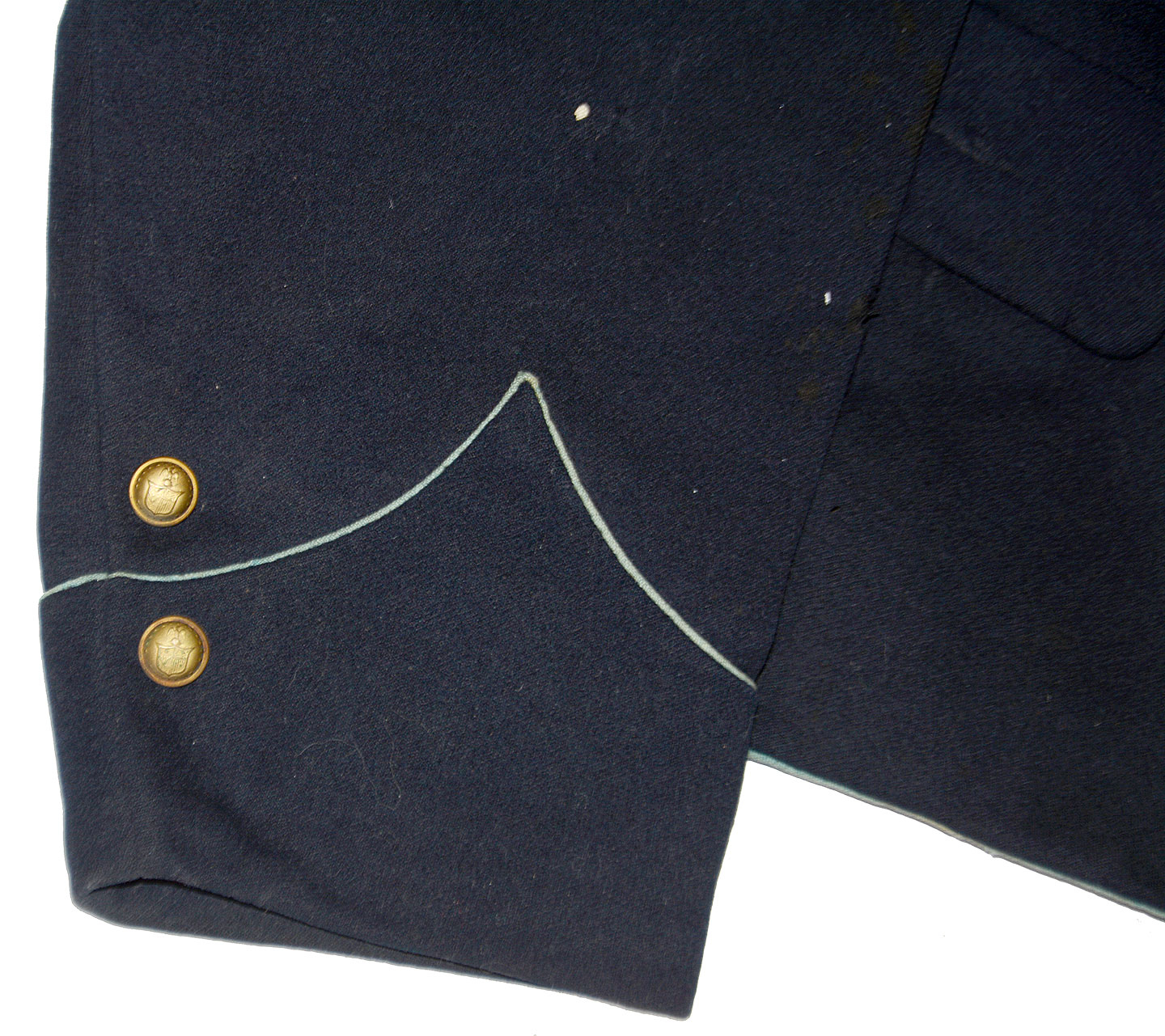
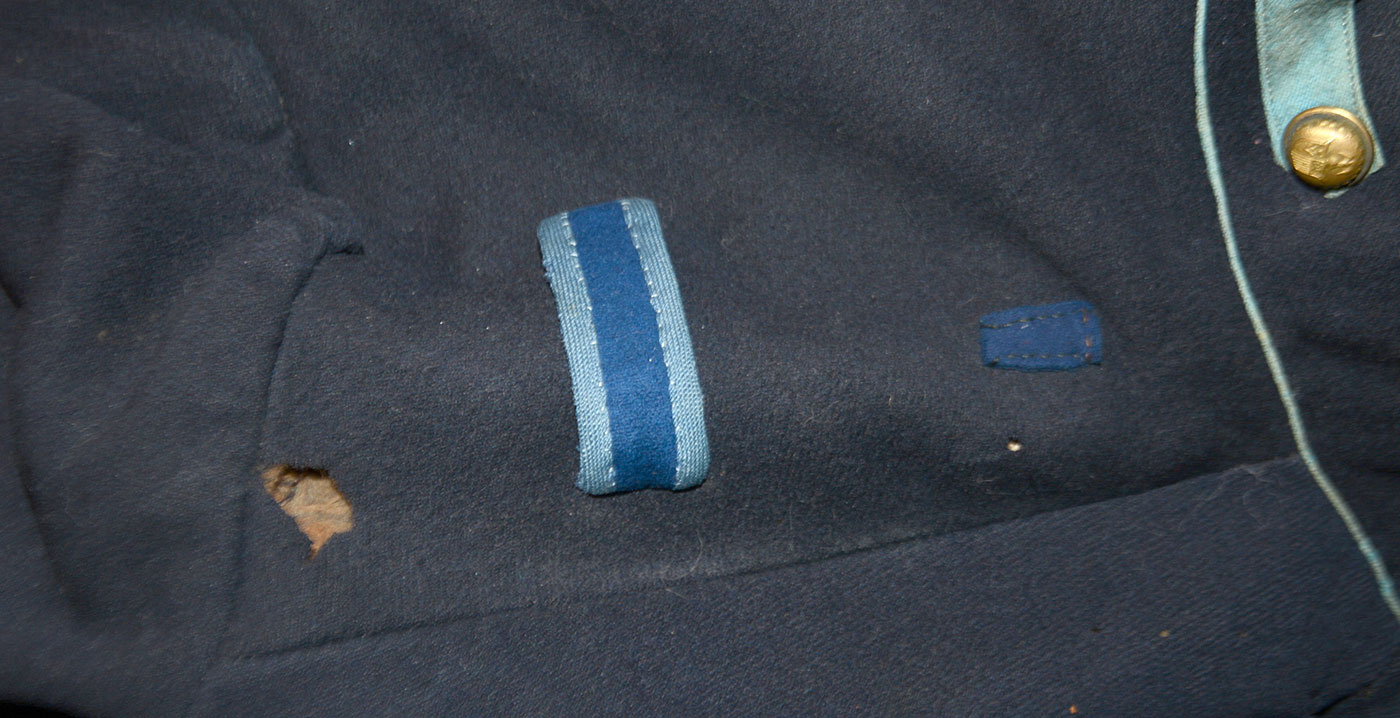
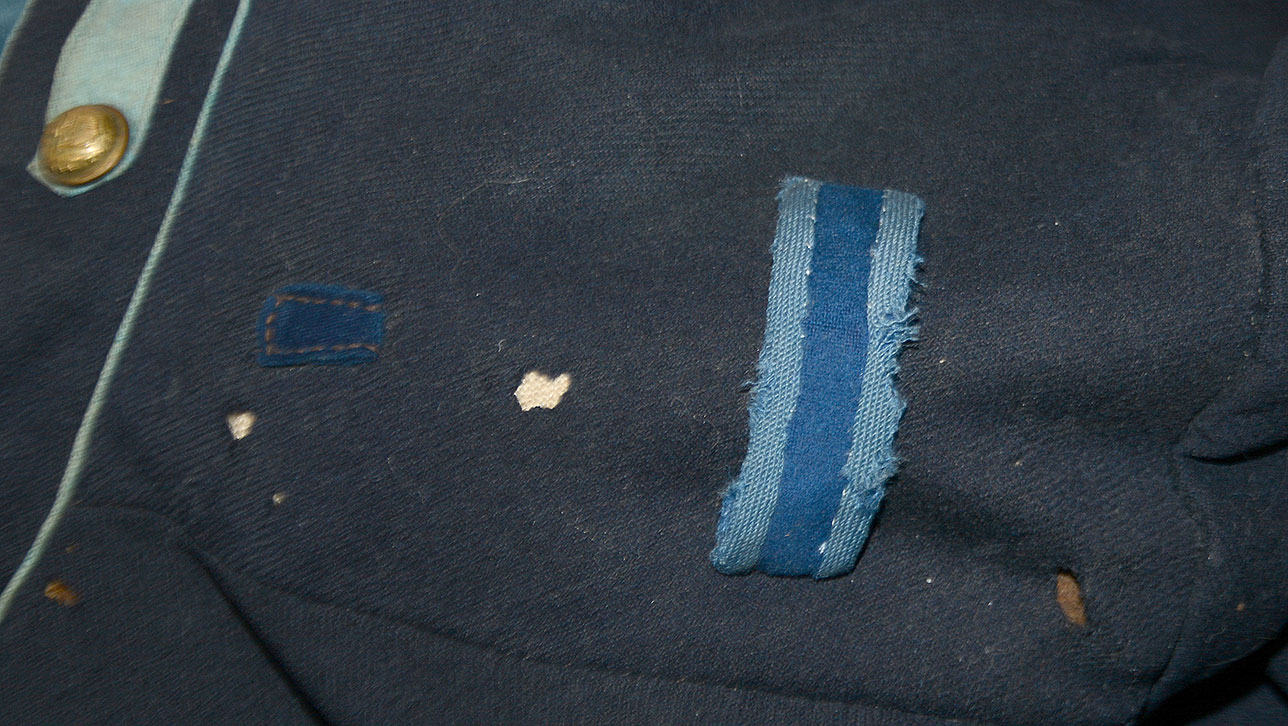
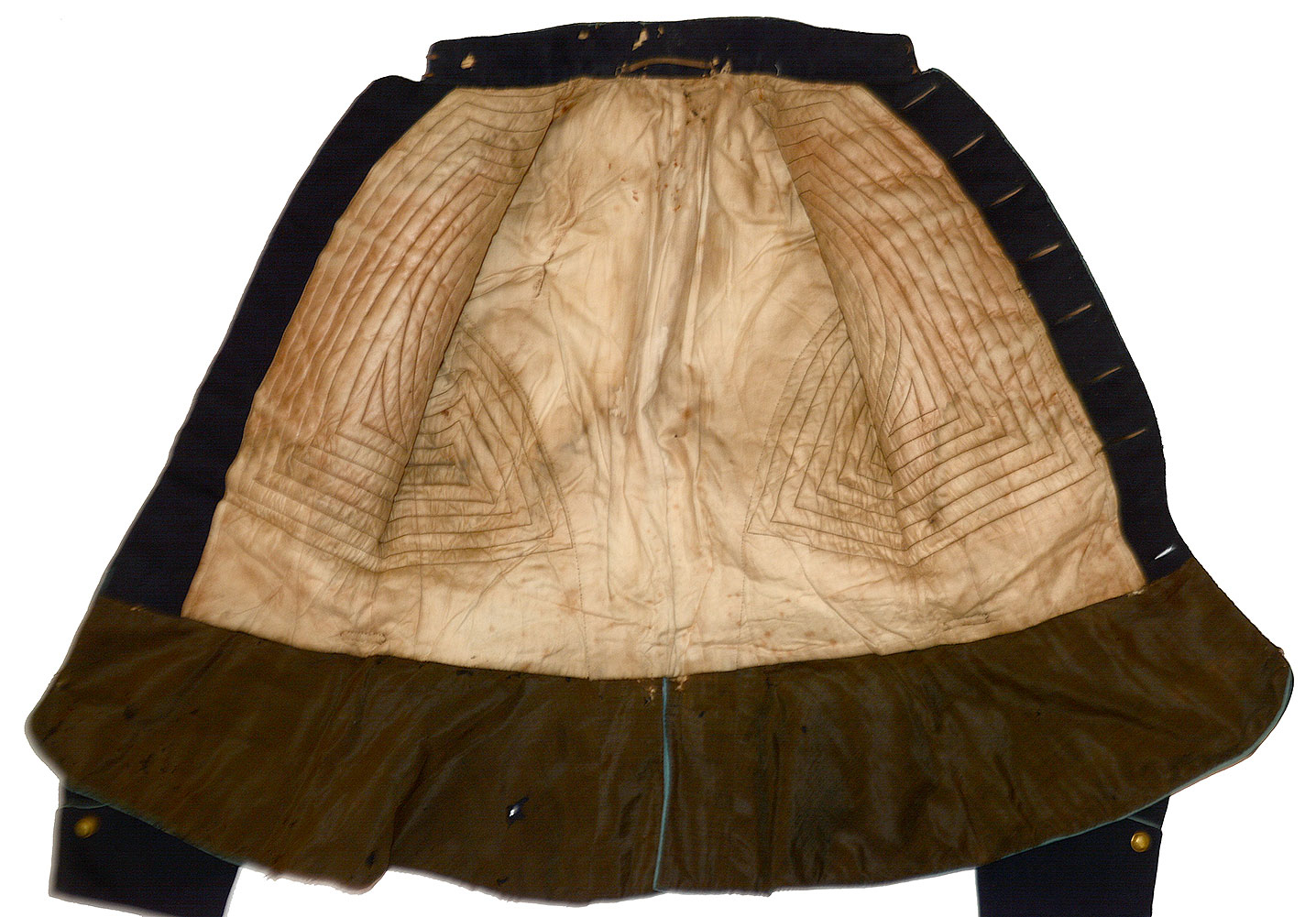
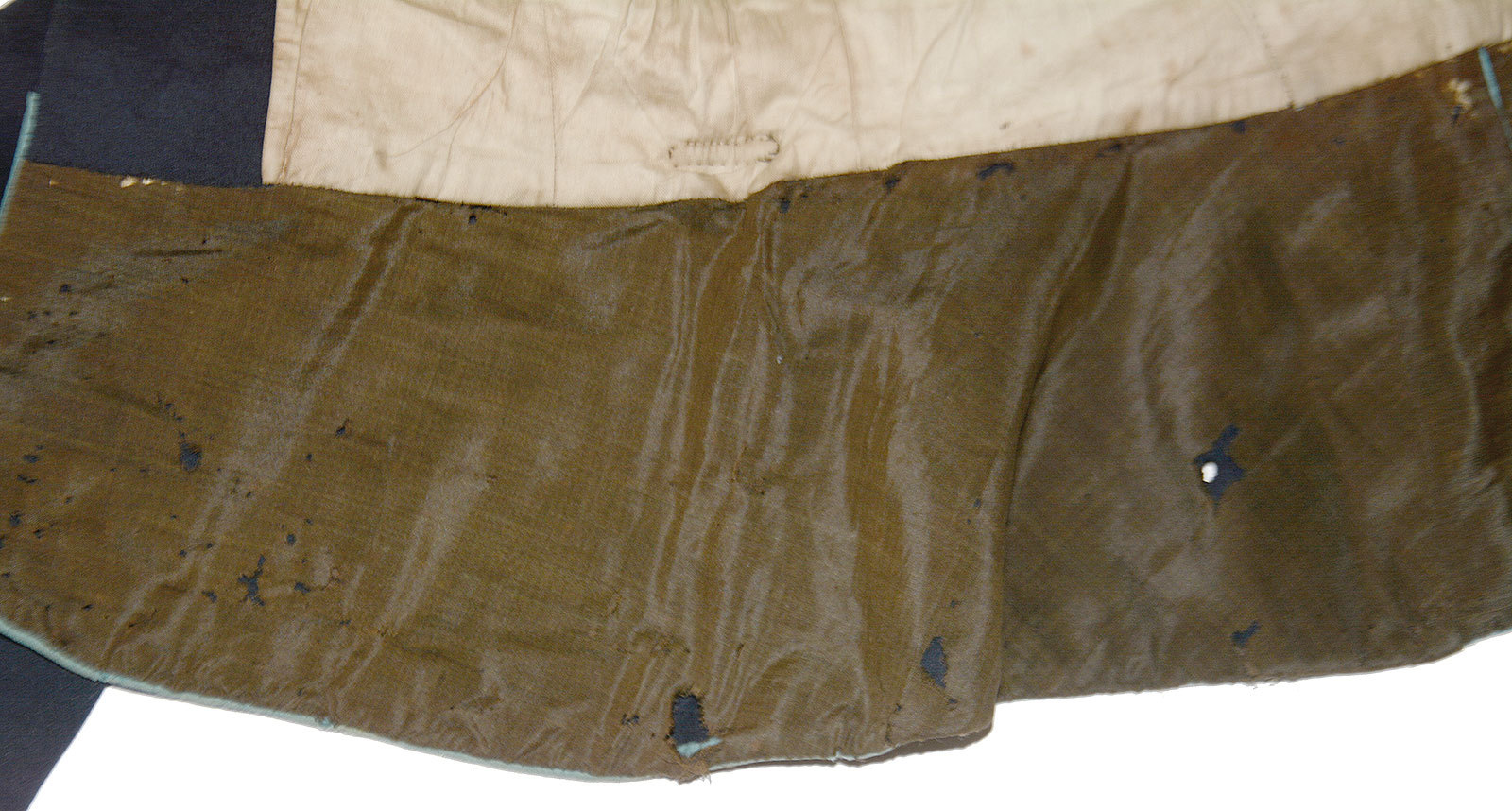
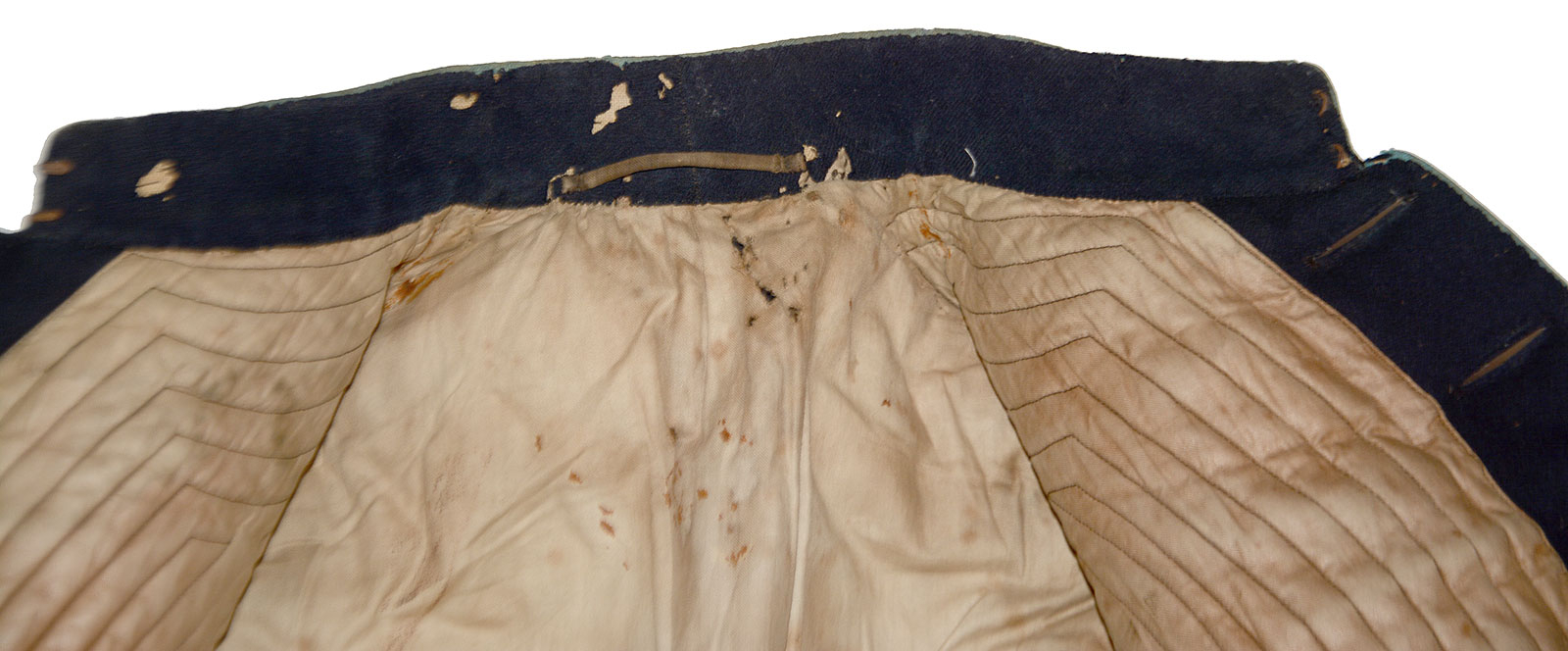
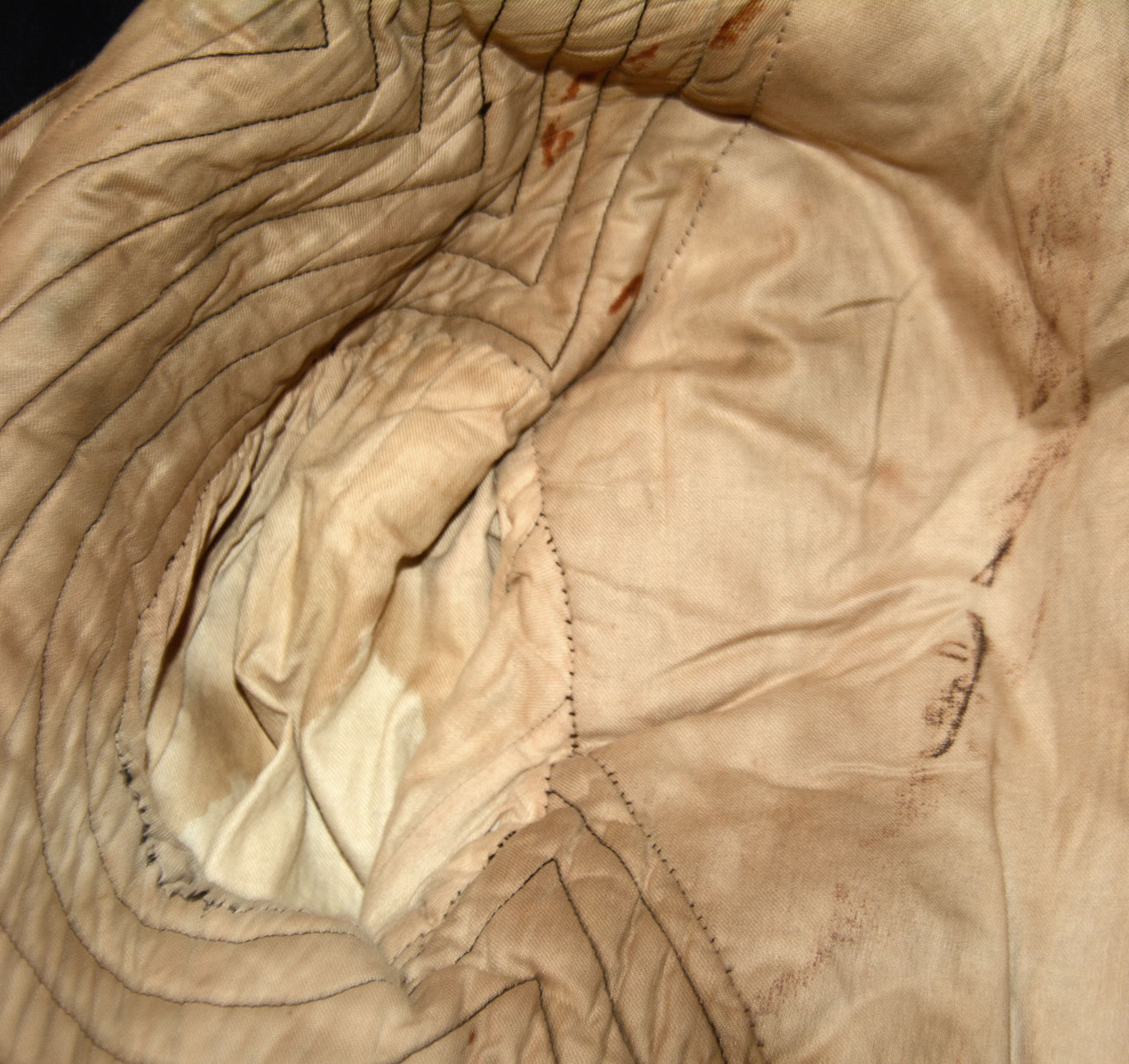
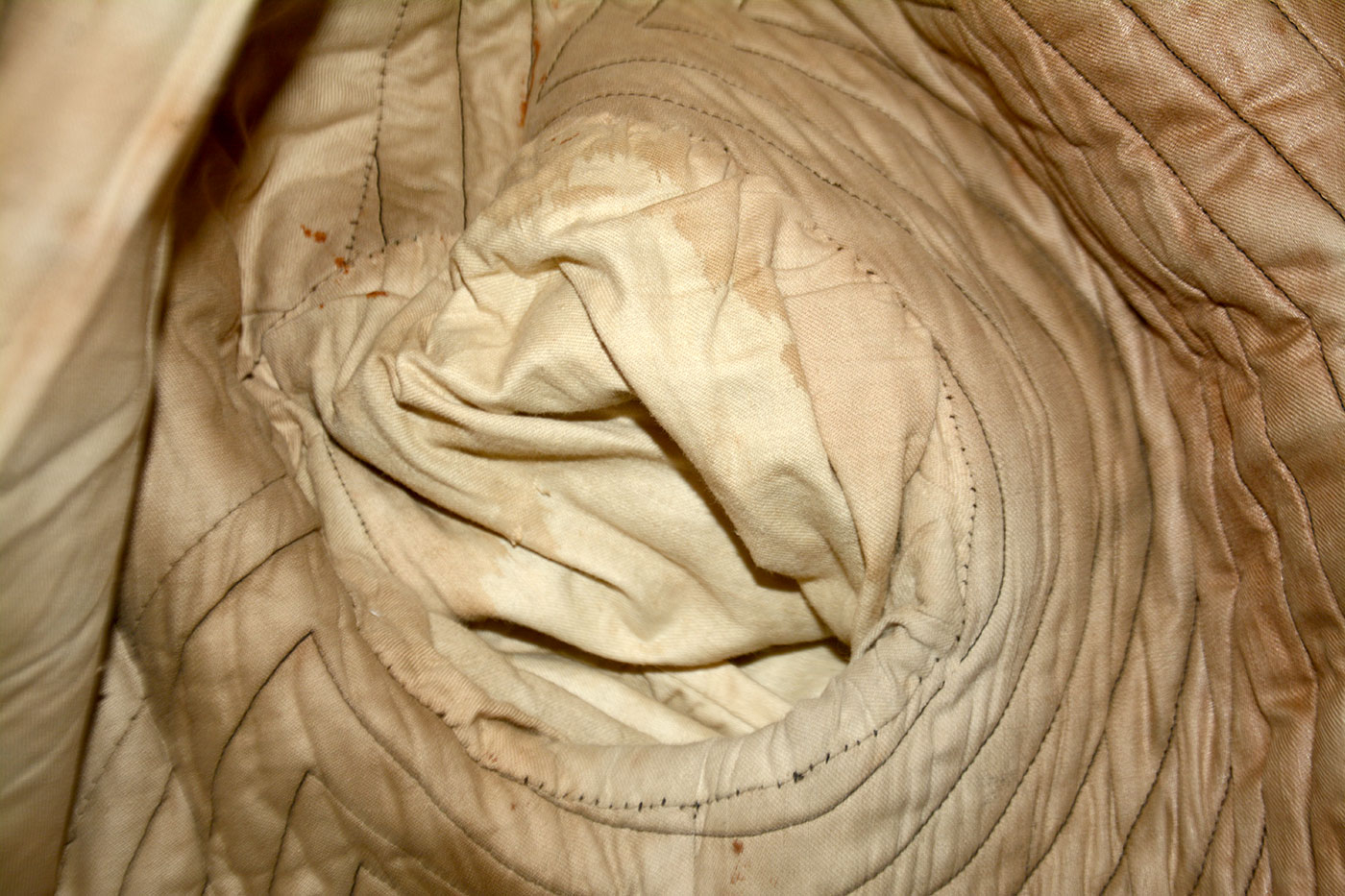
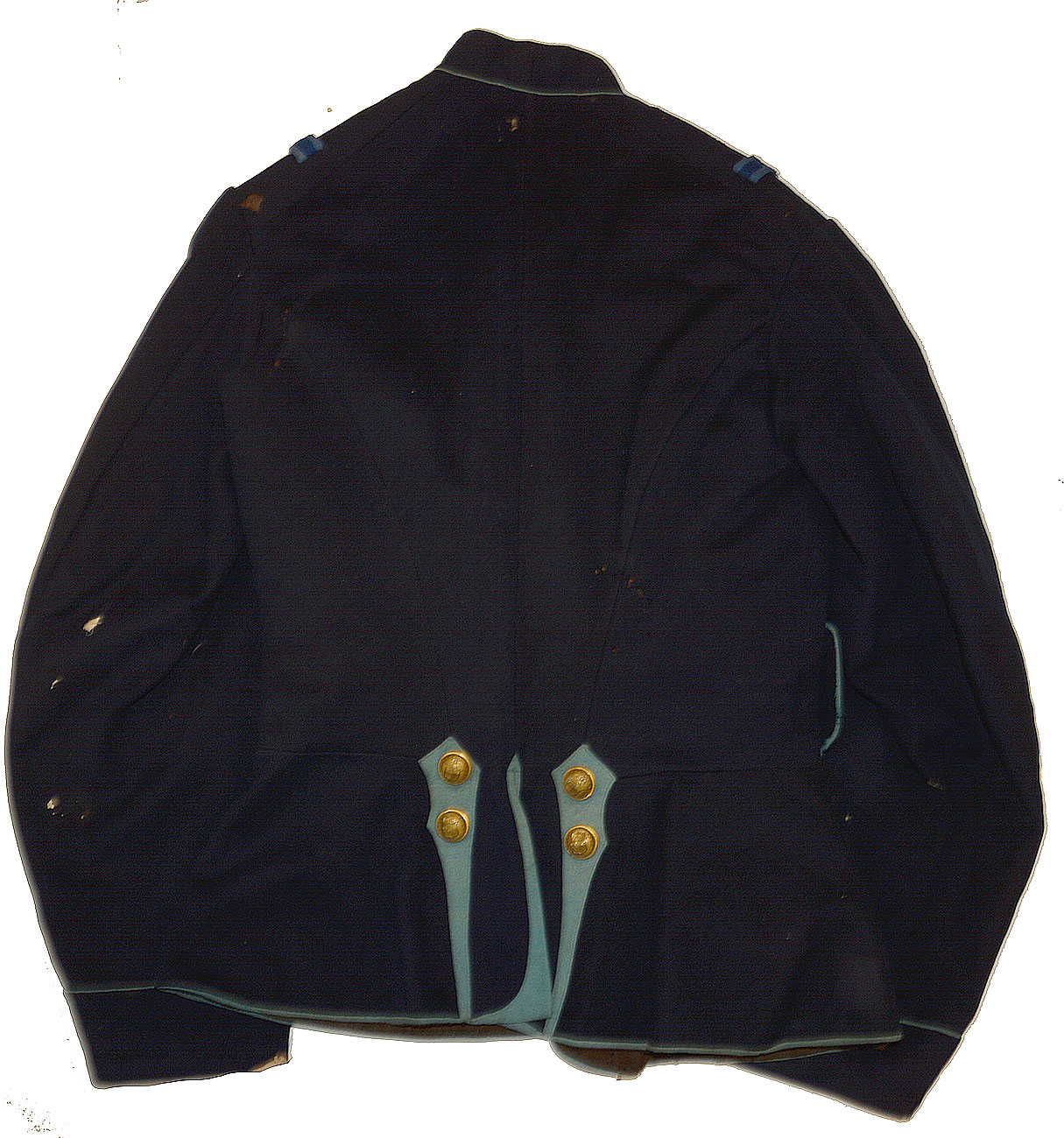
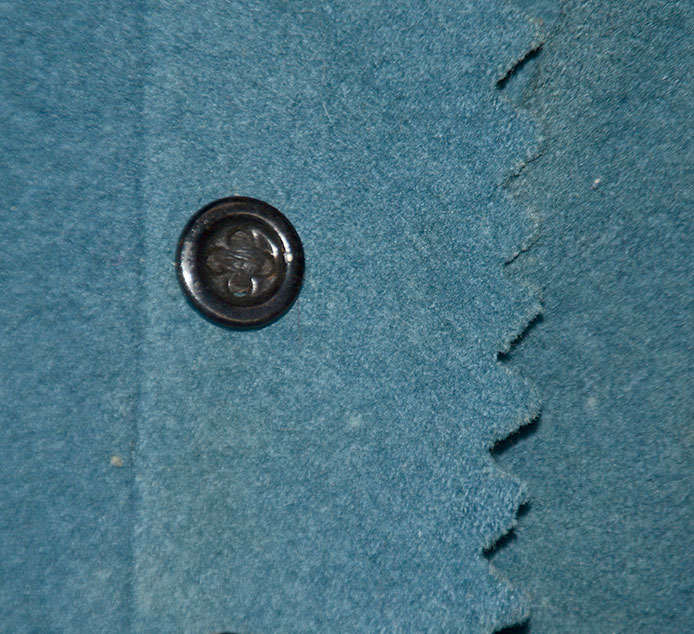
The jacket is dark blue, trimmed in sky blue, with sky blue piping along the upper, lower, and front edge of the standing collar, down the single-breasted lapel next to the buttonholes and along the bottom edge. The non-functional cuffs have a chevron of sky blue piping as well. The belt loops, buttoned at the top, on either side of the waist, are likewise piped in sky blue and the collar is faced on either side with a 4-inch long 5/8-inch wide strip of sky blue, and the short, 7-inch, skirts are faced with the same color on either side of their rear vent, forming a “W.” The shoulders are fitted for epaulets, with a dark blue strap edged in sky blue for them to slide under and a short sewn tab near the collar under which long double-wire hooks on the underside of the epaulets can fasten. The front is fastened by 9 large New York buttons, with four more on the tails at the vent, a smaller button on each side of the collar, two on either non-functional cuff, and one on each belt loop. The interior of the body in lined in white, quilted in the chest and sides, with a single interior pocket in the lower left. The sleeves are lined in white. The skirts are lined in a brown polished cotton.
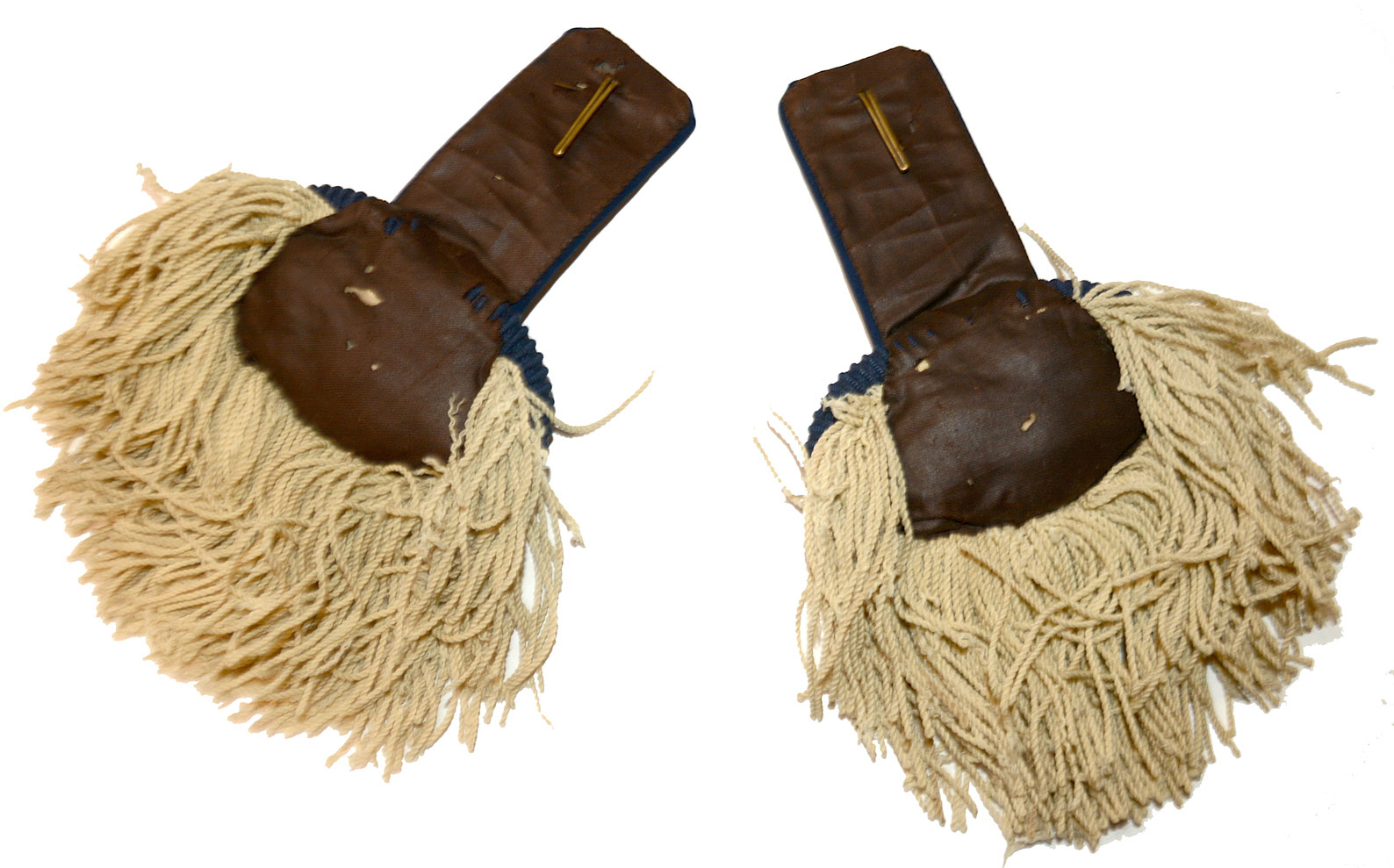
The epaulets are a deep, medium blue, called “Mazzarine blue” in the regimental history, with white fringe and white cord around the inner edge of shoulder pad. The undersides are lined with brown polished cotton. Small NY buttons are in place on the ends of the straps. The numerals and fastening hooks are in place.
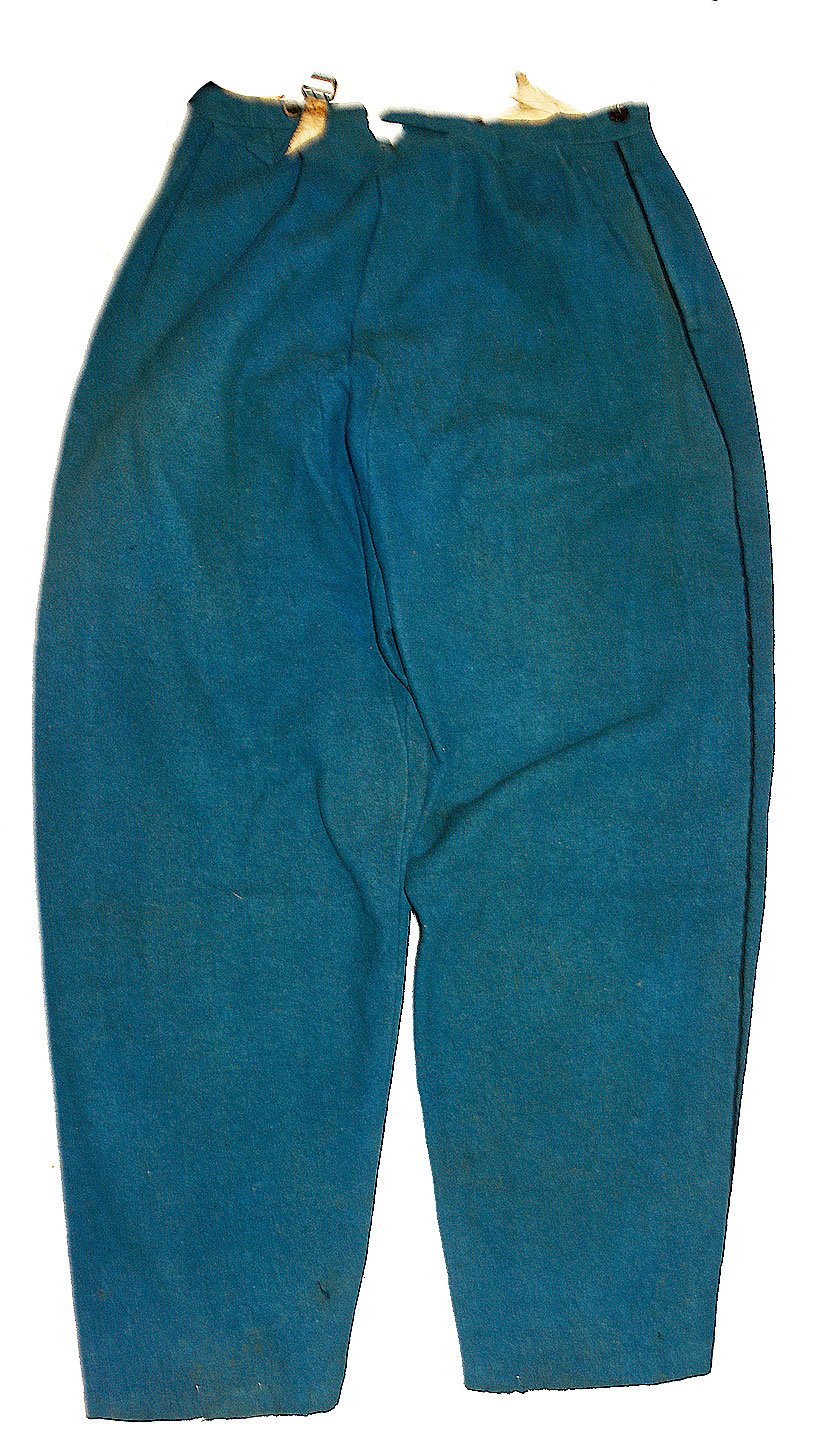
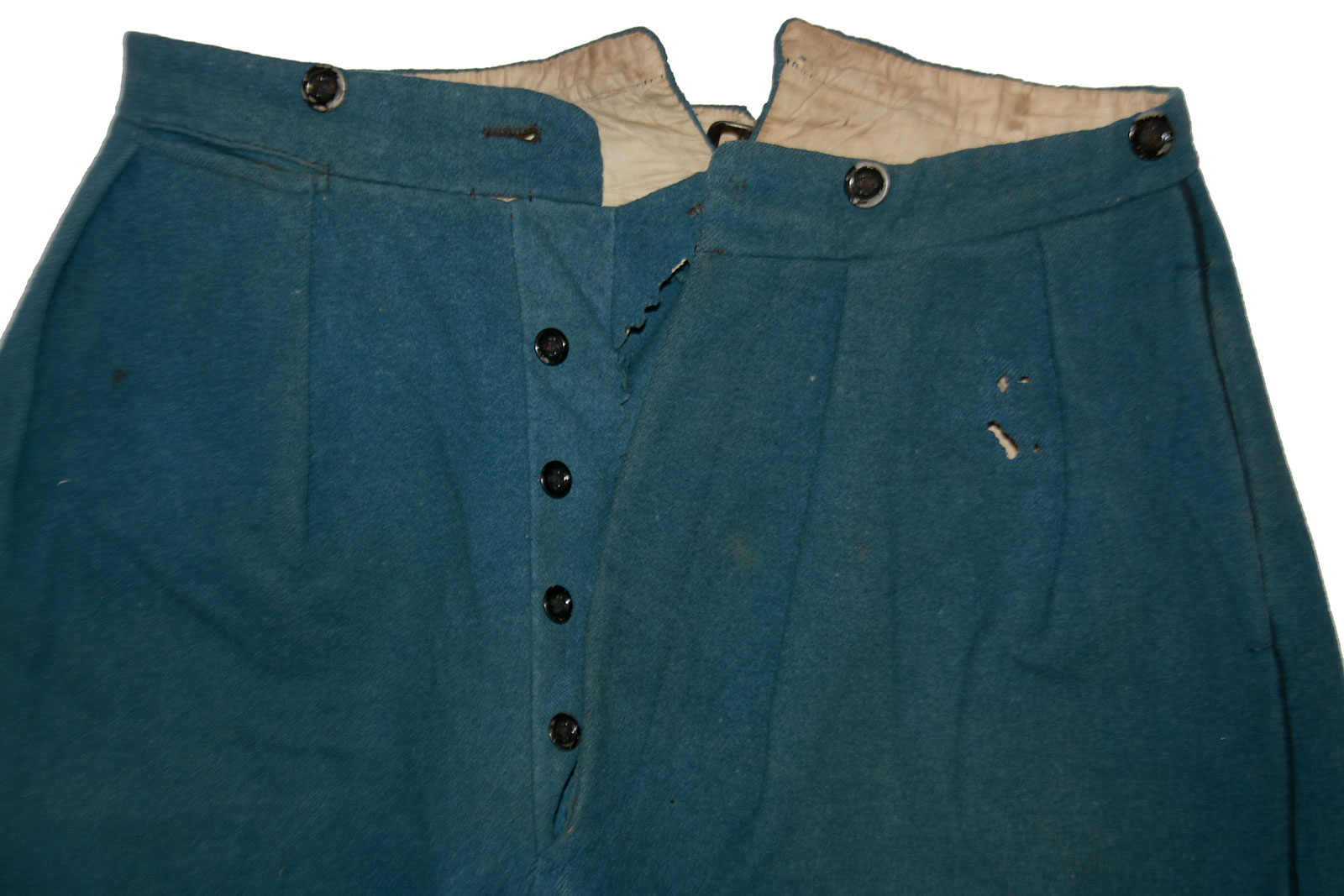
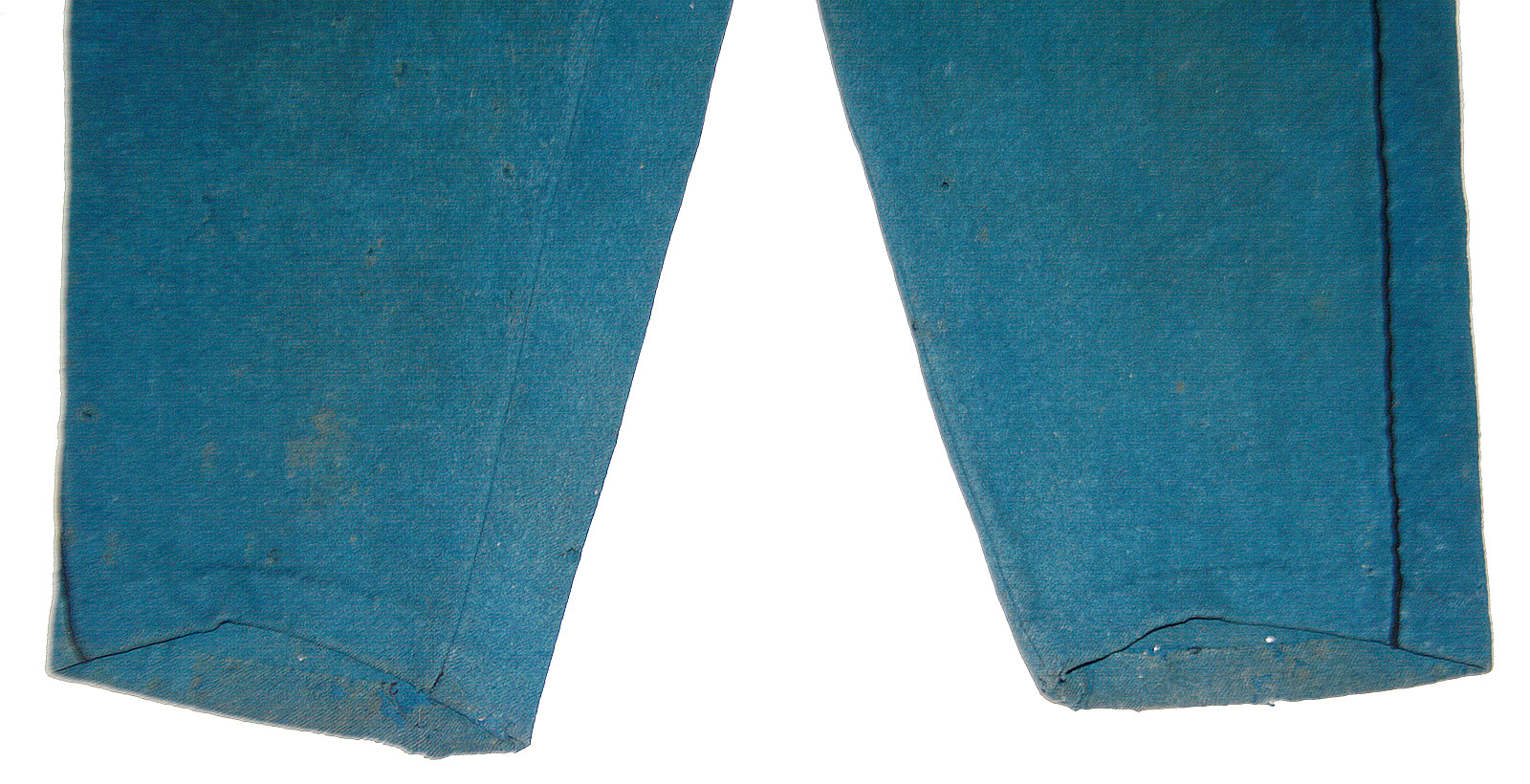
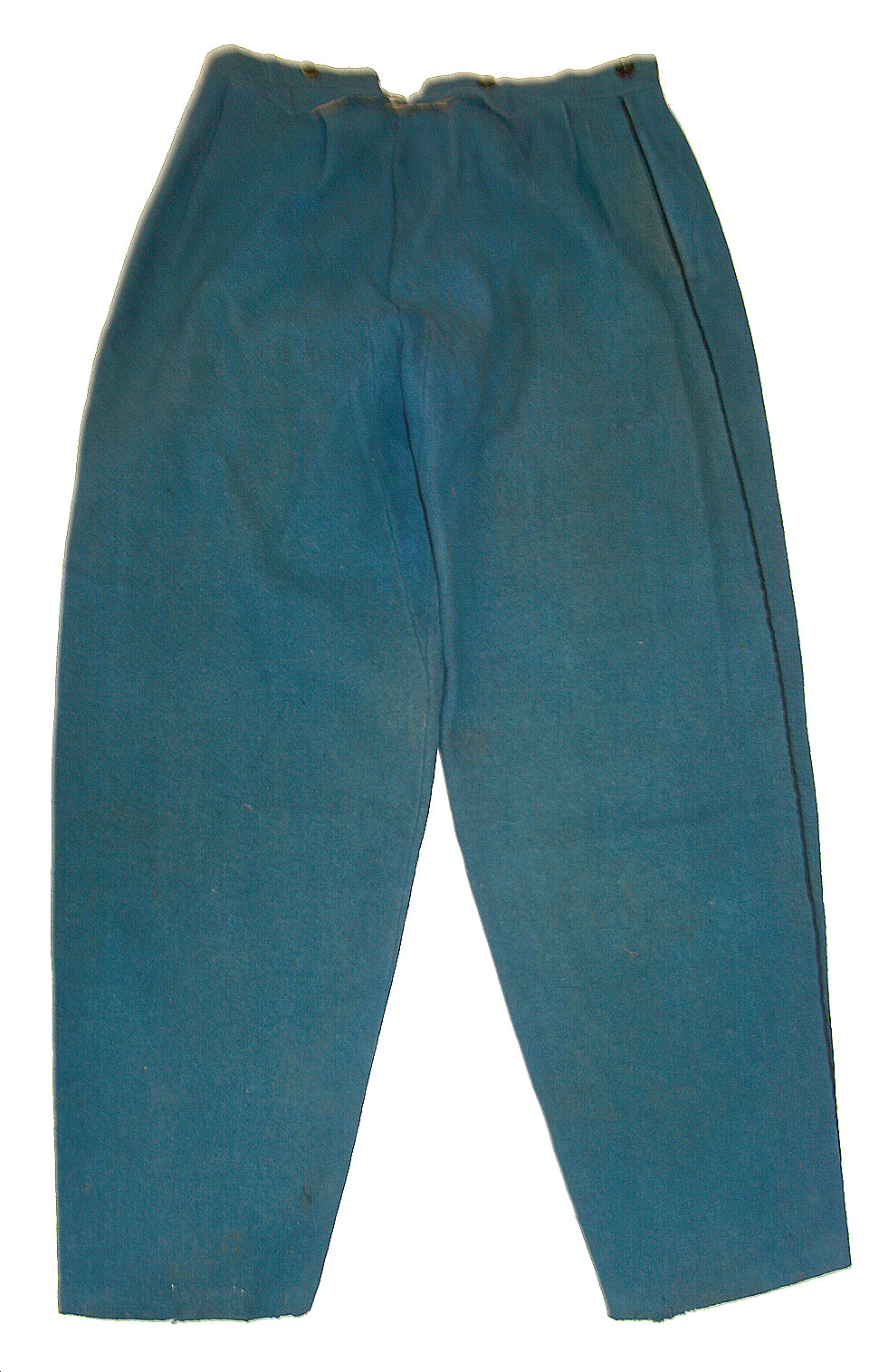
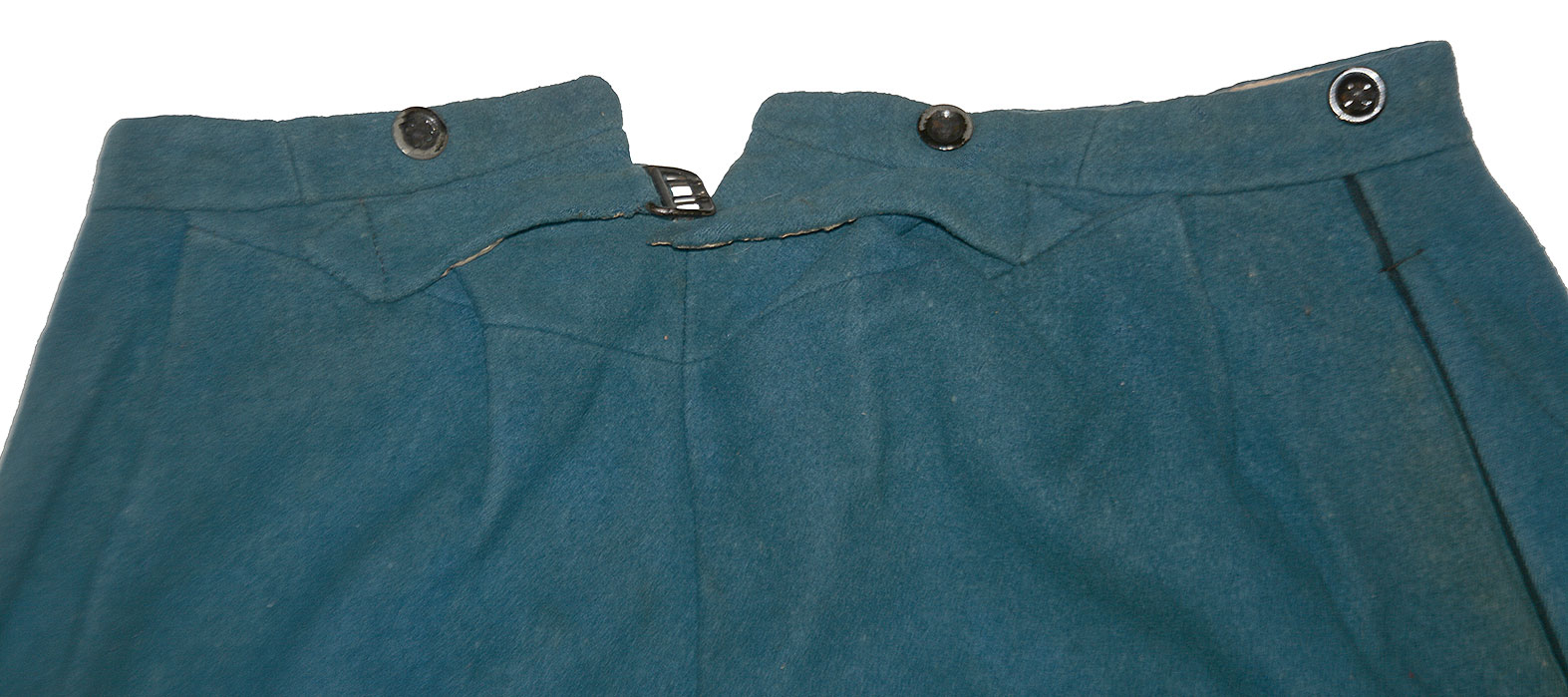
The trousers were described in the regimental history as, “loose sky-blue trousers of the "peg-top" or French pattern, fourteen inches larger at the waist than the actual measure, and plaited at the waistband.” They are fitted with four blackened tin suspender buttons, four buttons on the fly, two buttons on the waistband, and additional strap and button between the uppermost fly button and the waistband buttons. The waistband is about 1-1/2” tall at the front and 1” at the back. There is a short, 2-1/4” vent at the rear with tapering 1” wide tightening strap and buckle. There is a large pocket on either side in the seam and a small watch pocket in the lower edge of the waistband on the wearer’s right. The legs are piped in a dark blue cord in the outer seam. The waist has 4” linings with some tears and holes, but largely intact, as are the pockets.
The condition overall is very good. The jacket has a few moth nips on the inside rear of the collar, three or four small ones on the top of the right shoulder, a ½” hole on the rear of the left sleeve at the elbow, with two smaller below it, another on the back of the left shoulder where it joins the sleeve, and a third at top center rear 1-1/4” below the collar, just left of the center seam, that comes through the upper lining inside the back of the coat below the collar, and two or three small nips at lower right on the back. The front shows very few- three or four on the right skirt about halfway between the bottom button and the bottom of the skirt and a couple more below the false pocket on the lower right. The white interior of the body shows just minor stains. The brown lining of the skirts shows scattered moth bites, heavier on the wearer’s right, with a couple of ½” holes. The epaulets are excellent. The trousers have some small moth bites, mostly small pencil-eraser size, with just a few larger, on lower bottom of the lower right leg and upper left about 4” below the waist, and halfway between the fly and pocket, perhaps 1/8” wide and ¾” long, and some along the bottom and inner edges of the cuffs. None of the moth bites are affect the structural integrity of the uniform or are terribly noticeable, but all could be backed if desired. Please see our photos.
The regiment’s1863 deployment was their second and last stint of Civil War field service. Their first had officially been from May 28 to August 28, 1862, at Baltimore and Harpers Ferry, which they had extended one week by vote of the regiment when Confederate forces were rumored to be approaching. In fact, they returned to New York just in time, mustering out September 5, while the post and troops remaining there were surrendered just nine days later. Back in the City, their newly acquired drill and discipline were tested in suppressing disturbances among drunk volunteers and other police duty, and they were mobilized for field service a second time on June 18, 1863, as Lee moved north, setting out for Harrisburg the same day, mustering into US service for 30 days on June 24 as part of the Department of Susquehanna. They were under fire twice in skirmishes with advanced Confederate forces outside Harrisburg and Carlisle on June 30 and July 1, suffering one officer and two enlisted men wounded, and when Lee fell back, were temporarily attached to the 6th Army Corps in the pursuit and attempt to intercept Lee, the regimental history recording they marched 170 miles in the campaign, setting off for home only on July 17, and arriving to find that members of the regiment who had not mobilized had nevertheless been active, helping to put down the draft riots in the City.
For the history of the regiment, its service, and discussion of its uniforms please see their 1895 regimental history (available online,) the Journal of the Company of Miliary Historians Vols. 1.1 and 33.3, and especially Jan Gordon’s article in North-South Trader’s Civil War, Vol. 34.3 (2009,) which illustrates another, unidentified, example of this jacket on page 38.
This uniform group is a great combination of history and eye-appeal. [sr][ph:L]
~~~~~~~~~~~~~~~~~~~~~~~~~~~~~~~~~~~
THIS ITEM, AS WITH ALL OTHER ITEMS AVAILABLE ON OUR WEB SITE,
MAY BE PURCHASED THROUGH OUR LAYAWAY PROGRAM.
CLICK HERE FOR OUR POLICIES AND TERMS.
THANK YOU!
Inquire About 22ND NYNG CHASSEUR-STYLE JACKET, EPAULETS, AND TROUSERS
Most Popular
Historical Firearms Stolen From The National Civil War Museum In Harrisburg, Pa »
Theft From Gravesite Of Gen. John Reynolds »
Selection Of Unframed Prints By Don Troiani »
Fine Condition Brass Infantry Bugle Insignia »
Rare Identified 65Th Ny Sergeant’s Jacket, With Manscript Material: 1St U.s. Chasseurs »
featured item
IDENTIFIED PAIR OF REGULATION CIVIL WAR INFANTRY CORPORAL' S CHEVRONS – NATHAN WARREN, 45TH MASSACHUSETTS INFANTRY
These matching chevrons, right and left sleeve, were worn by Nathan Warren of the of Company E 45th Massachusetts Volunteers. Please click on this link (45th Regiment Massachusetts Volunteer Infantry). Corporal Warren's record reflects perfectly that… (1316-10). Learn More »
site search