

site search
online catalog
Holsters
Showing 21 to 28 out of 28
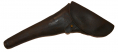
VERY NICE CONDITION EARLY CIVIL WAR U.S. CAVALRY HOLSTER
This is a very good condition early-war holster for a .36 caliber revolver with full military flap, wide belt loop secured by stitching and three rivets, toe plug, and sewn latch tab. The stitching is… (286-1332). Learn More »
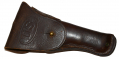
NICE CONDITION WORLD WAR ONE US HOLSTER - MAKER MARKED
Leather holster for the Model 1911 .45 pistol. Flap has a nicely stamped “US” in an oval. Reverse is marked “WARRAN LEATHER GOODS CO.” over “1918” over “J.A.O.” Leather surface is in… (362-1150). Learn More »
$150.00
SOLD
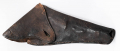
CIVIL WAR OFFICER’S BELT HOLSTER
This belt holster was made for a small revolver, likely a “pocket model” of some sort, very typical of those carried by infantry line officer as a sidearm for personal defense in addition to the… (1179-628). Learn More »
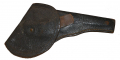
CIVIL WAR LEATHER HOLSTER FOR COLT ROOT OR SIMILAR POCKET REVOLVERS
The black leather of the holster is somewhat stiff but can be coaxed to take a weapon. The leather surface shows light crazing throughout. The holster has a rather wide flap with two parallel rows of… (490-3203). Learn More »
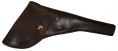
CONFEDERATE FLAP HOLSTER FOR REVOLVER
Hard to find, this is a non-regulation leather holster made to accommodate a large revolver such as a Colt or Remington “Army” revolver. The holster measures 12” along the front edge. Holster is… (1052-209). Learn More »
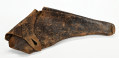
MILITARY FLAP HOLSTER FOR A .31 CALIBER REVOLVER
This is a scarce example of a privately purchased belt holster with a military style flap to carry a small .31 caliber percussion revolver, typical of those carried for personal defense by officers… (480-221). Learn More »
$446.00
Originally $495.00
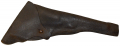
CIVIL WAR FLAP HOLSTER FOR M1849 POCKET MODEL REVOLVER
This is a black leather holster made for revolvers. The leather still shows the “profile” of a revolver cylinder and barrel. A .31 caliber “pocket” model with long barrel fits into this… (172-5636). Learn More »
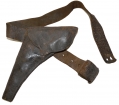
CIVIL WAR KERR REVOLVER HOLSTER ON BELT
This is a black leather holster made to accommodate the Kerr revolver. The leather still shows the “profile” of a revolver cylinder. The holster “pocket” measures approximately 9 ¼” along… (1117-97). Learn More »
Showing 21 to 28 out of 28
Most Popular
Historical Firearms Stolen From The National Civil War Museum In Harrisburg, Pa »
Theft From Gravesite Of Gen. John Reynolds »
Selection Of Unframed Prints By Don Troiani »
Fine Condition Brass Infantry Bugle Insignia »
featured item
CANADIAN MILITIA WAR OF 1812 VINTAGE PATTERN 1795 BROWN BESS WITH BAYONET
Many claim that the "Brown Bess" was named after Elizabeth I of England (However she was dead over a century before the first of these was made). Uses of the term first appear in the later 18th century. The Connecticut Courant in April 1771, said… (1273-31). Learn More »
site search