

site search
online catalog
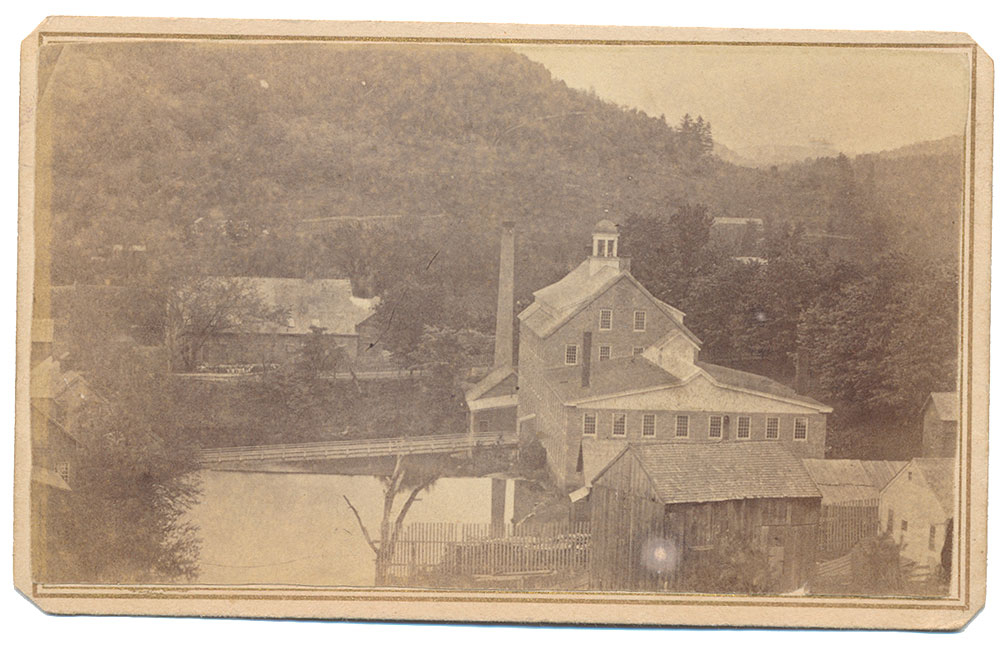
CDV VIEW OF THE ROBBINS AND LAWRENCE FACTORY- MAKERS OF THE M1841 RIFLE, THE “WINDSOR ENFIELD,” AND OTHER ARMS
Hover to zoom
$250.00 SOLD
Quantity Available: None
Item Code: 1138-2177
Few operations better illustrate the connection between arms production and the Industrial Revolution than the Robbins and Lawrence factory in Windsor, VT, whose armory building is now the home of the American Precision Museum, and well worth a visit. “But few plants have had so great an influence on American manufacturing,” according to J.W. Roe in English and American Tool Builders. This is a very clear outdoor view of the company’s armory building, erected on one side of Mill Brook, facing machine shops along the near side.
S.E. Robbins joined Windsor, VT, gunmakers Kendall and Lawrence Company in 1844 and gained a US contract for in February 1845 10,000 M1841 rifles to be delivered in 36 months. They purchased land, erected machine shops and a three-story armory along Mill Brook, expanded their work force, and not only completed their contract, but did so in half the allotted time. (Kendall left the company during production, so their later rifles omit his name on the lock plate.) Much of the company’s success was due to its machining of parts that were for all practical purposes identical and interchangeable, speeding production and easing repair, with the result that the company went into business producing precision machine tools for other businesses as well.
Their rifles got a medal at the Chrystal Palace Exhibition in London in 1851 and the machines that produced them got a British contract for machine tools for the Royal Small Arms Factory at Enfield Lock to produce Enfields with interchangeable parts. In 1855 the British connection looked even more promising with a contract for 25,000 Enfields and the prospect more in the future. The company expanded once again, even erecting a second factory in Hartford, but came to grief with production delays, occasioned largely by non-interchangeable pattern guns, inadequate gauges supplied by the British, and the cancellation of contracts with the end of the Crimean War. The company went bankrupt in 1856 and was acquisition by the Vermont Arms Company, who assembled several thousand rifles from existing parts, and then in turn went out of business in 1858, with the Hartford factory going to Sharps and the Windsor operation to Lamson and Goodnow who, as Lamson, Goodnow and Yale later filled a contract for the Special Model 1861 rifle-musket, which had Enfield characteristics, and with Lamson later producing the repeating Ball carbine late in the war as well. Whitney also got into the act, purchasing quantities of parts and some machinery, which helped in his production of Enfield-style rifle muskets, some of which, along with “Windsor Enfields,” ended up in the hands of southern militia companies and then Confederate forces.
This is a very good view of the factory that would make a great display piece alongside any of their products, or those resulting from their business misfortune. [sr][ph:L]
~~~~~~~~~~~~~~~~~~~~~~~~~~~~~~~~~~~
THIS ITEM, AS WITH ALL OTHER ITEMS AVAILABLE ON OUR WEB SITE,
MAY BE PURCHASED THROUGH OUR LAYAWAY PROGRAM.
CLICK HERE FOR OUR POLICIES AND TERMS.
THANK YOU!
Inquire About CDV VIEW OF THE ROBBINS AND LAWRENCE FACTORY- MAKERS OF THE M1841 RIFLE, THE “WINDSOR ENFIELD,” AND OTHER ARMS
Most Popular
Historical Firearms Stolen From The National Civil War Museum In Harrisburg, Pa »
Theft From Gravesite Of Gen. John Reynolds »
Selection Of Unframed Prints By Don Troiani »
Fine Condition Brass Infantry Bugle Insignia »
featured item
HISTORICALLY IMPORTANT - BATTLEFIELD USED SWORD - CARRIED BY GENERAL NELSON A. MILES
Adopted in August 1860 for staff officers, this pattern of US Army sword was used by officers of the staff and by general officers. A mistaken designation as the “1860 staff and field sword,” however, has taken hold among collectors. In use until… (1252-04). Learn More »
site search