


site search
online catalog
US CARTRIDGE BOX BELT PLATE FROM RESACA, EX-SYD KERKSIS
Hover to zoom
$450.00 SOLD
Quantity Available: None
Item Code: 2026-1261
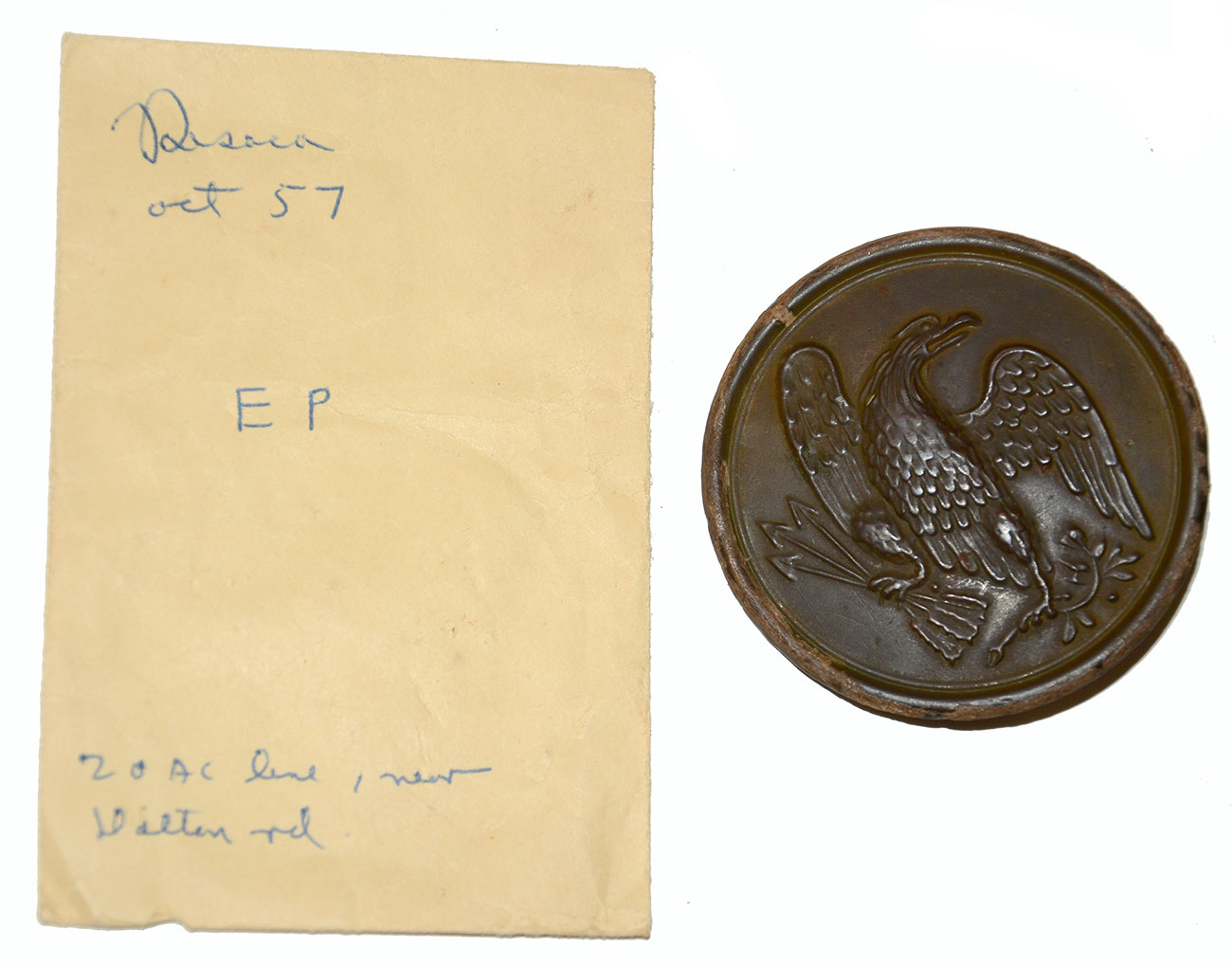
This regulation US eagle cartridge box belt plate was recovered in October 1957 at Resaca by Syd Kerksis, one of the legendary early relic hunters and collectors, author of books on military belt plates and Civil War projectiles. The plate is in Kerksis’s original paper storage envelope bearing his ink notation that he found it in the lines of the 20th Army Corps,“near Dalton rd.”
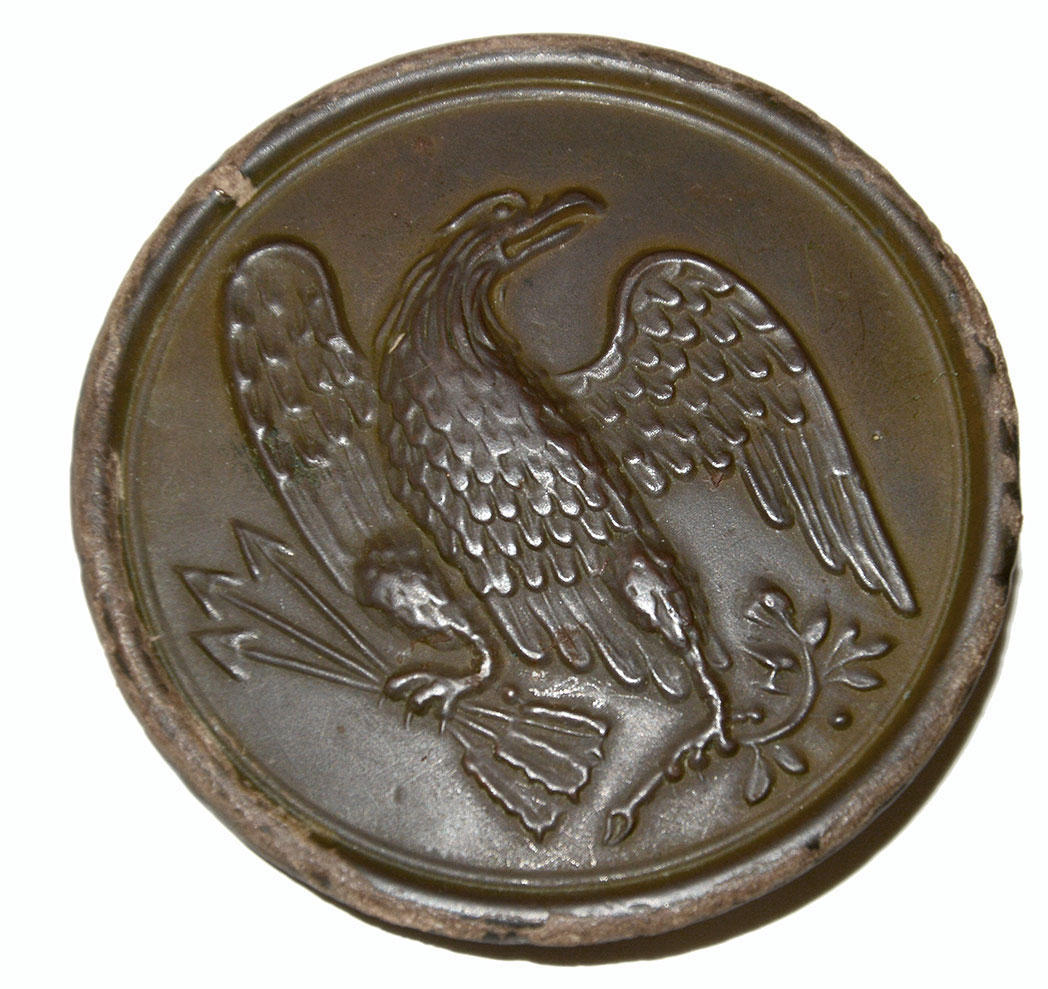
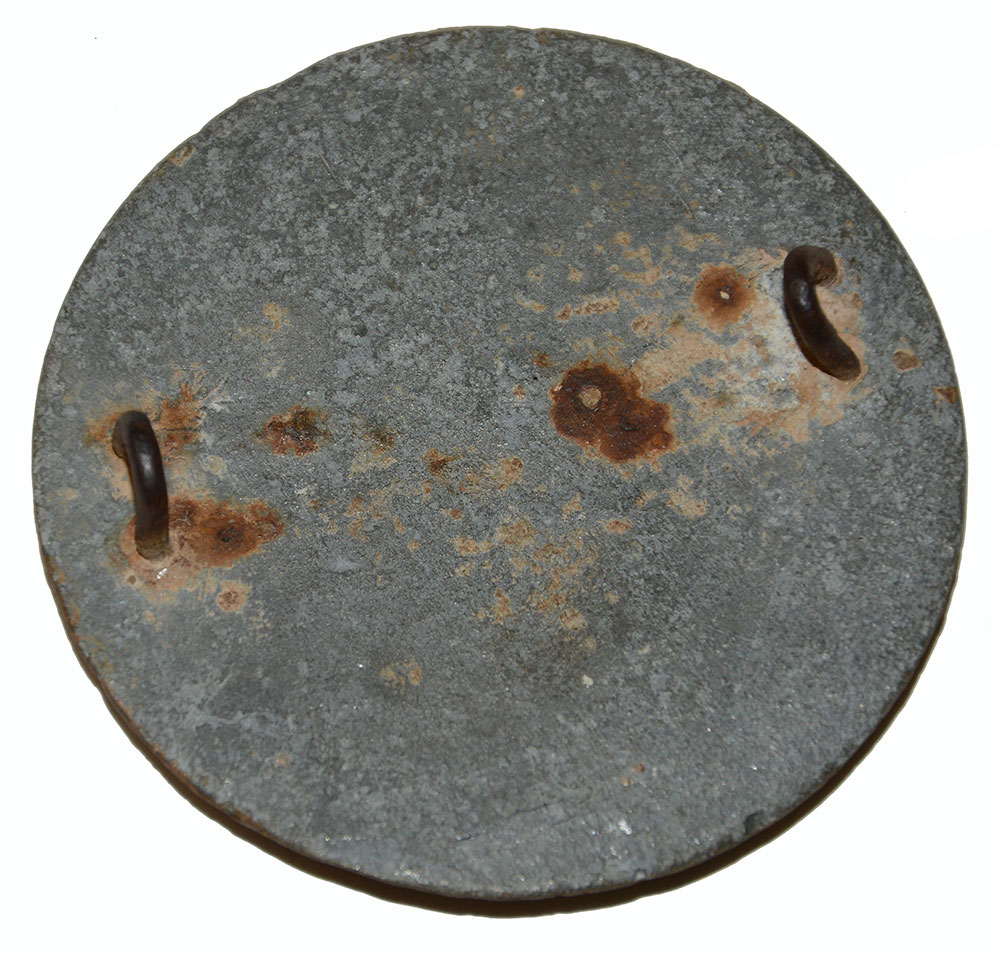
This is the regulation US plate worn on the infantry cartridge box sling, made of stamped rolled brass bearing a raised US eagle on the face, with a lead solder filled back to secure an iron wire bent to form two loops that would pass through narrow slits in the leather cartridge box sling to be secured by a thong. This pattern was first adopted in 1826 with hooks on the reverse for the bayonet shoulder belt and was made of stamped rolled brass for artillery and white metal for infantry. This was changed to brass for both services in 1831 and when the bayonet was moved to the waist belt around 1842 the plate was redesigned with two loops on the back for wear in a fixed position on the cartridge box sling. They were made by several suppliers during the war. See O’Donnell and Campbell, American Military Belt Plates, pages 274 ff., for a thorough discussion of its development, production, variations, etc. They were finally replaced by the introduction of the 1872 accouterments, though few would have been made after 1865.
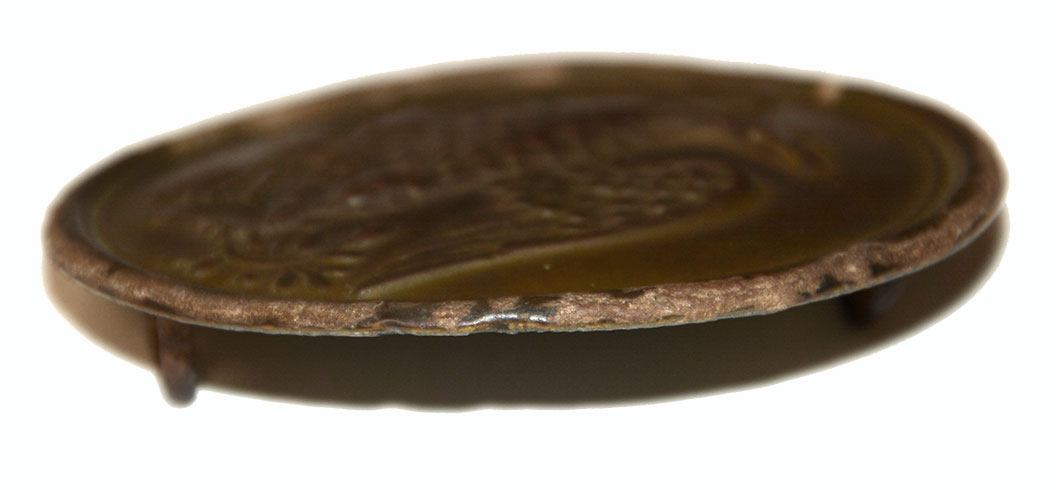
The face shows very good definition the central ground and the raised eagle with arrows and olive branch with an even brown patina. The rim shows some roughness: a couple of shallow dings at right with scattered gray and light brown crustiness around the circumference of the edge as shown. The back retains its full, level, lead-solder fill, with both iron wire loops in place. The surface shows mostly bluish gray with some white spots and some darker brown stains from oxidation of the iron wire inside, with the loops showing brown, but no deep pitting, and no losses or chipping to the fill.
Resaca was fought on May 14-15, 1864 after Sherman maneuvered Johnston back from Dalton in the opening of the Atlanta Campaign. Johnston arrayed his forces in a long arc facing west along a ridge. Kerkis’s note that he found the plate in 20th Corps lines near the Dalton Road indicates it was lost by member of Hooker’s command in the fighting of May 15 as Sherman struck the Confederate right flank, the 20th Corps shifting over to that flank, advancing along the Dalton Road, and suffering some 1,200 casualties in back-and-forth fighting that did not produce a breakthrough, Johnston pulling back only after learning his left flank was threatened to the south.
This is in very good, excavated condition, from a significant engagement, and with great provenance to an early and respected collector and author. [sr][ph:L]
~~~~~~~~~~~~~~~~~~~~~~~~~~~~~~~~~~~
THIS ITEM, AS WITH ALL OTHER ITEMS AVAILABLE ON OUR WEB SITE,
MAY BE PURCHASED THROUGH OUR LAYAWAY PROGRAM.
CLICK HERE FOR OUR POLICIES AND TERMS.
THANK YOU!
Inquire About US CARTRIDGE BOX BELT PLATE FROM RESACA, EX-SYD KERKSIS
Most Popular
Historical Firearms Stolen From The National Civil War Museum In Harrisburg, Pa »
Theft From Gravesite Of Gen. John Reynolds »
Selection Of Unframed Prints By Don Troiani »
Fine Condition Brass Infantry Bugle Insignia »
featured item
RARE PACK OF CONFEDERATE, RICHMOND ARSENAL, ARTILLERY FRICTION PRIMERS
Offered here is a very rare, nice condition, original pack of artillery friction primers manufactured at the Richmond Arsenal in Virginia during the Civil War. These “primers” are what was placed in the cannon vent hole and attached to a lanyard… (1268-512). Learn More »
site search