

site search
online catalog
LITTLE BIGHORN BATTLEFIELD RECOVERED U.S. ENLISTED MAN'S EAGLE COAT BUTTON, WITH PROVENANCE DOCUMENTATION AND FIND-LOCATION MAP
Hover to zoom
$550.00 SOLD
Quantity Available: None
Item Code: 557-318
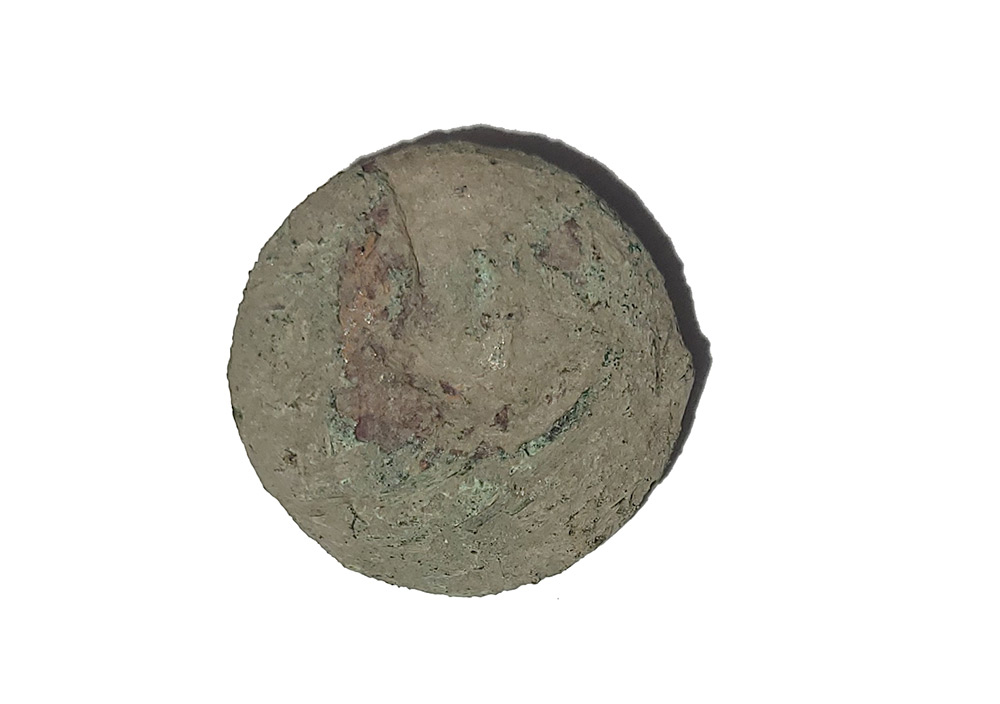
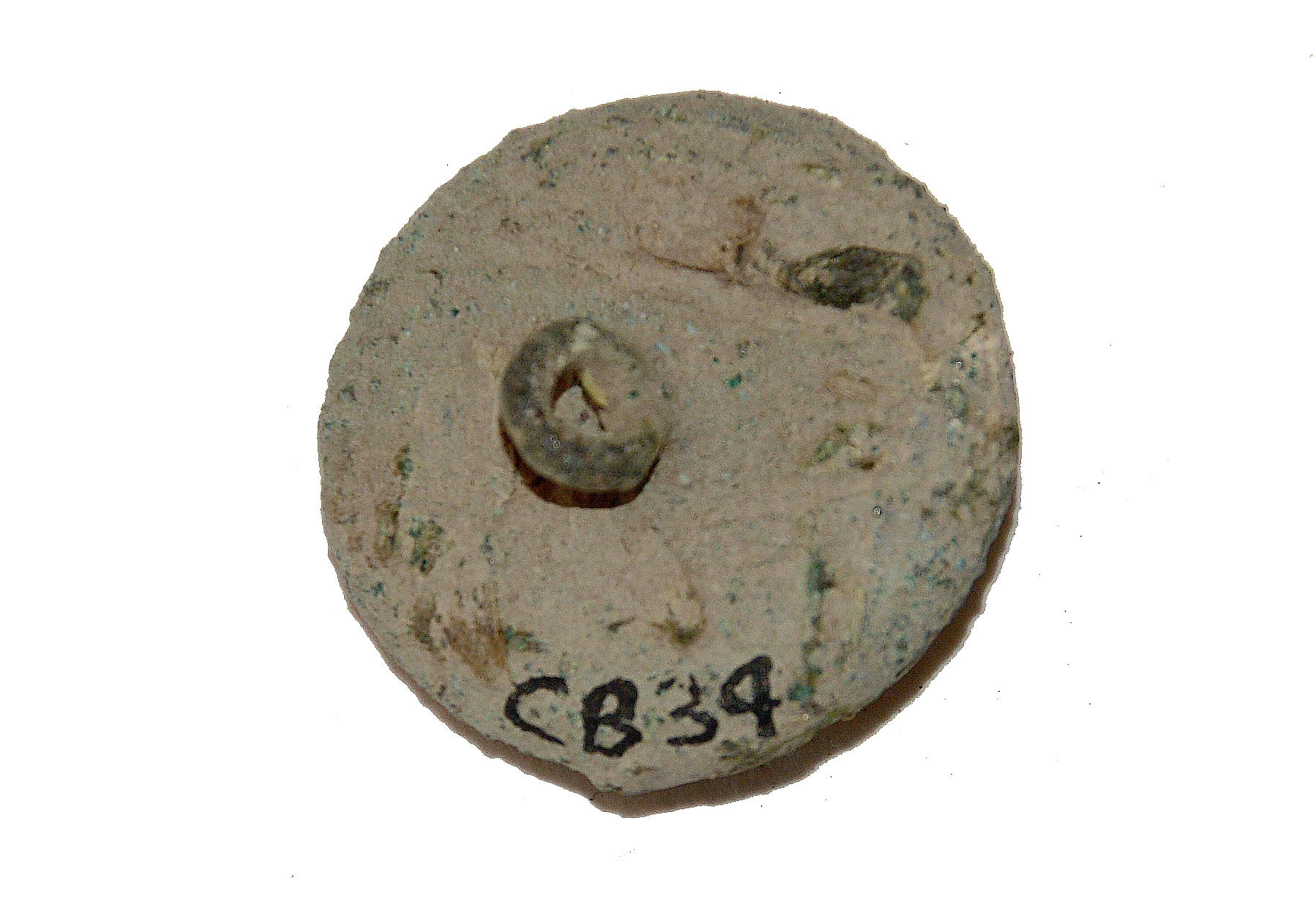
A U.S. Army general service eagle button in coat size, the pattern worn by enlisted men on the dress coat and fatigue blouse throughout the Indian Wars period, and the button carried by the troopers of the 7th U.S. Cavalry at the Little Bighorn, June 25-26, 1876. The button is a two-piece domed brass example, recovered by metal detector in the battlefield area and offered as excavated. It retains a heavy, stable crust of soil and mineral deposit with verdigris, through which portions of the spread eagle, most notably a wing, show in the red-brown of the underlying brass. The back is similarly encrusted, and the shank is intact. The reverse is numbered "CB39" in ink, matching the number recorded in the accompanying documentation. Housed in a clear capsule on black velvet.
FIND LOCATION
The accompanying map overlay marks the recovery spot of CB39 in the Little Bighorn River bottom near Medicine Tail Ford, with arrows indicating the approach to the ford. Medicine Tail Coulee and the ford below it figure prominently in accounts of the movements of Custer's battalion before the fighting on the ridges to the north.
PROVENANCE
According to the accompanying letter of William T. Goodman, this button was among a collection of excavated artifacts found by George Scott, a seasonal park ranger at what was then Custer Battlefield National Monument, and Goodman was assured that Scott found them legally on private land prior to 1984. Scott sold the collection to John N. Byrd of Helena, Montana, from whom Goodman purchased it between 1991 and 1993. In October 1999 Goodman transferred ownership of this button to Barry Kolbert of Schnecksville, Pennsylvania.
DOCUMENTATION INCLUDED
- Typed letter signed by William T. Goodman, Bozeman, Montana, identifying this button by its number, CB39, and recording its chain of ownership.
- Letter of Grover F. Botkin, Billings, Montana, on illustrated Colt's Patent Repeating Pistols letterhead, attesting to George Scott's character, his standing as an authority on the Custer-Reno-Benteen fight, his close relationship with the Crow, Cheyenne and Sioux people of the battlefield area, and his legal permission to metal detect and remove artifacts from private lands on and near the Reno-Benteen position and the Custer Hill area.
- Little Bighorn battlefield troop-movement map with overlay marking the find location of CB39 near Medicine Tail Ford.
CONDITION
As excavated and uncleaned. Encrustation obscures much of the eagle device and the back; shank intact; stable. Coat size, approx. 7/8 in. diameter.
A tangible relic of the most closely studied fight of the Indian Wars, with a documented chain of ownership running back to the finder and a recorded find location. [ss][ph:L]
~~~~~~~~~~~~~~~~~~~~~~~~~~~~~~~~~~~
THIS ITEM, AS WITH ALL OTHER ITEMS AVAILABLE ON OUR WEB SITE,
MAY BE PURCHASED THROUGH OUR LAYAWAY PROGRAM.
CLICK HERE FOR OUR POLICIES AND TERMS.
THANK YOU!
Inquire About LITTLE BIGHORN BATTLEFIELD RECOVERED U.S. ENLISTED MAN'S EAGLE COAT BUTTON, WITH PROVENANCE DOCUMENTATION AND FIND-LOCATION MAP
Most Popular
Historical Firearms Stolen From The National Civil War Museum In Harrisburg, Pa »
Theft From Gravesite Of Gen. John Reynolds »
Selection Of Unframed Prints By Don Troiani »
Fine Condition Brass Infantry Bugle Insignia »
Rare Identified 65Th Ny Sergeant’s Jacket, With Manscript Material: 1St U.s. Chasseurs »
featured item
AUGUST, 1862 CONFEDERATE DISCHARGE – PVT. JOHN MCCOLLUM, 3rd ARKANSAS – EX COCO-COLLECTION
This scarce subtype of document served as a record of the honorable discharge of Pvt. John McCollum of Company F, 3rd Arkansas Infantry. He enlisted on September 17th, 1861 for a term of 1 year, and his discharge is dated August 15th, 1862 and he… (1300-85). Learn More »
site search