


site search
online catalog
Uniforms & Cloth
Showing 121 to 140 out of 231
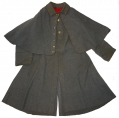
INDIAN WARS MOUNTED SERVICES GREATCOAT WITH NEW YORK BUTTONS AND MAKER MARKINGS
This unique military overcoat is of the post-Civil War Indian Wars period and features a unique pattern with New York State appointments. The piece seems to be something of a hybrid between the m1858… (490-7149). Learn More »
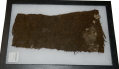
PIECE OF CIVIL WAR - INDIAN WAR FRONTIER US ARMY BLANKET FROM FORT PEMBINA, NORTH DAKOTA
This piece of a US Army military issue blanket comes from excavations at Fort Pembina, ND, conducted on private property with the owner’s permission, a fort established in 1870 by troops of the 20th… (1052-615). Learn More »
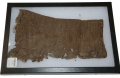
US ARMY SHIRT CUFF FROM FORT PEMBINA, NORTH DAKOTA
A relic from a small U.S. Army frontier post of the Indian Wars- part of a soldier’s shirt. This is the shirt cuff, still showing a small button near the corner, and a portion of the lower sleeve.… (1052-602). Learn More »
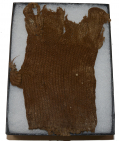
REMNANT OF SCARCE INDIAN WAR SOLDIER’S MITTEN FROM FORT PEMBINA, ND
This comes from the excavations at Fort Pembina, occupied 1870-1895, where cold weather in winter months might well be a concern. The army began issuing mittens in 1873. Before that men were left to… (1052-584). Learn More »
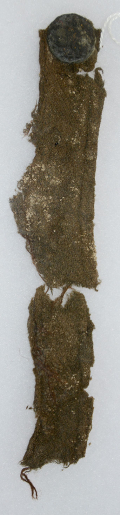
CIVIL WAR-INDIAN WAR UNIFORM COAT PIECE WITH BUTTON FROM FORT PEMBINA
This is part of the right lapel of a US army coat discarded by a soldier at Fort Pembina, ND, sometime between 1870 and 1895, and is from excavations in wet, anaerobic soil that has preserved leather… (1052-724). Learn More »
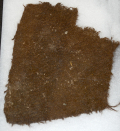
PIECE OF US ARMY BLANKET FROM FORT PEMBINA, NORTH DAKOTA
This piece of a US Army military issue blanket comes from excavations at Fort Pembina, ND, conducted on private property with the owner’s permission, a fort established in 1870 by troops of the 20th… (1052-616). Learn More »
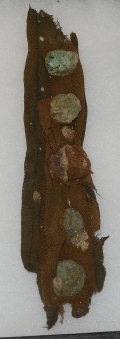
PIECE OF AN INDIAN WAR M1872 FATIGUE BLOUSE OR DRESS COAT FROM FORT PEMBINA, ND
This is a piece from the lapel of a US Army jacket showing part of the blue outer fabric, the lining and the remains of five corroded brass buttons. From the size and spacing of the buttons this is… (1052-608). Learn More »
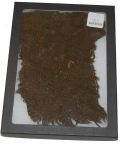
PIECE OF CIVIL WAR ARMY BLANKET FROM FORT PEMBINA, NORTH DAKOTA
The army had vast stocks of Civil War material left over at the end of the war. These supplies, along with the reduction of the postwar army meant U.S. troops were getting Civil War gear well into the… (1052-617). Learn More »
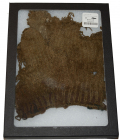
SCARCE INDIAN WAR SOLDIER’S MITTEN FROM FORT PEMBINA, ND
This comes from the excavations at Fort Pembina, occupied 1870-1895, where cold weather in winter months might well be a concern. The army began issuing mittens in 1873. Before that men were left to… (1052-620). Learn More »
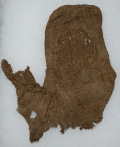
INDIAN WAR SOLDIER’S MITTEN FROM FORT PEMBINA, ND
This comes from the excavations at Fort Pembina, occupied 1870-1895, where cold weather in winter months might well be a concern. The army began issuing mittens in 1873. Before that men were left to… (1052-619). Learn More »
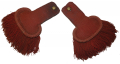
FINE PAIR OF RED EPAULETTES
Pair of red wool epaulettes with “eagle A” buttons. Epaulette outer-surfaces feature beautiful, woven red wool with a ribbed border, and thick rows of hanging tassels. A single eagle “A”… (1179-1652). Learn More »
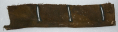
CIVIL WAR-INDIAN WAR UNIFORM LAPEL FROM FORT PEMBINA
This strip of cloth showing three buttonholes (and what seems to be part of a fourth) is the remnant of an army dress coat discarded after its useful days were done at Fort Pembina, a small frontier… (1052-610). Learn More »
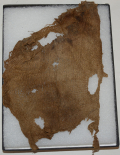
INDIAN WAR SOLDIER’S MITTEN PIECE FROM FORT PEMBINA, ND
This comes from the excavations at Fort Pembina, occupied 1870-1895, where cold weather in winter months might well be a concern. The army began issuing mittens in 1873. Before that men were left to… (1052-621). Learn More »
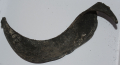
CIVIL WAR-INDIAN WAR FORAGE CAP VISOR
This is a well preserved leather visor from a forage cap recovered at Fort Pembina, ND, where it was preserved in remarkable condition by wet, anaerobic soil conditions. This is typical of the simple… (1052-485). Learn More »
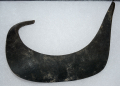
CIVIL WAR-INDIAN WAR FORAGE CAP VISOR
This is a well preserved leather visor from a forage cap recovered at Fort Pembina, ND, where it was preserved in remarkable condition by wet, anaerobic soil conditions. This is typical of the simple… (1052-482). Learn More »
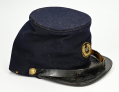
CIVIL WAR COMMERCIAL FORAGE CAP WITH MAINE BUTTONS AND ASSOCIATED INSIGNIA
Commercial caps were simply those purchased privately rather the issued by the government. They might more or less closely follow contract patterns with the purchaser able to suit his taste and… (1052-139). Learn More »
$4,000.00
Originally $4,500.00
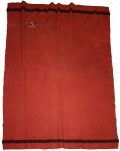
IDENTIFIED ISSUE RED BLANKET OF THEODORE P. BOWKER 13th MASSACHUSETTS - DIED OF WOUNDS AT ANTIETAM!
This is a rare, early-war, identified Massachusetts issue red blanket carried by a soldier in the 13th Massachusetts who was wounded at Antietam on Sept. 17, 1862, and died of those wounds at a U.S.… (490-7138). Learn More »
$6,500.00
Originally $7,500.00

EXCELLENT PAIR OF CIVIL WAR FEDERAL INFANTRY REGULATION CORPORAL CHEVRONS/STRIPES
Union infantry companies fielded eight corporals. Along with the sergeants they might be charged with supervising squads or fatigue details, but in battle were posted in the front rank of the line of… (490-7163). Learn More »
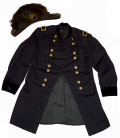
MINT IDENTIFIED BREVET BRIGADIER GENERAL’S FROCK COAT AND CHAPEAU OF ALONZO ALDEN
This sets consists of Brevet Brigadier General Alonzo Alden’s mint condition brigadier general’s frock coat with shoulder straps and his full dress “light French chapeau,” allowed for officers… (1179-156). Learn More »
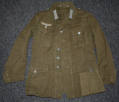
VETERAN BRING BACK GERMAN "AFRIKA CORPS" TUNIC
This enlistedman's open-collared field blouse is the style developed in 1940 in anticipation of deployment of German forces to North Africa under Irwin Rommel. This jacket of mid-brown canvas/cotton… (1235-453). Learn More »
$3,200.00
Originally $3,500.00
Showing 121 to 140 out of 231
Most Popular
Historical Firearms Stolen From The National Civil War Museum In Harrisburg, Pa »
Theft From Gravesite Of Gen. John Reynolds »
Selection Of Unframed Prints By Don Troiani »
Fine Condition Brass Infantry Bugle Insignia »
Rare Identified 65Th Ny Sergeant’s Jacket, With Manscript Material: 1St U.s. Chasseurs »
featured item
FINE ITALIAN SNAPHAUNCE BELT PISTOL CA. 1675
The snaphaunce is one of the earlier forms of flint and steel ignition and was introduced in the mid-16th century. It remained in use in Northern Italy into the mid-18th century giving it a particularly long period of use. Ornate pistols such as… (2026-657). Learn More »
site search