

site search
online catalog
Uniforms & Cloth
Showing 81 to 100 out of 223
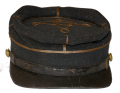
CONFEDERATE SURGEON'S KEPI FOUND IN SOUTH CAROLINA
This cap was discovered in a Civil War period home in Charleston SC near "The Battery" neighborhood not many years ago. When found the cap needed a few minor repairs but it otherwise remains untouched… (1130-09). Learn More »
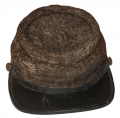
A FINE EXAMPLE OF A CONFEDERATE INFANTRYMAN'S KEPI
This cap's crown, top and base band are made from a medium weight open weave woolen fabric which may be a blend of sorts. It certainly looks "home spun". The kepi gives indications of being a depot… (1268-037). Learn More »
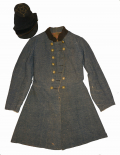
A BEYOND RARE CS ARKANSAS FROCK COAT AND "BONNET DE POLICE"
Mr. Ray Richey, owner of the Texas Civil War Museum, purchased this uniform coat and hat directly from an Arkansas estate in 2003. Twenty-six years prior to this it was acquired from the Beneux… (1268-057). Learn More »
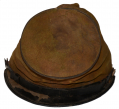
A FORAGE CAP THAT "WHISTLES DIXIE"
This coffee-colored wool forage cap was discovered in Morristown, Tennessee in 1964 by a Mr. Robert Walter. Based on the pre-war model 1858 cap it certainly is a wool and cotton blend and measures 3… (1268-554). Learn More »
$12,500.00
ON HOLD
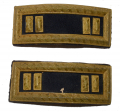
NICELY MARKED SMITH PATENT CAPTAIN OF STAFF SHOULDER STRAPS
A very good condition and good looking set of Smith Patent shoulder straps for a Captain on staff duty. There were at least a couple of patents during the Civil War for some form of metallic border in… (490-7268). Learn More »
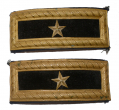
CIVIL WAR BRIGADIER GENERAL SMITH PATENT SHOULDER STRAPS
An excellent condition set of Smith Patent shoulder straps for a Brigadier General. James Smith’s patent used stamped and gilded brass metallic frames to imitate the bullion embroidered borders of… (490-7265). Learn More »

ZOUAVE FIRST SERGEANT CHEVRONS
These chevrons measure about 8 inches wide and 4 inches tall and use a red ground with three narrow, sewn, medium blue stripes and a diamond/lozenge, indicating a First Sergeant, the senior… (490-7153). Learn More »
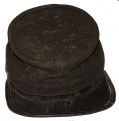
CONFEDERATE DEEP SOUTH DEPOT ENLISTEDMAN'S KEPI
Federal soldier George Wilson, 21st Missouri Infantry (US), captured this cap at the Fort Blakely fight near Mobile, Alabama April 9th, 1865. The cap appears to have been mass produced at a clothing… (2025-300). Learn More »
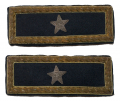
BRIGADIER GENERAL’S SHOULDER STRAPS
A very nice condition pair of Civil War period Brigadier General’s shoulder straps showing signs of actually having been worn on a uniform. These measure 1-1/2” wide by 3-7/8” long and are… (2025-278). Learn More »
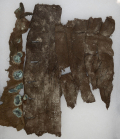
PIECE OF AN INDIAN WAR M1872 FATIGUE BLOUSE FROM FORT PEMBINA, ND
This is a portion of a rare Model 1872 fatigue blouse clearly showing the characteristic pleats of the pattern. These were replacements for the old Civil War M1858 fatigue blouse (the 4-button sack… (1052-579). Learn More »
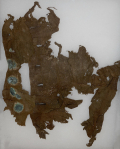
PIECE OF AN INDIAN WAR M1872 FATIGUE BLOUSE FROM FORT PEMBINA, ND
This is a portion of the rare Model 1872 fatigue blouse. The pattern was a replacement for the old Civil War M1858 fatigue blouse (the 4-button sack coat,) made with the idea of giving the soldier… (1052-578). Learn More »
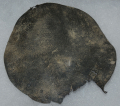
KEPI OR DRESS CAP STIFFENER FROM FORT PEMBINA
This comes from the excavations at Fort Pembina, ND, a small frontier army post in operation from 1870 to 1895, and is the stiffener from inside the top of a kepi a M1872 dress cap. It is black in… (1052-1152). Learn More »
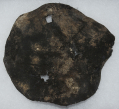
KEPI OR DRESS CAP STIFFENER FROM FORT PEMBINA
This comes from the excavations at Fort Pembina, ND, a small frontier army post in operation from 1870 to 1895, and is the stiffener from inside the top of a kepi a M1872 dress cap. It is black in… (1052-475). Learn More »
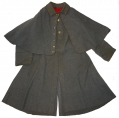
INDIAN WARS MOUNTED SERVICES GREATCOAT WITH NEW YORK BUTTONS AND MAKER MARKINGS
This unique military overcoat is of the post-Civil War Indian Wars period and features a unique pattern with New York State appointments. The piece seems to be something of a hybrid between the m1858… (490-7149). Learn More »
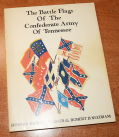
BOOK – THE BATTLE FLAGS OF THE CONFEDERATE ARMY OF TENNESSEE
By Howard Madaus & Robert Needham, published by the Milwaukee Public Museum in 1976. Soft cover, perfect bound, 152 pages, 8.5” x 11”. Heavily illustrated with line drawings of which some are… (1266-1055). Learn More »
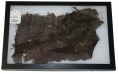
PIECE OF A U.S. FLAG FROM THE FRONTIER US ARMY FORT PEMBINA, NORTH DAKOTA
This piece of bunting comes from excavations at Fort Pembina, ND, conducted on private property with the owner’s permission, a fort established in 1870 by troops of the 20th US Infantry and… (1052-722). Learn More »
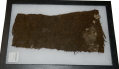
PIECE OF CIVIL WAR - INDIAN WAR FRONTIER US ARMY BLANKET FROM FORT PEMBINA, NORTH DAKOTA
This piece of a US Army military issue blanket comes from excavations at Fort Pembina, ND, conducted on private property with the owner’s permission, a fort established in 1870 by troops of the 20th… (1052-615). Learn More »
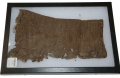
US ARMY SHIRT CUFF FROM FORT PEMBINA, NORTH DAKOTA
A relic from a small U.S. Army frontier post of the Indian Wars- part of a soldier’s shirt. This is the shirt cuff, still showing a small button near the corner, and a portion of the lower sleeve.… (1052-602). Learn More »
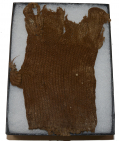
REMNANT OF SCARCE INDIAN WAR SOLDIER’S MITTEN FROM FORT PEMBINA, ND
This comes from the excavations at Fort Pembina, occupied 1870-1895, where cold weather in winter months might well be a concern. The army began issuing mittens in 1873. Before that men were left to… (1052-584). Learn More »

KEPI CHINSTRAP AND SIDE BUTTONS FROM AN INDIAN WAR FRONTIER
This is a complete leather chinstrap from an army kepi or forage cap from excavations at Fort Pembina, ND. The chinstrap is a two-piece style with a fixed loop on the end of one strap and a fixed… (1052-486). Learn More »
Showing 81 to 100 out of 223
Most Popular
Historical Firearms Stolen From The National Civil War Museum In Harrisburg, Pa »
Theft From Gravesite Of Gen. John Reynolds »
Selection Of Unframed Prints By Don Troiani »
Fine Condition Brass Infantry Bugle Insignia »
featured item
1/4 PLATE THERMOPLASTIC CASE WITH AMBROTYPE OF WOMAN & TINTYPE OF 2/LT. BAKER 20TH PA. INFANTRY – THE GREAT RAILROAD STRIKE OF 1877
Left half of this hard case houses an ambrotype of a finely dressed woman. Her cheeks and forehead are tinted. The image is matted, framed, and under glass as is typical. The right side of the case holds an 1877 tintype image of S. Charles Baker in… (1221-53). Learn More »
site search