

site search
online catalog
Bottles
Showing 1 to 20 out of 53
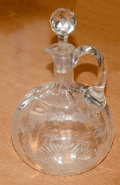
CIRCA 1870 ENGRAVED WHISKEY JUG BY DORFLINGER
Whiskey jug with beautifully engraved initials "T J H" on one side and a floral spray on the other. This piece was made by the Dorflinger factory in White Mills, PA around 1870. Dorflinger was one… (1239-162). Learn More »
$125.00
SOLD
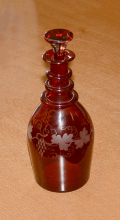
ENGRAVED, RED STAINED CONTINENTAL DECANTER, C. 1840-1850
Engraved red stained Continental decanter with three applied neck rings and an open pontil , 1840-1850. This decanter stands 7 1/4" tall and retains its original, cone-shape stopper. This type… (1239-158). Learn More »
$35.00
SOLD
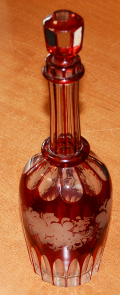
C. 1840-1860 BOHEMIAN CUT AND ENGRAVED DECANTER, FLASHED WITH RUBY GLASS
Bohemian cut and engraved colorless decanter flashed with ruby glass, 1840-1860. Flashed glass has a very thin coating of a second color glass over the colorless base. It is sometimes difficult to… (1239-157). Learn More »
$85.00
SOLD
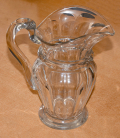
CIRCA 1830-1855 CUT MIDDLE PERIOD AMERICAN WATER PITCHER
Cut middle period American water pitcher 1830-1855, 9" tall, probably Wheeling, VA (now WV). The middle period of American glass is characterized by large, heavy pieces, cut with broad flutes or… (1239-160). Learn More »
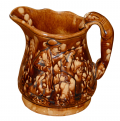
CIRCA 1850-1858 YELLOWWARE ROCKINGHAM GLAZE PITCHER ENTITLED “THE GAMEKEEPER”
Yellowware Rockingham glaze pitcher 8 ” tall. E.&W. Bennett 1850-1858 or Edwin Bennett 1858-1870, Baltimore MD. The name of this pitcher is “The Gamekeeper”. It depicts on the left a… (1239-147). Learn More »
$50.00
ON HOLD
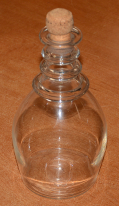
EARLY PRUSSIAN SHAPE QUART DECANTER, C1815-1825
Early Prussian shape quart decanter. From its bulbous shape, short neck and applied tripart neck rings, this decanter can be dated 1815-1825 and was probably made in the Eastern US. It is 8 1/4"… (1239-153). Learn More »
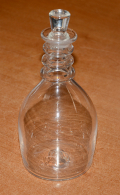
EARLY PRUSSIAN SHAPE PINT DECANTER, C1815-1825
Early Prussian shape pint decanter, 6 3/4" tall without the replaced glass stopper. From its bulbous shape, short neck and three applied neck rings, this decanter can be dated 1815-1825. Having a… (1239-152). Learn More »
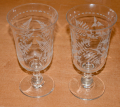
PAIR OF CELERY VASES C. 1869-1880
Pair of celery vases with cylindrical bowls and slightly flaring rims, applied baluster stems and round applied feet with polished pontils. United States, probably Wheeling, WV 1869-1880. The… (1239-148). Learn More »
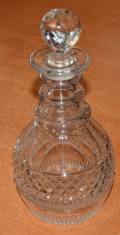
CUT GLASS REGENCY STYLE DECANTER, C. 1815-1840
This cut glass Regency style decanter with a polished pontil was made 1815-1840 either in the US or England and is 8 1/4" tall without the replaced stopper. It is beautifully cut with a band of… (1239-143). Learn More »
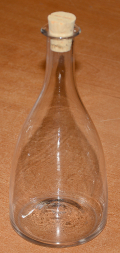
BLOWN LEAD GLASS TAPER DECANTER, 1780-1820
This decanter was probably made in the US and is not ground for a stopper, which means it was either corked, or intended as a serving bottle and emptied after use. It is 7 3/4" and has a rough… (1239-145). Learn More »
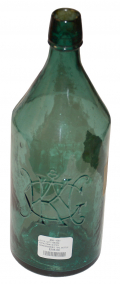
GETTYSBURG KATALYSINE WATER MONOGRAMMED BOTTLE (GKW)
The bottle is embossed on the bottom as having been made by Whitney Glassworks Glassboro NJ. This rare teal bottle dates from 1875-1890. There is nice bubbling in the glass. The springs were… (635-621). Learn More »
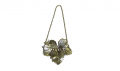
BOTTLE LABEL WITH CHAIN
Bottle ticket or label with a chain. Made of sterling silver it is in the shape of a leaf. In the center is the word PORT formed by removing material. On the back is the maker's mark "R" The silver… (179-272). Learn More »
$105.00
Originally $135.00
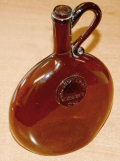
BLOWN AMBER WHISKEY BOTTLE C1858-1870
Blown amber whiskey bottle with an applied handle and open pontil, 8 7/8" tall. The front of the bottle has an applied seal marked "Chestnut Grove Whiskey C. W." Note the misspelling of Chestnut,… (1239-130). Learn More »
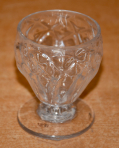
HEAVY LEAD GLASS SALT CELLAR
Heavy lead glass salt cellar, referred to as a bonnet glass in the UK. Ten molded diamonds over flutes, 3" tall, with an open pontil. American or Anglo/Irish 1760-1790. There is some debate as… (1239-135). Learn More »
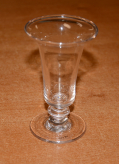
AMERICAN OR ENGLISH LEAD GLASS JELLY OR SYLLABUB GLASS
American or English lead glass jelly or syllabub glass, 4 3/8" tall, 1790-1810, with a compressed medial knop stem and open pontil on the foot. This now extinct form was used to serve syllabub, a… (1239-134). Learn More »
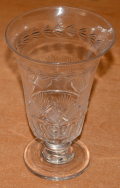
C1825-1835 CELERY VASE WITH STRAWBERRY DIAMOND AND FAN PATTERN
Celery vase cut in the strawberry diamond and fan pattern, probably Bakewell, Page and Bakewell, Pittsburgh, PA 1825-1835. There is a cut band of husk below the rim and a band of broad flutes… (1239-123). Learn More »
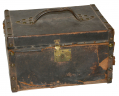
PRE-CIVIL WAR ERA MEDICINE CHEST WITH 17 ORIGINAL BOTTLES – EX-TEXAS CIVIL WAR MUSEUM COLLECTION
This leather-covered wood medicine box/chest closely fits examples from the pre-Civil War period in construction, design, and contents. The exterior leather shows wear consistent with age, including… (1179-672). Learn More »
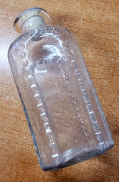
SMALL LEAD GLASS CASE BOTTLE, CIRCA 1790-1830
This small case bottle is of lead glass with chamfered corners cut with arches made of ovals; polished pontil; 6 1/4" tall; the thickness and crudeness of the glass suggests American manufacture. … (1239-112). Learn More »
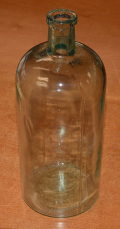
CIRCA 1880-1890 MEDICINE BOTTLE
This aqua tinted bottle stands 10 ½” tall with a base measuring 4” in diameter. Excellent condition, no chips or cracks. There are a few air bubbles in the glass, the largest one measuring… (1266-258). Learn More »
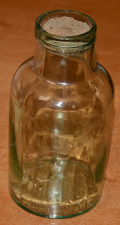
CIRCA 1880-1890 MEDICINE BOTTLE
This aqua tinted bottle stands approx. 8 ¼” tall with a 4” diameter base. It has an unusually wide neck and mouth, measuring 2 ¼” wide at the lip. No chips or cracks; scattered numerous… (1266-256). Learn More »
Showing 1 to 20 out of 53
Most Popular
Historical Firearms Stolen From The National Civil War Museum In Harrisburg, Pa »
Theft From Gravesite Of Gen. John Reynolds »
Selection Of Unframed Prints By Don Troiani »
Fine Condition Brass Infantry Bugle Insignia »
Rare Identified 65Th Ny Sergeant’s Jacket, With Manscript Material: 1St U.s. Chasseurs »
featured item
ID’D WW2 LEATHER A-2 FLYING JACKET, 351ST BOMB GROUP – B-17 P.O.W.
This nice condition A-2 jacket was worn in WW2 by Lt. Kenneth Lester Vaughn. He was a B-17 co-pilot with the 511th Bomb Squadron, 351st Bomb Group, 8th Air Force in England. The Type A-2 flying jacket was standardized by the U.S. Army Air Corps on… (534-46). Learn More »
site search