


site search
online catalog
Relics
Showing 141 to 160 out of 317
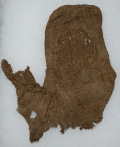
INDIAN WAR SOLDIER’S MITTEN FROM FORT PEMBINA, ND
This comes from the excavations at Fort Pembina, occupied 1870-1895, where cold weather in winter months might well be a concern. The army began issuing mittens in 1873. Before that men were left to… (1052-619). Learn More »

SPRINGFIELD 1838 DATED M1816 PERCUSSION CONVERSION MUSKET FROM THE YORK SPRINGS, PA., G.A.R. POST, WITH MILITARY RACK MARKINGS
A good example of a classic early Civil War musket: a Model 1816 converted from flintlock to percussion in the early 1850s to bring it up to par with the new, percussion M1842 muskets. These are .69… (1202-429). Learn More »
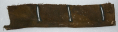
CIVIL WAR-INDIAN WAR UNIFORM LAPEL FROM FORT PEMBINA
This strip of cloth showing three buttonholes (and what seems to be part of a fourth) is the remnant of an army dress coat discarded after its useful days were done at Fort Pembina, a small frontier… (1052-610). Learn More »
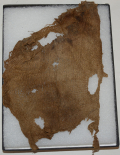
INDIAN WAR SOLDIER’S MITTEN PIECE FROM FORT PEMBINA, ND
This comes from the excavations at Fort Pembina, occupied 1870-1895, where cold weather in winter months might well be a concern. The army began issuing mittens in 1873. Before that men were left to… (1052-621). Learn More »
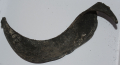
CIVIL WAR-INDIAN WAR FORAGE CAP VISOR
This is a well preserved leather visor from a forage cap recovered at Fort Pembina, ND, where it was preserved in remarkable condition by wet, anaerobic soil conditions. This is typical of the simple… (1052-485). Learn More »
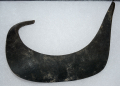
CIVIL WAR-INDIAN WAR FORAGE CAP VISOR
This is a well preserved leather visor from a forage cap recovered at Fort Pembina, ND, where it was preserved in remarkable condition by wet, anaerobic soil conditions. This is typical of the simple… (1052-482). Learn More »
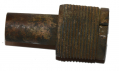
RELIC -- US NAVAL WATERCAP FUSE WITH BUSHING, DATED 1864
Excavated naval watercap fuse dated 1864 and in good condition. This fuse is made of brass with flange on top, with threaded portion and tapered body. A brass bushing is on this fuse to fit into… (2024-2327). Learn More »

EXCAVATED CONFEDERATE CAVALRY SABER
If they gave out awards for crudely made cavalry sabers, this one would be in the running. The guard is simple flat iron, curving in a broad semicircle, with a simple hole in one end through which the… (490-6746). Learn More »

SPEARHEAD FROM A BROKEN LANCE
This is the spearhead section only from a broken lance. The piece meas. approx. 38.50 inches long overall. The iron point of the spearhead itself is double edged with a raised ridge on each side… (490-3235). Learn More »
BUTTONS RECOVERED FROM BATTLE OF WÖRTH, 1870 – 45th, 48th & 56th FRENCH REGIMENTAL
The Battle of Wörth, also known as the Battle of Reichshoffen or as the Battle of Frœschwiller, refers to the second battle of Wörth, which took place on 6 August 1870 in the opening stages of… (1202-). Learn More »
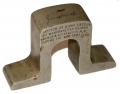
RAIL SECTION FROM THE MANASSAS GAP BRANCH, ORANGE & ALEXANDRIA RAILROAD
This is a nicely labeled section of rail stamped in small letters: “Section of U. rail used on the Manassas Gap branch Orange & Alexandria R.R. during the war 1861-65” and signed on the top… (1202-186). Learn More »
$450.00
ON HOLD
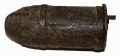
CONFEDERATE 3” MULLANE COMMON SHELL
Here is a fired Confederate 3” bourreleted Mullane Type 1 common shell recovered from an unknown battlefield location. Made for the 3” Ordnance Rifle. Also known as a “Tennessee Sabot”, this… (490-7005). Learn More »
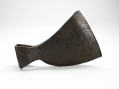
ANTIQUE BROAD AXE HEAD FROM FREDERICKSBURG
The Fredericksburg area was filled with army camps on both sides of the river and tools like this were needed for the construction of winter huts as well as cutting trees for firewood and field works.… (2023-3257). Learn More »

EXCAVATED CIVIL WAR BRITISH IMPORT SWORD BAYONET FOR THE ENFIELD SHORT RIFLE
This is a good, excavated example of the British sword bayonet for the short rifle, imported by both sides in the Civil War. The blade has no bends or breaks and is missing just a small bit of the tip… (1179-1237). Learn More »
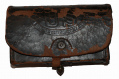
US CAVALRY MANN’S PATENT CARTRIDGE BOX EX-LEES HQ MUSEUM
The Mary Thompson house at Gettysburg, used by Lee as his headquarters at Gettysburg, was recognized by its owner in the 1890s as a valuable battlefield relic, perhaps a particular attraction for… (224-750). Learn More »
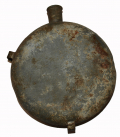
CONFEDERATE “PIE-PLATE” TIN DRUM CANTEEN
This is an interesting variation on the tin drum canteens that became very popular in the 1850s following the adoption of round drum-shaped tin canteen with convex sides by the US Army in 1836, though… (490-6762). Learn More »
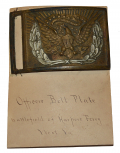
MODEL 1851 SWORD BELT PLATE FROM HARPERS FERRY ON A GREAT DISPLAY CARD
This sword belt plate, a very good example of an early pick-up, is mounted on a great old card typical of early relic displays labeled in brown ink, “Officers Belt Plate / battlefield of Harpers… (1202-196). Learn More »
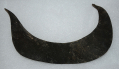
CIVIL WAR-INDIAN WAR FORAGE CAP VISOR
This is a well preserved leather visor from a forage cap recovered at Fort Pembina, ND, where it was preserved in remarkable condition by wet, anaerobic soil conditions. This is typical of the simple… (1052-480). Learn More »
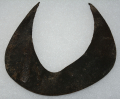
CIVIL WAR-INDIAN WAR FORAGE CAP VISOR
This is a well preserved leather visor from a forage cap recovered at Fort Pembina, ND, where it was preserved in remarkable condition by wet, anaerobic soil conditions. This is typical of the simple… (1052-483). Learn More »
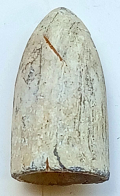
.69 CALIBER "NO-RING PRUSSIAN" BULLET
This was for the .69 caliber rifled muskets being used in the Federal service. These were machine "pressed and turned" bullets made at a Federal arsenal. This particular style features no grooves,… (2024-919). Learn More »
Showing 141 to 160 out of 317
Most Popular
Historical Firearms Stolen From The National Civil War Museum In Harrisburg, Pa »
Theft From Gravesite Of Gen. John Reynolds »
Selection Of Unframed Prints By Don Troiani »
Fine Condition Brass Infantry Bugle Insignia »
Rare Identified 65Th Ny Sergeant’s Jacket, With Manscript Material: 1St U.s. Chasseurs »
featured item
EXCELLENT CONDITION EARLY MARINE MAMALUKE WITH IVORY GRIP AND ENGRAVED SCABBARD
Manufactured: U.S. Maker: Unmarked Year: C1820-25 Model: Mamaluke Size: 29.25 inch blade 1.30 in. wide Condition: Excellent+ Sharply curved, single edged, blue and gold engraved blade decorated with ships mast, Indian with headdress, arms,… (870-72). Learn More »
site search