


site search
online catalog
Relics
Showing 261 to 280 out of 317
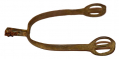
RELIC US/CS RAKING SPUR RECOVERED FROM FREDERICKSBURG
Item is a single, delicate brass spur with oval yokes and a horizontal rowel. The spur is solid but the rowel has rusted and is missing half of its surface. [ad]… (2023-1436). Learn More »
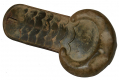
RELIC CIVIL WAR ENLISTED SHOULDER SCALE FROM FREDERICKSBURG
Introduced in 1851 for mounted troops, brass shoulder scales were decorative, but were also meant to be a shoulder defense against saber cuts. In 1854/55 they became regulation for all branches of… (2023-1473). Learn More »
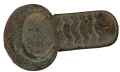
RELIC CIVIL WAR ENLISTED SHOULDER SCALE FROM FREDERICKSBURG
Introduced in 1851 for mounted troops, brass shoulder scales were decorative, but were also meant to be a shoulder defense against saber cuts. In 1854/55 they became regulation for all branches of… (2023-1474). Learn More »
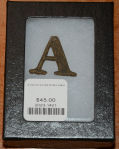
SELECTION OF CIVIL WAR BRASS HAT LETTERS AND NUMBERS
These were worn on soldier’s hats and caps to designate their specific Company or Regiment. Stamped brass, large size are approximately 1” tall; small size approximately 0.75” tall. They… (2023-). Learn More »
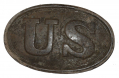
RELIC, PATTERN 1839 OVAL CARTRIDGE BOX PLATE DUG NEAR ORANGE, VA
Model 1839 cartridge box plate with central “US”. Plate has a great face with a mottled patina. Reverse has 100% of the lead fill. Both wire loops remain strong. This plate was recovered near… (1184-108). Learn More »
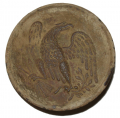
RELIC, US PATTERN 1826 EAGLE BREAST PLATE
This US shoulder belt plate was affixed to the front of the shoulder belt for the infantry cartridge box. It features the spread-winged eagle design. Brass face remains somewhat dirt covered with a… (1184-96). Learn More »
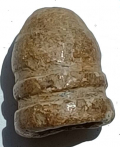
RARE TRANS-MISSISSIPPI “GWYN & CAMPBELL” BULLET
This is indeed a scarce Trans-Mississippi bullet. Called a “Gwyn & Campbell” carbine bullet by Mac Mason in the supplement of his ground breaking 1975 Civil War projectile reference book.… (2022-2817). Learn More »
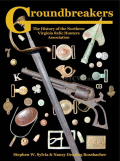
GROUNDBREAKERS: THE HISTORY OF THE NORTHERN VIRGINIA RELIC HUNTERS ASSOCIATION
Sylvia, Stephen W. and Nancy Dearing Rossbacher. Hardback, published 2023 by Northern Virginia Relic Hunters Association. 584 glossy pages, heavily illustrated with color photographs. There's… (ST501214). Learn More »
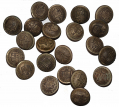
COAT SIZE NEW YORK STATE SEAL BUTTON EXCAVATED NEAR FREDERICKSBURG, VA
Various Civil War backmarks. Most with traces of original gilt finish in recesses. [ss] [ph:L] Please do not request a specific item. ~~~~~~~~~~~~~~~~~~~~~~~~~~~~~~~~~~~ THIS ITEM, AS WITH ALL OTHER… (2023-1709). Learn More »
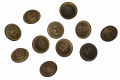
CUFF SIZE NEW YORK STATE BUTTON EXCAVATED NEAR FREDERICKSBURG, VA
Various Civil War backmarks. Traces of gilt finish remain. [ss] [ph:L] Please do not request a specific item. ~~~~~~~~~~~~~~~~~~~~~~~~~~~~~~~~~~~ THIS ITEM, AS WITH ALL OTHER ITEMS AVAILABLE ON OUR… (2023-1711). Learn More »
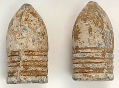
CONFEDERATE .58 CALIBER “RECUT MOLD” TEAT BASE BULLET
Excavated .58 caliber “minie ball” of Southern manufacture. Nose cast bullet with six fine grooves, a thick skirt with off-center cavity. There are mold seams visible up the sides and there is… (2022-2590). Learn More »
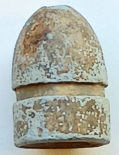
NICE .69 CALIBER “HIGH BASE” FRENCH TRIANGLE BASE BULLET
This scarce bullet is in dropped condition with a light gray/tan patina. This is the tall variant of the .69 caliber French bullets. Flat nose, single wide groove, and triangular cavity. In very fine,… (2022-2527). Learn More »
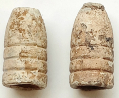
CRUDE .54 CALIBER CONFEDERATE BULLETS – NOSE CAST
These three-groove minie balls would have been for the .54 caliber Mississippi rifle or .55 caliber Austrian Lorenz. This style bullet features a smooth body, three fine grooves, is nose cast, and has… (2022-2672). Learn More »

RELIC VIRGINIA MANUFACTORY BAYONET
Bayonet is complete with a full-length triangular blade and mortised socket. Both are encrusted with a thin layer of rust. The blade face is wide with no visible fuller. Socket meas. approx. 3 3/16 of… (490-3270). Learn More »

RELIC MODEL 1851 CADET BAYONET
Bayonet is complete with a full-length triangular blade, socket and frozen locking ring. All are encrusted with a thin layer of rust. No markings are visible. The Cadet musket was authorized in 1851,… (490-3223). Learn More »
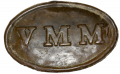
MAINE VOLUNTEER MILITIA CARTRIDGE BOX PLATE FROM CASTLEMAN’S FERRY
This is a nice chocolate brown color excavated VMM box plate found at Castleman’s Ferry, Virginia. This is on the Shenandoah River and was the scene of the Battle of Cool Spring in 1864, but was the… (766-1541). Learn More »
$1,250.00
Originally $1,450.00

POSSIBLE RICHMOND MANUFACTURED BAYONET FOR THE LORENZ
Bayonet is complete with a full-length triangular blade, socket and frozen locking ring. All are encrusted with a thin layer of rust. No markings are visible. The socket is thin and crudely made. The… (490-3226). Learn More »
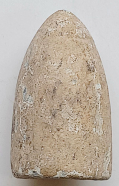
.69 CALIBER PRESSED AND TURNED “NO-RING PRUSSIAN” BULLET
Offered here is a very nice example of a Northern, arsenal-made bullet. This style of bullet was machine pressed to form the nose and cavity, then turned on a lathe to finish the shoulder and grooves.… (2022-2627). Learn More »
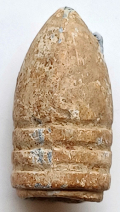
.58 CALIBER MINIE BALL WITH CASTING FLAW
Here is a “dug” three-groove minie ball with a slight extension from the cavity. This flaw is likely caused by the base plug not being properly seated in the mold. This casting error has made for… (2022-2518). Learn More »
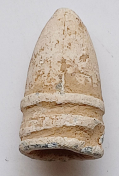
RARE .58 CALIBER “RALEIGH” BULLET
Here is an example of the rarest size of the Confederate Raleigh pattern bullet. With typical raised bands and pointy nose, but in .58 caliber. Manufactured at the North Carolina Institute for the… (2022-2624). Learn More »
Showing 261 to 280 out of 317
Most Popular
Historical Firearms Stolen From The National Civil War Museum In Harrisburg, Pa »
Theft From Gravesite Of Gen. John Reynolds »
Selection Of Unframed Prints By Don Troiani »
Fine Condition Brass Infantry Bugle Insignia »
Rare Identified 65Th Ny Sergeant’s Jacket, With Manscript Material: 1St U.s. Chasseurs »
featured item
WORLD WAR 2 PROPELLER BLADE FROM B-24 "LIBERATOR" BOMBER CRASH SITE IN ENGLAND
Offered here is a single propeller blade from a World War Two B-24 bomber from the 392nd Bomb Group that crashed on March 25, 1945. The crash occurred when two B-24s collided in the clouds while forming up for a mission to bomb a target in Hitzocker,… (1202-1164). Learn More »
site search