

site search
online catalog
Relics
Showing 221 to 240 out of 323
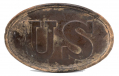
U.S. M1839 CARTRIDGE BOX PLATE RECOVERED BY SYD KERKSIS IN JANUARY 1958 IN THE LINES OF THE 4th CORPS AT PICKETT’S MILL: ATLANTA CAMPAIGN
This plate comes with its original collection envelope with notations on its provenance by Syd Kerksis, noted early collector and author. Pickett’s Mill was fought on May 27, 1864, in the Atlanta… (490-5779). Learn More »
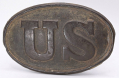
CARTRIDGE BOX PLATE FROM TUNNEL HILL, GA, EX-SYD KERKSIS
This regulation US cartridge box plate was recovered on the battlefield of “Tunnel Hill, Ga,” by Syd Kerksis, one of the legendary early relic hunters and collectors, author of books on military… (490-5771). Learn More »
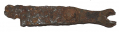
MODEL 1855/61 GUN TOOL ONCE OWNED BY J. HOWARD WERT
Recovered at Gettysburg, this is a complete Model 1855/61 gun tool. It is heavily rusted and the screwdriver tip is rusted tight. At the time of the Gettysburg campaign, twenty-two year-old John… (224-798). Learn More »
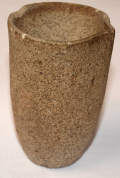
MID 19th CENTURY CRUCIBLE ONCE OWNED BY J. HOWARD WERT
One of many articles amassed by Wert after the Battle of Gettysburg. A crucible is also a container in which metals are melted, usually for temperatures above 500 °C. Crucibles are made of graphite… (224-794). Learn More »
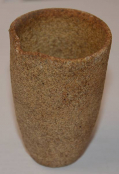
MID 19th CENTURY CRUCIBLE ONCE OWNED BY J. HOWARD WERT
One of many articles amassed by Wert after the Battle of Gettysburg. A crucible is also a container in which metals are melted, usually for temperatures above 500 °C. Crucibles are made of graphite… (224-793). Learn More »
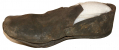
SCARCE CIVIL WAR ISSUE SHOE ALTERED TO CAMP/BARRACKS SHOE
The army did not issue “post,” “barracks,” or “camp” shoes until the 1880s. Before that it was up to soldiers to privately purchase or improvise footwear that might prove more comfortable… (1052-426). Learn More »
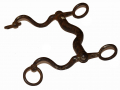
U.S. ARMY MODEL 1892 CURB BIT ONCE OWNED BY J. HOWARD WERT
This piece of US horse equipment is an original U.S. Army curb bit of the 1892 First Pattern, (a.k.a. the Whipple Bit) and was once owned by Gettysburg native J. Howard Wert. In strong condition, this… (224-790). Learn More »
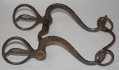
U.S. MODEL 1874 CAVALRY CURB BIT ONCE OWNED BY J. HOWARD WERT
This piece of original US horse equipment is an original U.S. cavalry curb bit of the 1874 pattern. In strong condition, this iron bridle bit has a hard pockmarked surface with moderated rust pitting.… (224-788). Learn More »
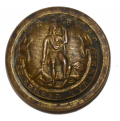
POST-WAR VIRGINIA STAFF OFFICER’S BUTTON BY HORSTMANN
This three-piece coat size Virginia button has substantial gilt left on the face and good detailing of the figures of the Virginia state seal and the motto on a ribbon on a lined background with an… (1000-2250). Learn More »
$115.00
Originally $145.00
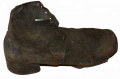
SCARCE INDIAN WAR US ARMY 1872 PATTERN SHOE: FORT PEMBINA, NORTH DAKOTA, ESTABLISHED 1870
New pattern shoes and boots were introduced in the U.S. Army in 1872 and in use until the 1880s. These shoes improved upon Civil War issue patterns mainly by using brass screws in the soles, rather… (1052-303). Learn More »
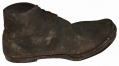
SCARCE INDIAN WAR US ARMY 1872 PATTERN SHOE WITH FIELD REPAIR
New pattern shoes and boots were introduced in the U.S. Army in 1872 and in use until the 1880s. These shoes improved upon Civil War issue patterns mainly by using brass screws in the soles, rather… (1052-576). Learn More »
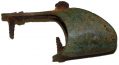
EXCAVATED MODEL 1855 PISTOL CARBINE PART
This unusual weapon consisted of a large single shot pistol that had a detachable shoulder stock which theoretically transformed it into a carbine. Here are two excavated brass parts from the pistol… (1000-1147). Learn More »
$260.00
Originally $325.00
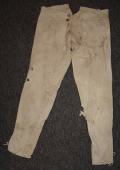
VERY RARE CIVIL WAR U.S. ARMY ISSUE DRAWERS
Civil War army-issue undergarments are extremely rare. They were made and issued in huge numbers, but were characteristically cheaply made, often disliked, and hardly worth preservation as a cherished… (1052-255). Learn More »
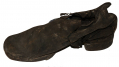
“FORTY MILES A DAY ON BEANS AND HAY IN THE REGULAR ARMY-O” SCARCE INDIAN WAR US ARMY 1872 PATTERN SHOE FROM FORT PEMBINA, N.D.
New pattern shoes and boots were introduced in the U.S. Army in 1872 and in use until the 1880s. These shoes were similar to Civil War issue patterns, with square toe, rough-side out black leather… (1052-292). Learn More »
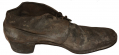
EARLY BARRACKS OR CAMP SHOE BY JOHN MUNDELL OF PHILADELPHIA
This is a usual soldier’s shoe from Fort Pembina, ND, a small U.S. army post from 1870 to 1895, and is typical army construction using rough-side out black leather and is clearly stamped “J.… (1052-388). Learn More »
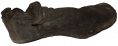
SCARCE INDIAN WAR US ARMY 1872/76 PATTERN CAVALRY BOOT FROM FORT PEMBINA, N.D.
This scarce Indian War U.S. cavalry boot actually comes from Fort Pembina, a small U.S. Army frontier fort in North Dakota in operation from 1870 to 1895. The army introduced new shoe and boot… (1052-304). Learn More »
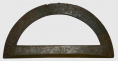
DUG 19TH CENTURY BRASS PROTRACTOR FOUND AT GETTYSBURG BY THE LATE RON MILLER
This small brass protractor meas. approx. 3.50 x 1.75 inches. The arc still shows faint measured graduations. Bottom center has a partial Philadelphia maker’s mark. Item was dug by the late Ron… (286-1212). Learn More »
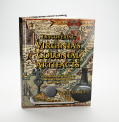
FIRST EDITION REFERENCE BOOK ON VIRGINIA COLONIAL RELICS FROM THE LIBRARY OF THE LATE DEAN S. THOMAS
The title of this volume is “DISCOVERING VIRGINIA’S COLONIAL ARTIFACTS. A COMPREHENSIVE GUIDE TO RECOVERY, IDENTIFICATION AND PRESERVATION” by Bill Dancy and published by Greybird Publishers of… (236-444). Learn More »
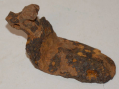
RELIC FRIZZEN RECOVERED FROM THE 1793 BATTLEFIELD OF WORTH
Frizzen is complete but rusted throughout. There were two battles fought at Worth, the first was part of the French Revolution in 1793 and the second was during the Franco-Prussian War in 1870. This… (1202-54). Learn More »
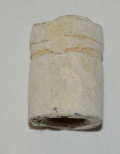
CONFEDERATE GARDNER BULLET THAT WAS PULLED?
Here is an odd bullet. It started out as a .58 caliber, two-groove, Gardner bullet. It was definitely “pulled” but the question is, by what? The nose of the bullet is now flat with a large… (2023-1985). Learn More »
Showing 221 to 240 out of 323
Most Popular
Historical Firearms Stolen From The National Civil War Museum In Harrisburg, Pa »
Theft From Gravesite Of Gen. John Reynolds »
Selection Of Unframed Prints By Don Troiani »
Fine Condition Brass Infantry Bugle Insignia »
featured item
RICHMOND SHARPS CARBINE BY S. C. ROBINSON
Presented here is a Richmond-made, straight-breech Confederate Sharps carbine. Of the approximately 5,000 firearms called “Richmond Carbines” made for the Confederate government between 1862 and 1864, 1,900 were produced at the S.C. Robinson Arms… (490-3531). Learn More »
site search