

site search
online catalog
Artillery
Showing 41 to 60 out of 134

ARTILLERY PRIMING WIRE FOR LARGE CANNON WITH WATERVLIET ARSENAL MARKINGS
This is a tool for punching a hole in the powder bag through the cannon vent hole. Made of stout wire, it is nearly 24” long overall with a 2.25” diameter loop handle at the top. The pointed end… (2026-1493). Learn More »

ARTILLERY PRIMING WIRE FOR LARGE CANNON
This is a tool for punching a hole in the powder bag through the cannon vent hole. Made of stout wire, it is nearly 24” long overall with a 2.25” diameter loop handle at the top. The pointed end… (2026-1492). Learn More »
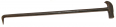
US CIVIL WAR ARTILLERY TOW HOOK WITH US MARKING
These simple, handy, iron tools were listed by Gibbon in his Artillerist’s Manual as among the “implements and equipments for field carriages, specifically those for a gun or howitzer carriage, to… (2026-9009). Learn More »
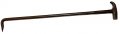
US CIVIL WAR ARTILLERY TOW HOOK
A good example of a Civil War artillery tow hook, with hammer head on one end and a hook on the other for removing the tow – thick chopped fiber wadding used as packing material to stabilize and… (2026-9008). Learn More »
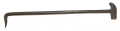
US CIVIL WAR ARTILLERY TOW HOOK
A good example of a Civil War artillery tow hook. This one measures 13-inches overall- they often vary slightly in length but have the same configuration—all iron construction with attached… (2026-9007). Learn More »
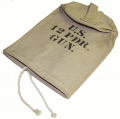
SPONGE COVER FOR THE 12 POUNDER NAPOLEON
This is postwar US artillery sponge cover made of canvas with a strap at top for a handle and knotted cord running along the bottom to tie it over the sponge head of an artillery rammer. The canvas is… (2026-2313). Learn More »

18” CIVIL WAR NAVAL PORTFIRE
Portfires were used to light cannon aboard the wooden deck of a ship. The portfire itself is similar to a flare. They were a composition of niter, sulphur, and mealed powder driven into a case of… (2026-9199). Learn More »
$39.50
SOLD
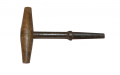
CIVIL WAR ARTILLERY WOODEN FUZE PLUG AUGER
This tool is illustrated in Arms and Equipment of the Union as a wooden fuze plug auger. These are understood by most collectors to be used simply to ream out wood fuze plugs, commonly used in… (2026-9178). Learn More »
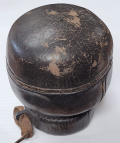
OUTSTANDING U.S. CIVIL WAR ARTILLERY POLE PAD – GEISELMAN COLLECTION
This item is a non-relic U.S. Artillery Pole Pad; these were used to protect the horse crew from injury by padding the ends of artilleryman’s implement poles. Poles were often carried loosely in… (2026-2306). Learn More »
$295.00
ON HOLD

U.S. ARTILLERY FUSE POUCH - WATERTOWN ARSENAL MARKED
Fine condition leather artillery fuse pouch. The leather of the outer flap is in sturdy condition with a mottled brown tone. The lower left corner shows a few crazing lines. The latch tab is stitched… (2026-2204). Learn More »

CIVIL WAR ARTILLERY LANYARD
The second Civil War artillery lanyard from the artillery portion of an old and respected collection we recently acquired. A very good condition example, complete with turned wood handle tapering to… (2026-9247). Learn More »

US NAVY 8-INCH SHELL GAUGE
A complete, good condition US Navy ring gauge for 8-Inch shells, a caliber widely used during the war in Dahlgren guns, Rodmans, Columbiads, siege howitzers and mortars, etc. These gauges were used… (2026-9442). Learn More »
$750.00
ON HOLD

US ORDNANCE MARKED TINNED IRON BOX FOR FRICTION PRIMERS
A rectangular tinned-iron box with lid embossed at center with the crossed cannon barrels and flaming bomb of the US Ordnance Department, with “100 FRICTION PRIMERS” in an arc of raised letters… (2026-9655). Learn More »

BOX FOR “100 FRICTION PRIMERS” WITH 37 STILL IN IT
A very scarce piece of ephemera- an original Civil War cardboard box with lid bearing a green paper label printed in black “100 / FRICTION PRIMERS.” The lower portion of the label shows some… (2026-9322). Learn More »
$595.00
SOLD

PACK OF FRANKFORD ARSENAL 15-SECOND ARTILLERY FUZES
Original pack of 15-second time fuzes manufactured at the Frankford Arsenal in Philadelphia, PA during the Civil War. Pack is constructed of a drilled wood block that holds five paper time fuses.… (2026-9653). Learn More »
$65.00
ON HOLD

PACK OF FRANKFORD ARSENAL 25-SECOND ARTILLERY FUZES
Original pack of 25-second time fuzes manufactured at the Frankford Arsenal in Philadelphia, PA during the Civil War. Pack is constructed of a drilled wood block that holds five paper time fuses.… (2026-9650). Learn More »
$65.00
ON HOLD

PACK OF FRANKFORD ARSENAL 20-SECOND ARTILLERY FUZES
Original pack of 20-second time fuzes manufactured at the Frankford Arsenal in Philadelphia, PA during the Civil War. Pack is constructed of a drilled wood block that holds five paper time fuses.… (2026-9648). Learn More »
$65.00
ON HOLD
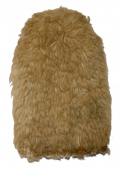
CIVIL WAR OR PRE-WAR WHITE ARTILLERY SPONGE FOR THE 6-POUNDER GUN
Civil War artillery implements are hard to find. The rammer/sponge staff is one such item and the actual sponge itself, tacked onto the cylindrical wood head on one end of that staff, is even tougher… (2026-9430). Learn More »
$250.00
ON HOLD
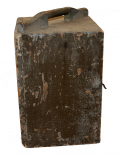
CIVIL WAR ARTILLERY PASS BOX
This is one of three original Civil War pass boxes we recently obtained from the artillery section of an old, well-respected collection that includes a lot of material bought directly off… (2026-9592). Learn More »
$550.00
SOLD
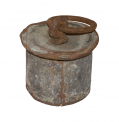
TINNED IRON ARTILLERY MUZZLE TOMPION FOR A FIELD GUN
A scarce muzzle tompion that would fit the 2.9” Parrott or 3” Ordnance Rifle. This is made of tinned iron with wide rim around the top to help seal the bore and keep out dirt and debris when not… (2026-9405). Learn More »
Showing 41 to 60 out of 134
Most Popular
Historical Firearms Stolen From The National Civil War Museum In Harrisburg, Pa »
Theft From Gravesite Of Gen. John Reynolds »
Selection Of Unframed Prints By Don Troiani »
Fine Condition Brass Infantry Bugle Insignia »
Rare Identified 65Th Ny Sergeant’s Jacket, With Manscript Material: 1St U.s. Chasseurs »
featured item
GETTYSBURG ASSOCIATED PRESENTATION SWORD TO AN OFFICER IN "GOSLINE'S ZOUAVES" – EDWIN MCEWEN; WOUNDED IN ACTION AT COLD HARBOR
Edwin McEwen of Philadelphia mustered into Co. F as a Sergeant on September 13th of 1861 in the 95th Pennsylvania Infantry. Please see this link (95th Pennsylvania Volunteer Infantry Regiment). He was promoted to a 2nd Lieutenant in Co. K July of… (2026-2145). Learn More »
site search