

site search
online catalog
Firearms
Showing 221 to 240 out of 315

“EXTREMELY RARE” SILVERED BRASS FRAME ALLEN AND WHEELOCK DROP-BREECH RIMFIRE RIFLE
Also known as the Allen Drop Breech, these breech-loading rimfire rifles were produced in limited numbers at Worcester, MA, from 1860 to 1871. Flayderman estimates them at 1,500 to 2,000 all told, but… (172-6030). Learn More »
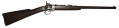
CIVIL WAR SMITH CAVALRY CARBINE #5941
This Smith carbine, complete and all original, rates very good or near fine for overall condition with lots of original finish, good markings, strong color to the metal and wood showing a little… (172-6029). Learn More »
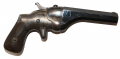
CONNECTICUT ARMS & MANUFACTURING CO. HAMMOND .44 RIMFIRE “BULLDOG” DERRINGER, CA. 1865-1868
This single-shot pistol is in very good condition, with clear markings and original blued barrel and casehardening on the frame. This is their standard production with 4” long barrel,… (490-7031). Learn More »
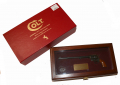
COLT LICENSED MINIATURE COLT BUNTLINE REVOLVER
Excellent condition, just about new-in-box miniature Colt Buntline. This has a case-hardened frame, blued barrel, and walnut grips, and is fitted with a folding rear sight on top of the flat frame.… (490-6814). Learn More »
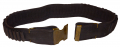
ANSON MILLS PATENT CARTRIDGE BELT FOR THE .45-70
This H-shaped, stamped belt plate was adopted by the U.S. Army in 1886 and used on what is sometimes called the “loose-loop” belt, which has woven cartridge loops. This clean blue belt and brass… (1216-219). Learn More »
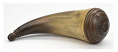
VERY PRETTY YORK COUNTY POWDER HORN
This a small, very pretty York County powder horn in about excellent condition, with nicely turned spout matching the rich brown color of the upper portion of the horn that smoothly transitions into… (490-6906). Learn More »
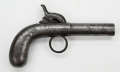
ALL-METAL RING TRIGGER PERCUSSION DERINGER
These small, unmarked, all-metal single action and singe-shot percussion pistols are the product of Bacon and Company of Norwich, CT, and manufactured in very small numbers from about 1852 to 1858, by… (490-7034). Learn More »
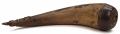
EARLY YORK COUNTY POWDER HORN
This is an early, classically York County style powder horn with two incised lines running around the top edge of the lathe-turned, convex base plug mirroring the two parallel incised lines along the… (490-6904). Learn More »
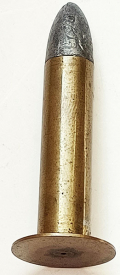
.35 CALIBER MAYNARD CARTRIDGE WITH COPPER RIVETED DISK
Dr. Edward Maynard held patent #22,565 dated January 11, 1859. By this patent, cartridge cases for the Maynard carbine were made of drawn brass to form a tube with a closed end. A brass disk was… (1212-186). Learn More »
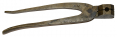
RARE HANOVERIAN TIGE-RIFLE BULLET MOLD
This is a two-piece, scissor-type bullet mold made of brass. The two halves are held together with an iron pin. One arm is marked with a “2”. The mold measures 7.25” long overall. Brass exhibits… (1211-256). Learn More »
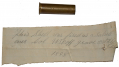
SPANISH AMERICAN WAR SHELL CASING FROM SALUTE FOR COL. C.H. WIKOFF, HIGHEST RANKING US OFFICER KILLED IN ACTION IN THE SPANISH AMERICAN WAR - SAN JUAN HILL
This fired brass shell casing was kept as a memento from the funeral of the highest-ranking U.S. officer killed in action in the Spanish-American War and comes with a period pencil note reading:… (1240-14). Learn More »
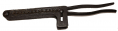
LARGE TWO-SIDED, 26-CAVITY IRON RIFLE BALL MOLD
Very large iron hinge-type mold to cast 26 lead round balls. Twelve cavities on top and twelve on the bottom. Each side is complete with its own funnel/sprue cutter. Cavities measure approximately… (236-1007). Learn More »
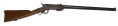
SHARPS AND HANKINS NAVY CARBINE
This is a good example of the single-shot, breech-loading .52 Caliber rimfire Sharps and Hankins Navy Carbine, also known as the Second Model or Model 1862, complete, all original, and showing some… (1224-01). Learn More »
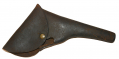
US NAVY HOLSTER FOR 1895 DOUBLE ACTION COLT
This holster pattern was adopted by the Navy in 1889 for the new .38 Caliber double-action revolvers ordered that year, most of which were returned to Colt for alteration to the Model 1895 cylinder… (431-72). Learn More »
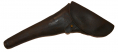
VERY NICE CONDITION EARLY CIVIL WAR U.S. CAVALRY HOLSTER
This is a very good condition early-war holster for a .36 caliber revolver with full military flap, wide belt loop secured by stitching and three rivets, toe plug, and sewn latch tab. The stitching is… (286-1332). Learn More »
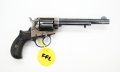
COLT MODEL 1877 DOUBLE ACTION .38 CAL. LONG BARREL LIGHTNING REVOLVER
Lots of original blue and some case colors with immaculate checkered hard rubber grips with the rampant colt at top on either side, about excellent condition. Long barrel version with ejector. Barrel… (490-5575). Learn More »
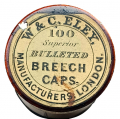
VERY RARE FULL TIN OF “BULLETED BREECH CAPS” BY W. & C. ELEY, LONDON
Offered here is a very fine condition japanned tin filled with 100 “bulleted breech caps.” A printed paper label on the lid reads, “100 Superior BULLETED BREECH CAPS. / W. & C. ELEY,… (2024-125). Learn More »
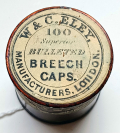
VERY RARE FULL TIN OF “BULLETED BREECH CAPS” BY W. & C. ELEY, LONDON
Offered here is a very fine condition japanned tin filled with 100 “bulleted breech caps.” A printed paper label on the lid reads, “100 Superior BULLETED BREECH CAPS. / W. & C. ELEY,… (2024-124). Learn More »
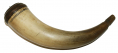
YORK COUNTY POWDER HORN
An elegant powder horn. From the size, a priming horn (approx 8" in length). Pleasing cream colored body shading to a greenish brown at the spout. The base is convex, lathe turned to produce incised… (480-354). Learn More »
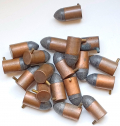
12MM PINFIRE CARTRIDGE BY CHARLES FUSNOT
These are cartridges for the Lefaucheux revolver. This is the “short” pinfire cartridge; with lead bullet seated into a copper case with a stout pin protruding from the bottom edge. This features… (M19951). Learn More »
Showing 221 to 240 out of 315
Most Popular
Historical Firearms Stolen From The National Civil War Museum In Harrisburg, Pa »
Theft From Gravesite Of Gen. John Reynolds »
Selection Of Unframed Prints By Don Troiani »
Fine Condition Brass Infantry Bugle Insignia »
Rare Identified 65Th Ny Sergeant’s Jacket, With Manscript Material: 1St U.s. Chasseurs »
featured item
MAGNIFICENT MARTIAL THIRD MODEL 1851 COLT NAVY REVOLVER
This is a wonderful example of a pre-Civil War production, US military contract Model 1851 Colt Navy of the type that went to the army, usually cavalry, rather than the navy. The gun is 100% complete, correct and original in every way. The revolver… (1304-68). Learn More »
site search