


site search
online catalog
Artillery
Showing 1 to 111 out of 111
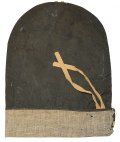
CIVIL WAR SPONGE COVER FOR 8-INCH MORTAR
Excellent condition tarred canvas sponge cover with ties for use with an 8-Inch mortar. Though classified as a siege mortar, these were light enough for field service, the mortar weighing a bit over… (2026-9606). Learn More »
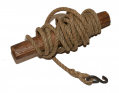
US OR CS CIVIL WAR ARTILLERY LANYARD
This is the standard form of the Civil War artillery lanyard, but with a far less finished and more simply turned handle than usually seen and a generic, perhaps even commercially acquired, S-hook… (2026-9248). Learn More »
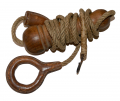
SCARCE US NAVY CANNON LANYARD
US Navy cannon were primed using a quill tube capped by an explosive wafer that would be detonated by heavy hammer actuated by a lanyard pulled by a gunner. We show a Civil War photo of some navy… (2026-9251). Learn More »
$475.00
ON HOLD
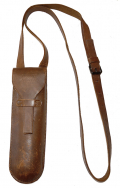
ST. LOUIS ARSENAL MARKED REAR SIGHT - PENDULUM HAUSSE - CASE FOR A MOUNTAIN HOWITZER
This carrying case for an artillery pendulum hausse is in superior condition and crisply marked. It is complete with two-piece shoulder strap with adjusting buckle and retaining loop, full-length… (2025-9289). Learn More »
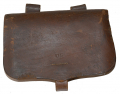
CIVIL WAR ARTILLERY GUNNER’S “TUBE POUCH”
These pouches were made of russet leather and fitted with two belt loops on the upper back to hang at the lower edge of a simple russet leather waistbelt with simple roller buckle. They were worn by… (2026-9173). Learn More »
$395.00
ON HOLD
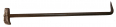
CONFEDERATE CIVIL WAR ARTILLERY TOW HOOK
Tow hooks are simple affairs- an iron handle bent at one end to help unpack artillery shells that that stabilized and cushioned during transport by thick wads of cut fiber “tow,” and with a short… (2026-9283). Learn More »

US/CS HEAVY ARTILLERY VENT PICK
This iron vent pick was a tool used by Civil War Heavy Artillerymen. It was inserted through the vent hole of the cannon in order to pierce the cartridge bag seated in the bore. This allowed the flame… (2026-952). Learn More »

ARTILLERY VENT PUNCH FOR 12” GUN – WATERVLIET ARSENAL MARKED
This is a tool for clearing the vent of any obstructions. It has an octagonal head with a hole in the center, and a 21.25” wire brazed to it. The wire tapers to a smaller diameter at the end. The… (2026-1494). Learn More »

ARTILLERY PRIMING WIRE FOR LARGE CANNON WITH WATERVLIET ARSENAL MARKINGS
This is a tool for punching a hole in the powder bag through the cannon vent hole. Made of stout wire, it is nearly 24” long overall with a 2.25” diameter loop handle at the top. The pointed end… (2026-1493). Learn More »

ARTILLERY PRIMING WIRE FOR LARGE CANNON
This is a tool for punching a hole in the powder bag through the cannon vent hole. Made of stout wire, it is nearly 24” long overall with a 2.25” diameter loop handle at the top. The pointed end… (2026-1492). Learn More »
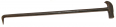
US CIVIL WAR ARTILLERY TOW HOOK WITH US MARKING
These simple, handy, iron tools were listed by Gibbon in his Artillerist’s Manual as among the “implements and equipments for field carriages, specifically those for a gun or howitzer carriage, to… (2026-9009). Learn More »
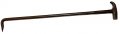
US CIVIL WAR ARTILLERY TOW HOOK
A good example of a Civil War artillery tow hook, with hammer head on one end and a hook on the other for removing the tow – thick chopped fiber wadding used as packing material to stabilize and… (2026-9008). Learn More »
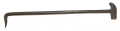
US CIVIL WAR ARTILLERY TOW HOOK
A good example of a Civil War artillery tow hook. This one measures 13-inches overall- they often vary slightly in length but have the same configuration—all iron construction with attached… (2026-9007). Learn More »
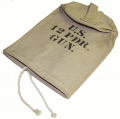
SPONGE COVER FOR THE 12 POUNDER NAPOLEON
This is postwar US artillery sponge cover made of canvas with a strap at top for a handle and knotted cord running along the bottom to tie it over the sponge head of an artillery rammer. The canvas is… (2026-2313). Learn More »

18” CIVIL WAR NAVAL PORTFIRE
Portfires were used to light cannon aboard the wooden deck of a ship. The portfire itself is similar to a flare. They were a composition of niter, sulphur, and mealed powder driven into a case of… (2026-9199). Learn More »
$39.50
ON HOLD
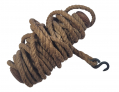
CIVIL WAR ARTILLERY LANYARD
An excellent example of the Civil War artillery lanyard. A turned, hardwood handle tapering from the center to the ends with raised rims for a secure grip, with rope cord attached at the center of the… (2026-9245). Learn More »
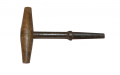
ARTILLERY GUNNER’S FUZE AUGER
An essential artillery tool when you need one! In his 1860 Artillerist’s Manual, Gibbon describes them as follows: FUZE-AUGER, Fig. 226, Pl. 14. After fuzes are set in position, it sometimes becomes… (2026-9178). Learn More »
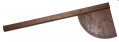
VERY SCARCE ARTILLERY QUADRANT IN EXCELLNT CONDITION COMPLETE WITH PLUMB BOB OR “PLUMMET”
This original Civil War artillery quadrant is made of wood, making its survival particularly remarkable, and even retains the small plumb bob (or “plummet”) and part of its cord in a small covered… (2026-9005). Learn More »
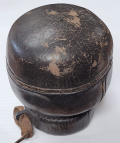
OUTSTANDING U.S. CIVIL WAR ARTILLERY POLE PAD – GEISELMAN COLLECTION
This item is a non-relic U.S. Artillery Pole Pad; these were used to protect the horse crew from injury by padding the ends of artilleryman’s implement poles. Poles were often carried loosely in… (2026-2306). Learn More »
$295.00
ON HOLD

U.S. ARTILLERY FUSE POUCH - WATERTOWN ARSENAL MARKED
Fine condition leather artillery fuse pouch. The leather of the outer flap is in sturdy condition with a mottled brown tone. The lower left corner shows a few crazing lines. The latch tab is stitched… (2026-2204). Learn More »
$550.00
ON HOLD

CIVIL WAR ARTILLERY LANYARD
The second Civil War artillery lanyard from the artillery portion of an old and respected collection we recently acquired. A very good condition example, complete with turned wood handle tapering to… (2026-9247). Learn More »
$395.00
ON HOLD

US NAVY 8-INCH SHELL GAUGE
A complete, good condition US Navy ring gauge for 8-Inch shells, a caliber widely used during the war in Dahlgren guns, Rodmans, Columbiads, siege howitzers and mortars, etc. These gauges were used… (2026-9442). Learn More »
$750.00
ON HOLD

US ORDNANCE MARKED TINNED IRON BOX FOR FRICTION PRIMERS
A rectangular tinned-iron box with lid embossed at center with the crossed cannon barrels and flaming bomb of the US Ordnance Department, with “100 FRICTION PRIMERS” in an arc of raised letters… (2026-9655). Learn More »

BOX FOR “100 FRICTION PRIMERS” WITH 37 STILL IN IT
A very scarce piece of ephemera- an original Civil War cardboard box with lid bearing a green paper label printed in black “100 / FRICTION PRIMERS.” The lower portion of the label shows some… (2026-9322). Learn More »
$595.00
ON HOLD

PACK OF FRANKFORD ARSENAL 15-SECOND ARTILLERY FUZES
Original pack of 15-second time fuzes manufactured at the Frankford Arsenal in Philadelphia, PA during the Civil War. Pack is constructed of a drilled wood block that holds five paper time fuses.… (2026-9653). Learn More »
$65.00
ON HOLD

PACK OF FRANKFORD ARSENAL 25-SECOND ARTILLERY FUZES
Original pack of 25-second time fuzes manufactured at the Frankford Arsenal in Philadelphia, PA during the Civil War. Pack is constructed of a drilled wood block that holds five paper time fuses.… (2026-9650). Learn More »
$65.00
ON HOLD

PACK OF FRANKFORD ARSENAL 20-SECOND ARTILLERY FUZES
Original pack of 20-second time fuzes manufactured at the Frankford Arsenal in Philadelphia, PA during the Civil War. Pack is constructed of a drilled wood block that holds five paper time fuses.… (2026-9648). Learn More »
$65.00
ON HOLD
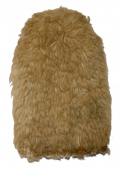
CIVIL WAR OR PRE-WAR WHITE ARTILLERY SPONGE FOR THE 6-POUNDER GUN
Civil War artillery implements are hard to find. The rammer/sponge staff is one such item and the actual sponge itself, tacked onto the cylindrical wood head on one end of that staff, is even tougher… (2026-9430). Learn More »
$250.00
ON HOLD
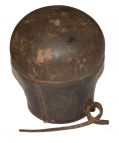
U.S. CIVIL WAR ARTILLERY POLE PAD
Another obscure but key piece of artillery gear- the pad that would be attached to the end of the pole on a limber to prevent the lead horses being injured by it, the pole extending just between the… (2026-9400). Learn More »
$250.00
ON HOLD
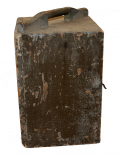
CIVIL WAR ARTILLERY PASS BOX
This is one of three original Civil War pass boxes we recently obtained from the artillery section of an old, well-respected collection that includes a lot of material bought directly off… (2026-9592). Learn More »
$550.00
ON HOLD
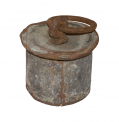
TINNED IRON ARTILLERY MUZZLE TOMPION FOR A FIELD GUN
A scarce muzzle tompion that would fit the 2.9” Parrott or 3” Ordnance Rifle. This is made of tinned iron with wide rim around the top to help seal the bore and keep out dirt and debris when not… (2026-9405). Learn More »
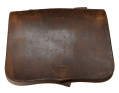
U.S. ARTILLERY FUSE POUCH - WATERTOWN ARSENAL MARKED
Fine condition leather artillery fuse pouch. The leather of the outer flap is in sturdy condition with a mottled brown tone. The lower left corner shows a few crazing lines. The latch tab is stitched… (2026-9171). Learn More »
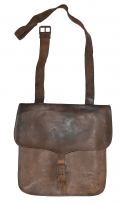
CIVIL WAR ARTILLERY GUNNER’S HAVERSACK
These were a vital safety measure in a battery of field artillery, worn by “Number 5” of a gun crew to carry an artillery round from the ammunition chest on the limber or caisson to the gun,… (2026-9488). Learn More »
$1,250.00
ON HOLD

CIVIL WAR ARTILLERY LINSTOCK
Although percussion and friction primers had long been in use in the artillery, it was still deemed wise to keep a back-up. Indeed, at least one US battery in the Mexican War had to fall back on old… (2026-9280). Learn More »
$495.00
ON HOLD
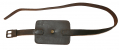
CIVIL ARTILLERY VENT COVER
An excellent condition Civil War artillery vent cover. These were strapped around the breech of the cannon barrel when the piece was not in use to keep the vent free of debris. This is made of black… (2026-9002). Learn More »
$495.00
ON HOLD
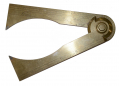
CIVIL WAR ARTILLERY CALIPERS
This comes from the artillery portion of an old, large, and well-respected collection, much of which was acquired directly from the well-known firm of Bannerman’s, who handled immense amounts of… (2026-9290). Learn More »
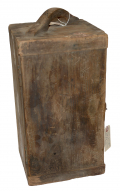
CIVIL WAR ARTILLERY PASS-BOX, EX-BANNERMAN
Wood pass-boxes were used during the Civil War to carry the powder charge from the magazine to an artillery piece in fortifications and gun emplacements. Needless to say, it was rather important to… (2026-9587). Learn More »
$850.00
ON HOLD
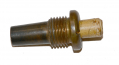
NON-DUG HOTCHKISS TIME FUSE ADAPTER & FUSE
Here is a very fine condition, non-dug Hotchkiss time fuse adapter. Made of brass, this has a mellow bronze patina. An original paper time fuse is inserted. There are a few small dings on the… (2026-2207). Learn More »
$100.00
ON HOLD
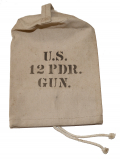
SPONGE COVER FOR THE 12 POUNDER NAPOLEON
This is a postwar US artillery sponge cover made of canvas with a strap at top for a handle and knotted cord running along the bottom to tighten it over the sponge head of an artillery rammer. The… (2026-9419). Learn More »
$100.00
ON HOLD
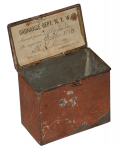
CIVIL WAR US NAVY PRIMER TIN WITH 1880s REINSPECTION & ISSUE LABEL
This painted, tinned iron box measuring 3-1/4 x 2-5/8 x 1-3/4 inches is an original Civil War US Navy tin for cannon primers. This has its hinges, small latch tab and catch in place. It has some… (2026-9174). Learn More »
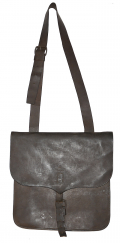
US WATERVLIET ARSENAL MARKED CIVIL WAR GUNNER’S HAVERSACK
A very crisply arsenal marked example of the artillery gunner’s haversack, complete and in excellent condition. These were worn by “Number 5” of the crew manning a field gun to carry the… (2026-9043). Learn More »
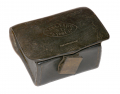
1861 DATED US NAVY PRIMER POUCH
Also known as a tube pouch and other names, these small leather boxes carried the primers for naval cannon and were worn on the waistbelt by a member of the gun crew who would insert a primer in vent… (2026-9176). Learn More »
$225.00
ON HOLD
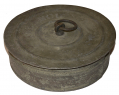
TINNED IRON MUZZLE TOMPION FOR A 10-INCH MORTAR
This is one of two muzzle tompions made of corrugated, stamped tinned iron that we have for a US Model 1841 10-Inch Mortar, either siege or seacoast. This comes from the artillery portion of an old… (2026-9486). Learn More »
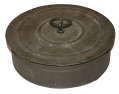
TINNED IRON MUZZLE TOMPION FOR A 10-INCH MORTAR
This is one of two muzzle tompions made of corrugated, stamped tinned iron that we have for a US Model 1841 10-Inch Mortar, either siege or seacoast. This comes from the artillery portion of an old… (2026-9485). Learn More »
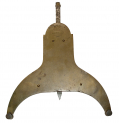
WATERVLIET ARSENAL 1861 DATED GUNNER’S LEVEL
The gunner’s level was an essential tool enabling an artillery crew to correctly aim a cannon even if not on level ground. This one is clearly marked across the top on one side with an eagle over… (2026-9292). Learn More »
$2,250.00
ON HOLD
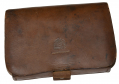
EXCELLENT WASHINGTON ARSENAL MARKED CIVIL WAR ARTILLERY GUNNER’S IMPLEMENT/FUSE POUCH
This is the regulation Civil War artillery gunner’s pouch, complete, in excellent condition, crisply marked on the outer flap above the stitching for the latch tab, “U.S.” over “WASHINGTON”… (2026-9170). Learn More »
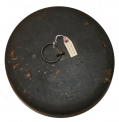
US M-1841 TEN-INCH SIEGE OR SEACOAST MORTAR TOMPION
Siege mortars became increasingly important as the Civil War progressed and field armies came to rely more on field fortifications and entrenchments, battle lines became static and campaigns devolved… (2026-9483). Learn More »
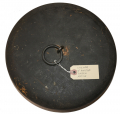
US M-1841 TEN-INCH SIEGE OR SEACOAST MORTAR TOMPION
Siege mortars became increasingly important as the Civil War progressed and field armies increasingly came to rely on field fortifications and entrenchments, battle lines became static and campaigns… (2026-9482). Learn More »
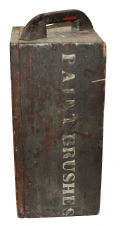
CIVIL WAR ARTILLERY PASS BOX EX-BANNERMAN’S ISLAND
This comes from an old and well-respected collection that includes a lot of material bought directly off Bannerman’s Island or through their Blue Point Long Island operation, opened after they… (2026-9583). Learn More »
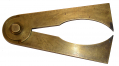
CIVIL WAR WATERVLIET ARSENAL MARKED ARTILLERY CALIPERS
Made of heavy brass, these are constructed like a pair of dividers, with the arms pivoting around a round base. This has a pleasing, undisturbed, aged patina with a few thin age stains, and clear… (1328-01). Learn More »
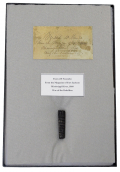
CONFEDERATE TEN SECOND PAPER TIME FUSE
This ten-second fuse originated from the magazine at Fort Jackson, Louisiana. Fuse was recovered by a Union soldier in 1862, who packaged several in a box and documented it by writing the information… (R21944). Learn More »
$150.00
Originally $200.00
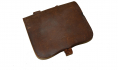
CONFEDERATE ARTILLERY FUSE POUCH WITH LEAD FINIAL
Brown leather Confederate artillery fuse pouch is in good condition. This is the leather pouch that went on the side of the Confederate artilleryman. It held his paper time fuses for firing the… (381-20). Learn More »
$2,500.00
Originally $3,150.00
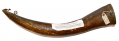
Ca. 1760-1820 U.S. ARTILLERY PRIMING HORN
This is a rare piece in exceptional condition that would make a great addition to artillery display, especially one concentrating on the period of the American Revolution and War of 1812. It comes… (2026-9352). Learn More »
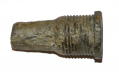
LONG STYLE PARROTT FUSE ADAPTOR
These Parrott time fuses were made of a white metal compound, primarily zinc and lead. These are fuse adaptors as they held the actual time fuse. This measures 2 3/8” long overall, and 1 1/4” in… (844-257). Learn More »
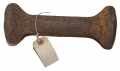
REVOLUTIONARY WAR – WAR OF 1812 BAR SHOT - LAKE CHAMPLAIN
Untouched, very good example of Revolutionary War to War of 1812 period bar shot. Made of iron, about 8-1/2” long with swelled ends roughly 3.4” in diameter, this weighs in at 8 lbs 6 oz,… (2026-9574). Learn More »
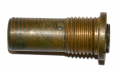
U.S. 3-INCH SCHENKL PERCUSSION FUSE
This is a “dug” brass fuse in such clean condition that it appears non-excavated. Beautiful brass fuse perfect for fuse collection or to screw into a Schenkl shell that needs a fuse. Patent… (844-242). Learn More »
$100.00
ON HOLD
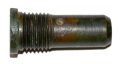
RELIC, U.S. 3-INCH SCHENKL PERCUSSION FUSE
Excavated brass fuse in good condition. Beautiful brass fuse perfect for fuse collection or to screw into a Schenkl shell that needs a fuse. Green patina overall with some small dings on top flange.… (844-246). Learn More »
$40.00
ON HOLD
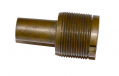
NON-DUG -- US NAVAL WATERCAP FUSE WITH BUSHING, DATED 1862
A nice, naval watercap fuse dated 1862 and in very good condition. This fuse is made of brass with flange on top, with threaded portion and tapered body. A brass bushing is on this fuse to fit into… (844-236). Learn More »
$125.00
ON HOLD
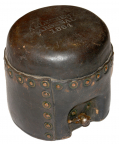
1864 DATED ALLEGHENY ARSENAL CIVIL WAR ARTILLERY LIMBER POLE PAD
A nicely marked and dated example. Made of heavy leather secured by copper rivets, these are described in the 1862 Ordnance Manual under artillery harness. Limbers and caissons were normally drawn… (2026-9403). Learn More »
$550.00
ON HOLD
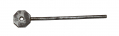
ARTILLERY VENT PUNCH
This 5.25” long tool was used by US and CS artillery during the Civil War. Made up of a 4.25” long rod attached an octagonal head. This head has a hole in the center. These were used to… (844-84). Learn More »
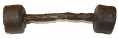
REVOLUTIONARY WAR IRON BAR SHOT, CYLINDRICAL-HEAD ("HAMMER") TYPE, RECOVERED IN THE CHAMPLAIN VALLEY, CIRCA LATE 18TH CENTURY
A solid wrought- and cast-iron bar shot of the cylindrical-head form, comprising two drum-shaped heads united by a single rigid bar. Bar shot — "dismantling shot" — was anti-rigging ordnance fired… (1298-21). Learn More »
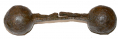
REVOLUTIONARY WAR / WAR OF 1812 IRON BAR SHOT (c. 1775-1815)
Iron bar shot of the classic two-headed ("dumbbell") form: a pair of solid cast-iron spheres joined by a heavy central bar. USE: Bar shot was first and foremost an anti-rigging round. In a naval… (1298-20). Learn More »
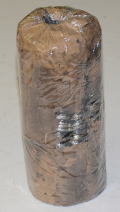
COMPLETE PACKAGE OF TAYLOR FUSE IGNITERS
Here is a paper-wrapped stack of tin fuse igniters for Taylor’s time fuse. The whole stack is wrapped in tan packing paper. The packing paper is water damaged, missing a few fragments, and quite… (727-50). Learn More »
$675.00
Originally $1,250.00
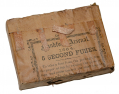
PACK OF FRANKFORD ARSENAL 5-SECOND ARTILLERY FUZES
Original pack of 5-second time fuzes manufactured at the Frankford Arsenal in Philadelphia, PA during the Civil War. Pack is constructed of a drilled wood block that holds five paper time fuses.… (1202-1346). Learn More »
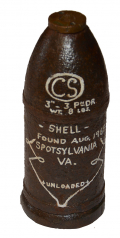
3-INCH VIRGINIA PATTERN BOURRELATED READ SHELL FROM SPOTSYLVANIA
This is a very good example recovered at Spotsylvania in 1968 that retains its original Confederate copper band sabot at its base and time-fuze adapter in its nose. Attractive painted recovery… (2026-1288). Learn More »
$595.00
ON HOLD
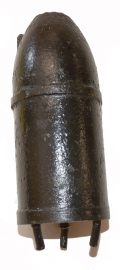
CS 3-INCH TENNESSEE PATTERN MULLANE SHELL
This is an excavated example of the Mullane shell for the 3-inch Ordnance Rifle that shows signs of being intentionally damaged before completion either to prevent it falling into Federal hands or… (2026-1292). Learn More »
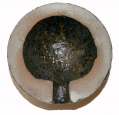
24-POUNDER COEHORN MORTAR SECTIONED SHELL
A very good example of a 24-pounder shell with 7/8” fuze hole, sectioned to show the powder chamber and fuze opening. Dickey & George (1993) p.51 discuss these shells, noting that the smaller… (844-212). Learn More »
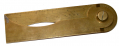
EXCELLENT SET OF CIVIL WAR ARTILLERY GUNNER’S CALIPERS
This is an excellent set of Civil War-era artillery gunner’s calipers. A scarce artilleryman’s implement, these are believed to have been issued at a rate of one for every six guns. Gunner… (844-58). Learn More »
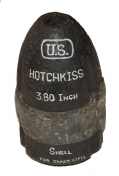
3.8-INCH HOTCHKISS SHELL FOR JAMES RIFLE FROM CHANCELLORSVILLE
Hotchkiss 3.8-Inch projectiles were used in the 14-pounder James Rifle, with Hotchkiss 3.67-Inch rounds in theory for rifled 6-pounder guns. The nomenclature of the guns is muddied by the broader use… (2026-1283). Learn More »
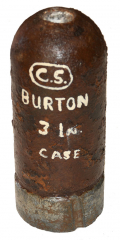
3-INCH DYER CASE SHOT
These were for a long time identified as Confederate “Burton” projectiles, as prominently noted on this one in old white paint. For the discussion and the corrected identification see Dickey &… (2026-1286). Learn More »
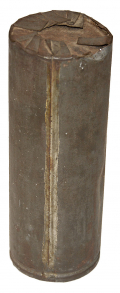
ORIGINAL CIVIL WAR NON-EXCAVATED 3-INCH HOTCHKISS CANISTER ROUND
Canister was the close-in and sometimes last-ditch anti-personnel round for Civil War artillery. At a distance artillery crews would fire case-shot at infantry- explosive shells filled with shrapnel… (1130-18). Learn More »
$2,295.00
ON HOLD
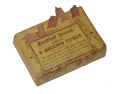
PACK OF FRANKFORD ARSENAL 8-SECOND FUSES - 1864
This pack of 8-second artillery fuses originates from the Frankford Arsenal and was produced in 1864. The pack is constructed of a drilled wood block covered with a printed paper label. This paper… (844-131). Learn More »
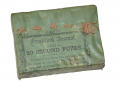
PACK OF FRANKFORD ARSENAL 20-SECOND FUSES
This pack of 20-second artillery fuses originates from the Frankford Arsenal and was produced in 1864. These longer burning fuses are harder to find than the short-burning fuses. The pack is… (1202-1349). Learn More »
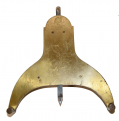
1863 WATERVLIET ARSENAL MARKED GUNNER’S LEVEL
This gunner’s level is clearly marked across the top on one side with an eagle over “U.S. / WATERVLIET / ARSENAL/ 1863.” This was an essential artillery tool enabling an artillery crew to… (1202-1331). Learn More »
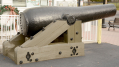
10” CONFEDERATE COLUMBIAD CANNON-TREDEGAR IRON WORKS - FORMER TEXAS MUSEUM
This large cast-iron cannon was produced at the Tredegar Iron Works in Richmond, Va. In 1836, a group of Richmond businessmen and industrialists led by Francis B. Deane, Jr. set about to capitalize on… (1268-1240). Learn More »
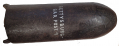
EXCAVATED U.S. 3” PARROTT SHELL FROM GETTYSBURG GAR POST #9
Here is a Gettysburg excavated Civil War Federal 3” field artillery projectile often referred to as a Parrott Type III shell excavated from an unknown location area on the Gettysburg battlefield… (2024-2135). Learn More »

CIVIL WAR ARTILLERY PENDULUM HAUSSE LEATHER CASE
This is a scarce piece of Civil War artillery related leather. This is a pendulum hausse sight case. Pendulum Hausse sights were weighted brass pieces that were mounted on the breech of a cannon and… (2025-2038). Learn More »
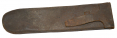
CIVIL WAR ARTILLERY PENDULUM HAUSSE LEATHER CASE
This is a scarce piece of Civil War artillery related leather. This is a pendulum hausse sight case. Pendulum Hausse sights were weighted brass pieces that were mounted on the breech of a cannon and… (2025-2022). Learn More »
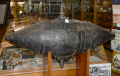
EXTRAORDINARILY RARE AND IMPORTANT CONFEDERATE RAINS BARREL TORPEDO - 1 OF 2 KNOWN - FROM THE TEXAS MUSEUM
This is a Rains barrel torpedo that was recovered during the Civil War in Mobile Bay, AL. It was developed by Gabriel James Rains, Chief of the Confederate Torpedo Service. Gabriel Rains was born in… (1268-690). Learn More »
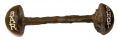
REVOLUTIONARY WAR 6-POUNDER BAR SHOT
Much of the American Revolution took place on the seas between a budding Continental Navy and the powerful British Royal Navy. Naval gunners on both sides fired a range of specialized projectiles from… (1202-950). Learn More »
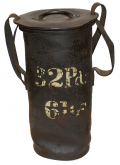
VERY GOOD 1864 DATED US NAVY YARD MARKED PASS BOX FOR THE 32 POUNDER GUN
The 32-pounder was an iron smoothbore cannon used on ships and in coastal fortifications. It was largely superseded by more advanced guns during the war but remained in service throughout, with the… (1268-669). Learn More »
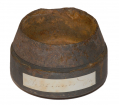
3.8” HOTCHKISS BASE CUP WITH “RICHMOND, VA” LABEL FROM YORK SPRINGS, PA G.A.R. POST #37 COLLECTION
Offered here is an early “battlefield pick-up” relic that was part of the collections on display at the York, PA, #37 “General Sedgwick” Grand Army of the Republic Post. The item is the iron… (1202-878). Learn More »
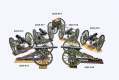
ASSORTMENT OF SCALE MODEL CANNON BY RUSSELL A. NORGAN
Excellent condition assortment of handcrafted, limited edition scale model cannon. Priced at $1,250.00 each except for the limber chest, which is priced at $850.00. Each item has its corresponding… (2025-). Learn More »
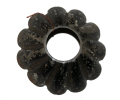
TAYLOR FUSE IGNITER
Here is a tin fuse igniter for Taylor’s time fuse. The Taylor fuse was patented April 11, 1865, so did not see any use during the Civil War. The purpose of these tin “igniters” was to direct the… (1202-455). Learn More »
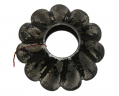
TAYLOR FUSE IGNITER
Here is a tin fuse igniter for Taylor’s time fuse. The Taylor fuse was patented April 11, 1865, so did not see any use during the Civil War. The purpose of these tin “igniters” was to direct the… (1202-454). Learn More »
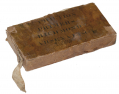
RARE PACK OF CONFEDERATE, RICHMOND ARSENAL, ARTILLERY FRICTION PRIMERS
Offered here is a very rare, nice condition, original pack of artillery friction primers manufactured at the Richmond Arsenal in Virginia during the Civil War. These “primers” are what was placed… (1268-512). Learn More »
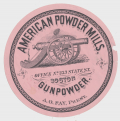
AMERICAN POWDER MILLS BOSTON CIRCULAR LABEL
Measures 6” in diameter. Nice woodcut of a cannon in center; printed on pink paper. Minor damage to each. [ss] [PH:L] ~~~~~~~~~~~~~~~~~~~~~~~~~~~~~~~~~~~ THIS ITEM, AS WITH ALL OTHER ITEMS AVAILABLE… (516-572). Learn More »
$35.00
Originally $44.00
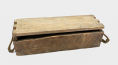
BRITISH ARTILLERY SHIPPING CRATE
This is one of several scarce British artillery crates that recently came to hand, some of which were marked “Quebec.” This is clearly stenciled in black on one end: “11/59” / “W[broad… (2024-1156). Learn More »
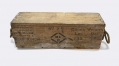
BRITISH ARTILLERY SHIPPING CRATE
This is one of several scarce British artillery crates that recently came to hand, some of which were marked “Quebec.” Along with other ordnance and shipping markings, this is clearly stenciled at… (2024-1154). Learn More »

ARTILLERY GIMLET FOR 12-INCH GUN – WATERVLIET ARSENAL
The "gimlet" has a screw on the end and was intended to be used to remove broken pieces of friction primers from the vent. It could also serve as a priming wire to poke a hole in the powder bag. This… (2024-2312). Learn More »
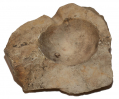
STONE MOLD HALF FOR LARGE GRAPE SHOT
This piece is an early mold half for a round grape shot ball. This piece measures approximately 3.5” x 2” x 2.5”. The cavity measures just shy of 2” in diameter. The funnel leading into the… (236-1026). Learn More »

ARTILLERY VENT PUNCH FOR 12-INCH MORTAR – WATERVLIET ARSENAL
This is a tool for clearing the vent of any obstructions. It has an octagonal head with a hole in the center, and a 21” wire brazed to it. The wire tappers at the end. The flat head is stamped,… (2024-2314). Learn More »
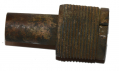
RELIC -- US NAVAL WATERCAP FUSE WITH BUSHING, DATED 1864
Excavated naval watercap fuse dated 1864 and in good condition. This fuse is made of brass with flange on top, with threaded portion and tapered body. A brass bushing is on this fuse to fit into… (2024-2327). Learn More »
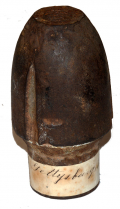
3” HOTCHKISS SHELL WITH GETTYSBURG TAG – FROM YORK SPRINGS GAR POST
This shell is part of the collection that was housed at the York Springs GAR Post 551. Many of the items were collected and curated by David Starry, a Civil War veteran who served in an emergency… (1202-230). Learn More »
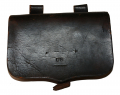
U.S. ARTILLERY FUSE POUCH MARKED “US”
Very nice condition leather fuse pouch. The leather of the outer flap is in very good condition. There is some crazing on the top “hinge” area of the flap. There is a deep “US” stamp on the… (864-14). Learn More »
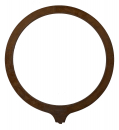
1855 DATED 11-INCH SHOT/SHELL GAUGE
These simple iron ring gauges allowed for quick inspection and sorting of shot and shell by size, something of critical importance to a gun crew and a large task given the huge stacks of cannon balls… (490-6754). Learn More »
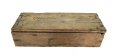
BRITISH ARTILLERY CRATE FOR 9-POUND SOLID SHOT
The smooth-bore, muzzle-loading 9-pounder cannon was a standard British field-piece in service from 1805 to 1881, with a maximum range of about 1,400 yards and notable service in the Napoleonic Wars… (2024-1155). Learn More »
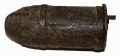
CONFEDERATE 3” MULLANE COMMON SHELL
Here is a fired Confederate 3” bourreleted Mullane Type 1 common shell recovered from an unknown battlefield location. Made for the 3” Ordnance Rifle. Also known as a “Tennessee Sabot”, this… (490-7005). Learn More »
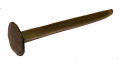
CIVIL WAR “SPINNER” QUILL PRIMERS FOR NAVAL CANNONS
These Naval cannon primers are constructed using fowl quills; less likely to corrode around salt water. These are percussion, not friction primers. In use, these were ignited by the blow from a… (2024-1521). Learn More »
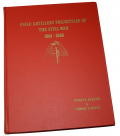
BOOK – FIELD ARTILLERY PROJECTILES OF THE CIVIL WAR 1861-1865 BY KERKSIS & DICKEY
First edition, hardcover signed by both authors. Limited to 500 numbered copies, this is #303. Text clean and unmarked; 307 pages, 8.5” x 11”. The binding is tight and square. Cover is bright and… (2024-1206). Learn More »
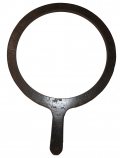
11-INCH SHOT/SHELL GAUGE
These simple iron ring gauges allowed for quick inspection and sorting of shot and shell by size, something of critical importance to a gun crew and a large task given the huge stacks of cannon balls… (490-6807). Learn More »
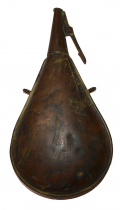
RARE USN GOSPORT NAVY YARD PRIMING FLASK
Gosport Shipyard was the original name of the facility in Portsmouth, Virginia, that was founded in 1767, passed into the hands of Virginia in the Revolution, was leased from that state by the U.S.… (490-6824). Learn More »
$4,500.00
ON HOLD
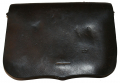
NICE U.S. ARTILLERY FUSE POUCH
The leather is in nice, smooth condition with a pleasing dark brown tone. The latch tab is stitched to the underside of the flap. This tab remains unbroken but well worn. The outer flap is only… (490-6254). Learn More »
THEFT REPORTED AT AUTUMN GETTYSBURG SHOW
A vendor at the Autumn Gettysburg Civil War show held at the Allstar Events Complex on Oct. 28-29 reported that a Maryland sword belt plate valued at $3500 was stolen from a display case on Sunday…. Learn More »
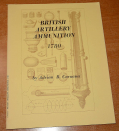
BOOKLET ON 18TH CENTURY BRITISH ARTILLERY AMMUNITION FROM THE LIBRARY OF THE LATE DEAN S. THOMAS
The title of this pamphlet is “BRITISH ARTILLERY AMMUNITION 1780” by Adrian B. Caruana and published by Museum Restoration Service of Bloomfield, Ontario, Canada in 1979. Yellow heavy stock paper… (236-416). Learn More »
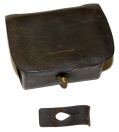
U.S. NAVY FRICTION PRIMER BOX
Small leather box to hold friction primers were carried on the belt (past terminology designated this type box as a Navy fuse box). The box is relatively square in shape to accommodate the shape of… (490-5342). Learn More »
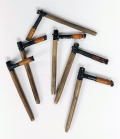
CIVIL WAR QUILL PRIMERS FOR NAVAL CANNONS
These Naval cannon primers are constructed using fowl quills; less likely to corrode around salt water. These are percussion, not friction primers. In use, these were ignited by the blow from a… (490-2928). Learn More »
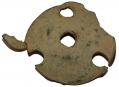
COPPER SABOT FROM 3” MULLANE SHELL FROM GETTYSBURG
Found in Gettysburg after the battle. From the Soldier’s National Museum auction of 2014. Copper sabot stripped from a Confederate 3” Mullane artillery shell. The sabot is a round disk with a… (224-514). Learn More »

MEXICAN WAR TO CIVIL WAR PORTFIRE STOCK
Before the introduction of the friction primer it was necessary to keep a ready flame handy for the lighting of linstocks carrying slow match to fire the gun or to fire it directly and even later they… (1158-07). Learn More »
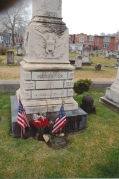
THEFT FROM GRAVESITE OF GEN. JOHN REYNOLDS
A large artillery shell, one of pair that sit on either side of the grave of Gen. John F. Reynolds in Lancaster Cemetery, Lancaster, PA has been removed from the site. If anyone comes into contact…. Learn More »
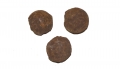
CONFEDERATE 32 LB CANISTER BALL FROM ATLANTA
Offered is a Confederate canister ball from Atlanta Georgia. Each weighs approximately 1 lb. 4 oz. and are 2.10” in diameter. All show signs of moderate to heavy rust. These were uncovered during… (R3556). Learn More »
Showing 1 to 111 out of 111
Most Popular
Historical Firearms Stolen From The National Civil War Museum In Harrisburg, Pa »
Theft From Gravesite Of Gen. John Reynolds »
Selection Of Unframed Prints By Don Troiani »
Fine Condition Brass Infantry Bugle Insignia »
Rare Identified 65Th Ny Sergeant’s Jacket, With Manscript Material: 1St U.s. Chasseurs »
featured item
EYE-CATCHING 1859-1861 VIRGINIA MILITIA GROUPING OF CAPT. J.Q.A. NADENBOUSCH, BERKELEY BORDER GUARDS, LATER COLONEL 2nd VA INFANTRY OM RECOMMENDATION OF LEE AND STONEWALL JACKSON
An historic and eye-catching Virginia officer’s group belonging to John Quincy Adams Nadenbousch while Captain of the “Berkeley Border Guards,” a militia company raised in response to the John Brown raid, present at the execution of Brown’s… (2025-3677). Learn More »
site search